

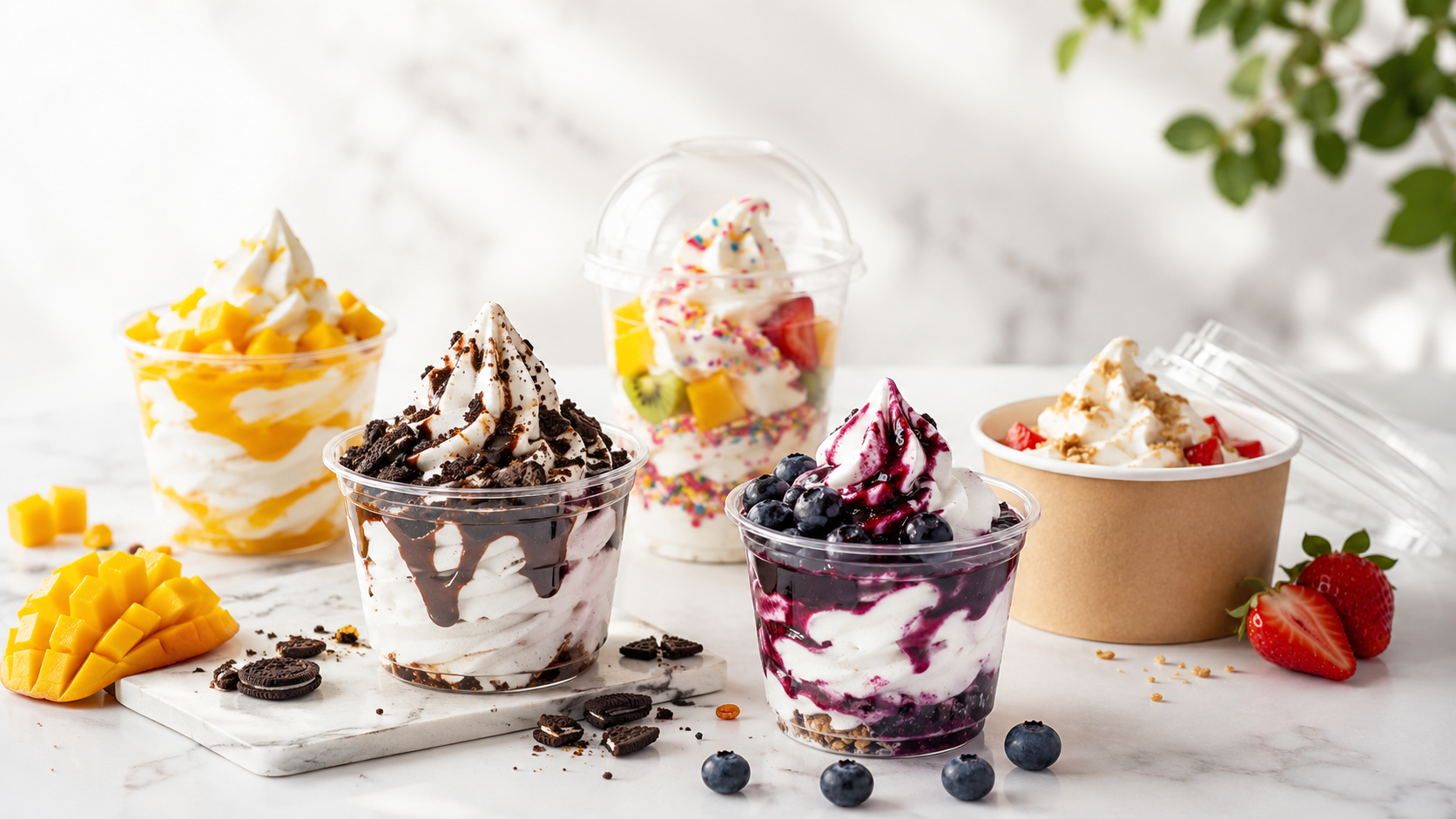
Frozen yogurt, commonly called froyo, is a chilled dessert made by combining yogurt with sugar or another sweetener, flavouring it, and freezing it until smooth and scoopable. It offers the familiar satisfaction of ice cream while giving home bakers, cafés, cloud kitchens and dessert businesses a highly customisable product that can be sold in individual cups with sauces, fruits, spreads, sprinkles and crunchy toppings.
The renewed interest in froyo is not only about eating a frozen dessert. Customers increasingly enjoy products they can customise, photograph, share and order in multiple flavours. A simple frozen yogurt base can become a mango froyo cup, chocolate hazelnut froyo, blueberry cheesecake froyo, cookie spread froyo or a colourful children’s dessert simply by changing the sauce, topping and packaging.
For an Indian home baker or food business, this flexibility is important. You do not need an extremely large menu or a separate recipe for every flavour. You can prepare one or two dependable yogurt bases, portion them into suitable dessert containers with lids, and create several menu variations using products from Bakeyy’s spreads and sauces, fillings and toppings, sugar confetti and compounds and couverture collections.
Quick answer: To make froyo, strain or use thick yogurt, combine it with sugar, a small quantity of milk or cream if required, and your chosen flavour. Chill the mixture thoroughly, churn or freeze it using the method explained below, portion it into lidded dessert cups, and store it under consistently frozen conditions. For selling, calculate the complete cost of the yogurt base, flavour, toppings, packaging, spoon, labour, wastage and delivery before deciding the selling price.
In this complete guide, you will learn: what frozen yogurt is, how it differs from ice cream, how to make a smooth base, which flavours can work in India, how to select a portion size, how to package froyo for takeaway, how to calculate costs, and how to turn it into a practical menu item for a home bakery, café or cloud kitchen.
What Is Frozen Yogurt or Froyo?
Frozen yogurt is a frozen dessert in which yogurt is the main dairy base. Depending on the recipe, it may also include sugar, cream, milk powder, fruit, cocoa, chocolate, stabilisers or flavourings. It can be served freshly churned with a soft texture or frozen until firm and sold in sealed takeaway cups.
The word “froyo” is simply a shortened version of frozen yogurt. Although it is often compared with soft-serve ice cream, the two products are not identical. Yogurt gives froyo a light tang that works especially well with fruit, honey, chocolate, biscuit spreads, caramel, nuts and sweet sauces.
Froyo can range from mildly sweet and yogurt-forward to rich and dessert-like. A café may offer a relatively light Greek-yogurt version with fresh fruit, while a bakery may sell an indulgent chocolate froyo cup finished with cookie spread, chocolate sauce, brownie pieces and sugar pearls. Both can be called frozen yogurt as long as yogurt remains the central base.
The nutrition of the final product depends entirely on the yogurt, sweetener, cream and toppings used. Adding yogurt does not automatically make every froyo cup low in sugar or high in protein. A product should only be described as high-protein, low-sugar or reduced-fat after its complete recipe and nutrition have been properly evaluated.
Why Froyo Is a Strong Dessert Business Idea in 2026
Froyo works as a business product because one base recipe can support many flavours, portion sizes and price points. It can be positioned as a refreshing summer dessert, a premium café cup, a children’s treat, a fruit-based dessert or a loaded indulgent product.
Unlike a dessert that has only one fixed presentation, frozen yogurt encourages customisation. Customers can select a base, sauce, topping and final garnish. This gives businesses opportunities to offer paid upgrades without developing a completely new recipe for every menu item.
A standard vanilla or plain yogurt base can be transformed using mango filling, blueberry topping, chocolate sauce, hazelnut spread, biscuit spread, couverture shavings, brownie crumbs, cookie pieces, nuts or colourful edible sprinkles. The same production batch can therefore support a varied menu.
Froyo is also visually suitable for social media. Clear cups allow customers to see sauces, layers and toppings. A dome lid provides additional space for a generous finish, while small lidded cups can be used for samples, party catering, tasting boxes and miniature dessert assortments.
For Bakeyy customers, the category connects naturally with products already used by home bakers and dessert sellers. Relevant supplies include acrylic dessert cups, dessert tubs, plastic dessert tubs, disposables, wooden spoons, sauces, fruit fillings, spreads, chocolate and edible decorations.
Frozen Yogurt vs Ice Cream vs Gelato
Frozen yogurt is based primarily on yogurt, ice cream is commonly based on milk and cream, and gelato is an Italian-style frozen dessert generally served with a dense texture. The exact composition varies by recipe, but the following comparison helps explain the practical differences for a small dessert business.
| Feature | Frozen yogurt | Ice cream | Gelato |
|---|---|---|---|
| Main character | Tangy, refreshing and customisable | Creamy, rich and familiar | Dense, smooth and flavour-focused |
| Primary dairy base | Yogurt or Greek-style yogurt | Milk and cream | Milk with a recipe-specific amount of cream |
| Typical flavour profile | Light tang with sweet toppings | Sweet and creamy | Intense flavour with less air |
| Best business use | Custom cups, topping bars, seasonal menus and delivery | Scoops, sundaes, tubs and shakes | Premium scoop counters and plated desserts |
| Customer expectation | Fresh, fruity or loaded with toppings | Classic frozen indulgence | Premium texture and flavour |
Froyo should not be marketed as a replacement for ice cream in every situation. Its light tang is part of its identity. Trying to remove the yogurt flavour completely can produce an unnecessarily sweet product and make it difficult for customers to understand what makes the dessert different.
Ingredients Needed to Make Frozen Yogurt
A dependable frozen yogurt recipe requires a thick yogurt base, sufficient sweetness, flavouring and careful moisture control. Sugar is not used only for taste; it also influences how hard the mixture freezes. Very low-sugar formulas can become icy and difficult to scoop unless they are professionally balanced.
| Ingredient | Purpose | Practical guidance |
|---|---|---|
| Thick yogurt | Creates the main body and tangy flavour | Use thick, smooth yogurt or strain regular yogurt to remove excess whey |
| Sugar | Adds sweetness and helps control hardness | Adjust after considering the sweetness of sauces and fillings |
| Cream or milk | Can soften texture and round out acidity | Use only as needed; too much liquid can dilute flavour |
| Milk powder | Adds milk solids and improves body | Whisk carefully to prevent lumps |
| Fruit filling or purée | Adds fruit flavour and colour | Use controlled quantities so the base does not become watery |
| Chocolate or cocoa | Creates chocolate variants | Blend completely before freezing for a smooth finish |
| Sauces and spreads | Create swirls, layers and premium toppings | Use as a ribbon or topping rather than adding excessive quantities to the base |
Before scaling the recipe, make a small test batch. Record every ingredient in grams, the final batch weight, the number of cups produced and the texture after 24 hours of freezing. A recipe that tastes good immediately after mixing may become too hard, too sour or too icy after storage.
Basic Frozen Yogurt Recipe for Home Bakers
A practical starting recipe uses thick yogurt, sugar, a small amount of cream and vanilla. This is a testing formula rather than a legally standardised commercial recipe. Adjustments may be required based on the yogurt’s thickness, acidity, fat content and the performance of your freezer.
| Ingredient | Test quantity |
|---|---|
| Thick strained yogurt | 800 g |
| Fine sugar | 140–180 g, adjusted to taste and texture |
| Fresh cream | 80–120 g |
| Milk powder | 30–50 g |
| Vanilla | As required |
| Fine salt | A small pinch |
Step 1: Prepare the yogurt. If the yogurt is loose or contains visible whey, place it in a clean muslin cloth or suitable strainer under refrigeration. Allow excess liquid to drain until the texture is thick and smooth. Weigh the yogurt after straining, not before.
Step 2: Dissolve the sugar. Combine the sugar with the cream or a small part of the yogurt. Mix until the sugar is fully dispersed. Undissolved sugar can create an uneven texture.
Step 3: Add the milk powder. Sift it before adding. Whisk gradually to avoid lumps. Milk powder can help improve body, but excessive quantities may create a powdery taste.
Step 4: Combine the base. Add the remaining yogurt, vanilla and salt. Blend only until smooth. Excessive high-speed blending can incorporate unnecessary air and warm the mixture.
Step 5: Chill thoroughly. Cover and refrigerate the mixture until it is completely cold. A cold base freezes faster and generally produces smaller ice crystals than a warm mixture.
Step 6A: Use an ice cream machine. Churn according to the equipment instructions. Transfer the semi-frozen mixture into containers before it becomes too firm to portion cleanly.
Step 6B: Use the freezer method. Pour the mixture into a shallow freezer-safe container. Freeze it and whisk or blend it at intervals during the early freezing stage to break up ice crystals. This method can work for testing, although a properly operated ice cream machine usually provides more consistent results.
Step 7: Portion and harden. Fill clean cups, close the lids and freeze promptly. Avoid leaving filled cups at room temperature while completing the whole batch.
Step 8: Evaluate after storage. Check the product after 24 hours. Record scoopability, iciness, sweetness, flavour and melting behaviour. Change only one or two variables in the next test so you can identify what improved or damaged the result.
Six Froyo Flavours That Can Work for Indian Dessert Menus
The best froyo menu starts with a small number of distinct flavours rather than a long list of nearly identical options. Offer one classic flavour, two fruit flavours, one chocolate flavour and one premium loaded flavour. Seasonal specials can then be rotated without complicating production.
1. Classic vanilla froyo: Use the basic yogurt recipe and finish it with vanilla. Serve it plain, with fruit, or as the foundation for a build-your-own topping menu. This is the most flexible flavour because it pairs with nearly every sauce and garnish.
2. Mango froyo: Fold a controlled quantity of mango filling or thick mango preparation into the chilled yogurt base. Avoid adding excessive watery pulp. A mango ripple can also be added while filling the cup, creating visible layers without changing the complete base batch.

Relevant Bakeyy product: Mala’s Mango Fruit Filling, 1 kg. The connected store listed it at ₹400 at the time this guide was prepared. Use it as a measured fruit ripple or topping and test the final sweetness before increasing the sugar in the yogurt base.
3. Blueberry cheesecake froyo: Start with vanilla froyo. Add a blueberry ripple and finish the cup with biscuit crumbs. Keep crunchy crumbs separate until service when possible, because prolonged contact with moisture will soften them.
4. Chocolate froyo: Blend cocoa or properly prepared chocolate into the base. Finish with chocolate sauce, chocolate shavings or small compound chocolate pieces. The slight acidity of yogurt can make chocolate taste more intense, so test the balance carefully.

Relevant Bakeyy product: Mala’s Chocolate Sauce, 1 litre, listed at ₹295 at the time of writing. A measured drizzle can create a premium finish without overwhelming the yogurt flavour.
5. Biscoff-style cookie froyo: Use a plain or vanilla yogurt base, add a cookie spread ribbon and finish with biscuit crumbs. Keep the spread as a swirl instead of mixing too much into the complete batch. This preserves visual contrast and allows better portion control.

Relevant Bakeyy product: MICKS Belgiyumm Biskoff Spread, 1 kg, listed at ₹756 when this article was created. Calculate the cost per 10 g or 15 g topping portion before finalising the menu price.
6. Hazelnut crunch froyo: Pair vanilla or chocolate froyo with a measured hazelnut spread ribbon. Add roasted nuts, chocolate pieces or biscuit crunch immediately before serving. This can be positioned as a premium cup because the topping cost is usually higher than that of a basic sauce or sprinkle.
Best Frozen Yogurt Topping Combinations
A successful froyo topping combination should provide contrast in flavour, texture and appearance. Combine one sauce or fruit component, one crunchy component and one small finishing garnish. Adding too many toppings can make the cup expensive, messy and difficult to close.
| Menu name | Froyo base | Sauce or fruit | Crunch and garnish |
|---|---|---|---|
| Mango Sunshine | Vanilla | Mango filling | White chocolate shavings or biscuit crumb |
| Berry Cheesecake | Vanilla or cream-cheese-style | Blueberry or raspberry filling | Biscuit crumb |
| Chocolate Crunch | Chocolate | Chocolate sauce | Brownie crumbs and chocolate pieces |
| Cookie Swirl | Vanilla | Cookie spread | Caramelised biscuit crumb |
| Strawberry Sprinkle | Strawberry or vanilla | Strawberry filling | Pink or multicolour edible sprinkles |
| Hazelnut Choco | Chocolate or vanilla | Hazelnut spread | Roasted nuts and chocolate curls |
Edible sprinkles work best as a controlled finishing element. They add colour and texture, but a large quantity can make the cup excessively sweet. Store sprinkles in a dry environment and apply them shortly before service when possible.

Relevant Bakeyy product: Vermicelli-Shaped Sugar Confetti, 200 g, available in several colour variants and listed from ₹85 at the time of writing. Bakeyy also stocks seven-size mixed sugar confetti pearls for premium dessert presentation.
What Is the Best Cup Size for Froyo?
A 100–150 ml cup is a practical starting size for a standard individual froyo serving, while 50–70 ml cups work for samples, parties and tasting portions. Larger 250–350 ml containers are better for loaded desserts, sharing portions or takeaway products with separate toppings.
| Container capacity | Best use | Menu positioning | Packaging note |
|---|---|---|---|
| 50–70 ml | Samples, events and tasting boxes | Mini or trial serving | Use a secure lid and a small spoon |
| 100–150 ml | Standard single serving | Regular cup with one or two toppings | Leave headspace for expansion and toppings |
| 200–250 ml | Loaded premium cup | Multiple layers and toppings | A clear lid helps display the product |
| 300–350 ml | Sharing cup or delivery bowl | Family, meal-combo or premium format | Confirm lid fit and freezer performance through testing |
Do not decide the serving size only by the advertised capacity of the container. Fill one cup using your actual product, toppings and sauce. Weigh the complete filled cup and observe how much headspace remains. A nominal 130 ml container should not automatically be filled with 130 ml of frozen product if a dome topping or expansion space is required.
Best Bakeyy Packaging for Frozen Yogurt Cups
The best froyo packaging is a food-grade container with a secure lid, enough headspace, good stackability and a shape that suits the intended serving. Clear containers support visual presentation, while larger kraft bowls may be considered for loaded portions and delivery.
Always test the selected container with the actual recipe before launching. Freeze filled samples, stack them, transport them in an insulated bag and inspect the lid, walls, condensation, leakage and customer opening experience.

Clear Dome Dessert Cup with Lid: The clear dome dessert cup is available in 50 ml and 130 ml variants. At the time of writing, the 50 ml pack of 100 was listed at ₹1,050, or approximately ₹10.50 per set, while the 130 ml pack of 100 was listed at ₹1,425, or approximately ₹14.25 per set.
The 50 ml size can be used for tasting portions, event samples and small dessert assortments. The 130 ml size is more suitable for an individual froyo cup. Its dome provides visual space for a topping while helping protect the presentation.

Triangular Dessert Container with Lid: The transparent triangular dessert container is available in 50 ml and 140 ml options. At the time of writing, the 50 ml pack of 100 was listed at ₹975 and the 140 ml pack of 100 at ₹1,725.
This shape is useful for premium mini desserts, catered events and visually distinctive servings. Before using a shaped cup for routine delivery, confirm that it stacks properly in your freezer and shipping box.

Round Ribbed Dessert Container: The round ribbed plastic dessert container with clear lid is supplied in packs of 50 and was listed at ₹500, approximately ₹10 per container set, when this guide was created.
The white and gold-toned base options can support different brand styles. A white base suits a clean, everyday menu, while a gold-toned base can be considered for premium catering, gifting and event dessert assortments.

350 ml Kraft Food Bowl with Lid: The 350 ml kraft bowl with lid was listed at ₹545 for a pack of 50, approximately ₹10.90 per set. It can be evaluated for large, loaded or sharing portions.
Because kraft containers are opaque, they do not show the product from the side. Use a clear lid, branded label or attractive top presentation to communicate the flavour. Always test the bowl with the actual frozen product before committing to bulk packaging.
Froyo Packaging Comparison Table
| Bakeyy packaging | Available format | Listed pack price* | Approximate packaging cost | Recommended use |
|---|---|---|---|---|
| Clear dome cup | 50 ml, pack of 100 | ₹1,050 | ₹10.50 per set | Samples and mini froyo |
| Clear dome cup | 130 ml, pack of 100 | ₹1,425 | ₹14.25 per set | Standard individual serving |
| Triangular dessert container | 50 ml, pack of 100 | ₹975 | ₹9.75 per set | Tastings and events |
| Triangular dessert container | 140 ml, pack of 100 | ₹1,725 | ₹17.25 per set | Premium single serving |
| Round ribbed container | Pack of 50 | ₹500 | ₹10 per set | Premium presentation |
| 350 ml kraft bowl | Pack of 50 | ₹545 | ₹10.90 per set | Loaded or sharing format |
*Prices were retrieved from Bakeyy’s connected Shopify catalogue on July 16, 2026. Product prices, variants and availability may change. Check the linked product page for current information before calculating your selling price.
Which Spoons Should Be Packed with Froyo?
Use a spoon that matches the depth of the cup and the firmness of the frozen yogurt. Mini wooden spoons are suitable for tasting cups, while a longer wooden or premium plastic dessert spoon is more practical for standard and loaded portions.

Bakeyy’s wooden disposable spoons are available in several sizes. At the time of writing, the available 95 mm and 110 mm pack-of-100 variants were listed at ₹64, while the 140 mm variant was listed at ₹68. This equals approximately ₹0.64–₹0.68 per spoon before other costs.
For a premium presentation, consider the Premium Dessert Spoon in clear, black and matte gold. The pack of 100 was listed from ₹260, approximately ₹2.60 per spoon. Use a premium spoon only when the selling price and brand position can absorb the higher packaging cost.
How to Package Frozen Yogurt Cups Step by Step
Froyo should be portioned quickly into clean, dry containers and returned to frozen storage without unnecessary delay. The exact process should be adapted to your kitchen, equipment and food-safety system.
1. Prepare all packaging before production. Arrange cups, lids, labels, spoons, weighing scale and storage trays. Do not search for packaging while the frozen product is softening.
2. Confirm that cups and lids are dry. Water droplets inside the container can freeze and reduce presentation quality. Store packaging in a clean, protected area.
3. Standardise the fill weight. Do not rely only on visual judgement. Place an empty cup on the scale, tare it and add the required grams of froyo. Standard weights improve costing and reduce customer complaints about inconsistent portions.
4. Leave headspace. Do not overfill the container. Space may be needed for a sauce layer, garnish, dome lid and slight product expansion.
5. Add sauces in measured portions. Use squeeze bottles, piping bags or a measured spoon. A difference of only 5–10 g per cup can significantly change the cost across a large batch.
6. Add crunchy toppings at the correct time. For immediate service, they can be added directly. For delivery or storage, consider supplying moisture-sensitive toppings separately so they remain crisp.
7. Close the lid completely. Check the full edge, not only one side. Some lids appear closed while a section remains loose.
8. Label each flavour. Include the flavour name, relevant allergen information, storage instructions, production details and other information required for your operation.
9. Freeze in a single layer initially. Allow cups to harden before placing heavy stacks on top. This helps protect toppings, lids and cup shape.
10. Perform a transport test. Pack the product exactly as it will be delivered. Travel over a realistic route, then inspect melting, movement, condensation, leakage and spoon placement.
How to Deliver Froyo Without It Melting
Frozen yogurt delivery requires a reliable cold chain, short dispatch time and insulated secondary packaging. A sealed cup alone cannot keep the product frozen. Delivery feasibility depends on the recipe, weather, distance, insulation and cooling material.
Begin with a limited delivery radius. Test the product during realistic warm-weather conditions rather than assuming a successful short indoor test will represent an actual delivery journey.
Use an insulated delivery bag or box with suitable frozen gel packs. Keep the cups upright and prevent them from moving. Avoid direct contact that could crush a lid or distort a soft container.
Do not place warm sauces, freshly baked brownie pieces or room-temperature components directly onto the froyo before dispatch. Every warm component adds heat and accelerates softening.
When practical, pack crunchy toppings separately in a small sealed container or pouch. This prevents them from becoming soggy and gives customers a more interactive serving experience.
Provide clear customer instructions. Ask the customer to freeze the cup immediately if it will not be eaten on arrival. Avoid promising a specific holding time unless it has been tested under your actual production and delivery conditions.
How to Calculate the Cost of a Frozen Yogurt Cup
The complete cost of a froyo cup includes much more than yogurt. Calculate the base, sauce, toppings, cup, lid, spoon, label, labour, freezer electricity, wastage, outer packaging, payment charges and delivery contribution.
Use this formula:
Total batch cost ÷ number of saleable cups produced = base cost per cup.
Then add the cost of toppings, packaging, spoon, labour allocation, overhead and expected wastage. Do not calculate the margin using only the ingredient cost.
| Illustrative cost item | Example cost for one 130–150 ml cup | How to calculate accurately |
|---|---|---|
| Yogurt base | ₹20 | Total base cost divided by actual saleable portions |
| Sauce or fruit ripple | ₹6 | Cost per kilogram or litre multiplied by grams used |
| Crunch or garnish | ₹5 | Weigh one standard topping portion |
| Cup and lid | ₹14.25 | Pack price divided by pack quantity |
| Spoon and label | ₹2 | Include every item supplied to the customer |
| Labour and overhead | ₹7 | Allocate production time, electricity and business overhead |
| Wastage and handling | ₹3 | Base the allowance on recorded production losses |
| Illustrative total | ₹57.25 | Replace every example with your actual cost |
Illustrative Froyo Cup Cost Distribution Chart
This chart shows how a ₹57.25 illustrative cup cost may be distributed. It is not a recommended selling price or a substitute for your own calculation.
| Yogurt base | |
| Cup and lid | |
| Sauce and garnish | |
| Labour and overhead | |
| Spoon, label and wastage |
The chart highlights why packaging selection matters. A premium cup can represent a significant share of the product cost. This does not mean premium packaging should always be avoided. It means the selling price, menu positioning and customer experience must justify it.
How to Set the Selling Price
Set the selling price only after calculating the complete landed cost and required margin. Do not copy another business’s price without knowing its portion weight, packaging, ingredient quality, overhead, discount strategy and delivery model.
Consider creating three price levels:
Mini: A 50–70 ml trial or event cup with one simple topping.
Classic: A 100–150 ml cup with one sauce and one garnish.
Loaded: A 200–350 ml dessert with premium spread, fruit, crumbs, chocolate or multiple toppings.
A tiered menu helps customers understand why prices differ. It also allows price-sensitive customers to try the product without forcing the business to reduce the price of a premium loaded cup.
When selling through a marketplace or delivery platform, include commissions, taxes, packaging requirements, promotional discounts and refund risk in the calculation. A price that works for direct pickup may not work after platform deductions.
How to Build a Profitable Froyo Menu
Begin with four or five well-differentiated products and a limited topping list. A focused menu is easier to produce, photograph, cost, stock and explain.
| Menu role | Suggested flavour | Purpose |
|---|---|---|
| Entry product | Classic vanilla | Simple flavour with accessible pricing |
| Fruit bestseller | Mango or strawberry | Familiar flavour for broad appeal |
| Chocolate option | Chocolate crunch | Serves customers seeking indulgence |
| Premium option | Cookie spread or hazelnut | Supports higher pricing and upgrades |
| Seasonal special | Berry, pineapple, festive or limited edition | Creates urgency and repeat interest |
Use the same ingredients across multiple menu items when possible. Mango filling can be used in froyo, cakes, pastries and dessert tubs. Chocolate sauce can be used for froyo, brownies, waffles and milkshakes. This reduces the risk of buying an ingredient for only one slow-moving menu item.
Offer paid topping upgrades rather than including every expensive ingredient in the base price. Examples include an extra sauce, premium spread, brownie crumbs, chocolate curls or additional fruit topping.
Photograph each cup using the exact packaging customers will receive. Do not advertise a tall, overflowing cup and deliver a smaller sealed container with a different presentation. Accurate product photography improves trust and reduces disappointment.
Using Froyo Cups for Parties, Catering and Events
Mini froyo cups can be sold as tasting desserts for birthdays, weddings, corporate events and dessert tables. The main operational challenge is maintaining frozen temperature throughout transport and service.
For catered events, use small 50–70 ml cups with simple toppings. Mini portions are easier to serve, reduce melting time and allow guests to try multiple desserts.
Offer a preselected assortment rather than unlimited customisation for large orders. For example, supply equal quantities of mango, chocolate and blueberry froyo. This simplifies production and prevents errors.
Use clear labels or colour coding for each flavour. If different products contain nuts, gluten, dairy or other allergens, the distinction must be clear.
Confirm the venue’s freezer access before accepting an order. Ice boxes and gel packs can support transportation, but they should not automatically be treated as a complete replacement for reliable frozen storage throughout a long event.
Common Frozen Yogurt Mistakes
The most common froyo problems are iciness, excessive hardness, loose texture, overpowering acidity and packaging failure. Most can be reduced through small controlled test batches and accurate record keeping.
Using watery yogurt: Excess moisture contributes to ice crystal formation. Start with a thick base and record its final strained weight.
Reducing sugar without reformulating: Sugar affects freezing behaviour as well as taste. Removing a large amount may create a hard, icy product.
Adding too much fruit purée: Fruit can add both water and sugar. Use a measured filling or concentrated preparation and test the complete formula.
Putting warm toppings on frozen product: Warm sauces, brownies and freshly toasted nuts accelerate melting. Cool components before assembly.
Overfilling cups: This creates lid problems, messy delivery and inconsistent costing.
Ignoring packaging cost: A visually attractive container may cost more than expected per unit. Calculate the cup, lid and spoon together.
Launching without a delivery test: A product may perform well in the freezer but fail during a 30-minute delivery journey.
Offering too many flavours: A large menu increases ingredient inventory, labelling complexity and production mistakes. Start small and expand based on actual sales.
Frequently Asked Questions About Frozen Yogurt
What is froyo? Froyo is a shortened name for frozen yogurt. It is made by sweetening and flavouring a yogurt-based mixture and freezing it until it becomes a scoopable or soft frozen dessert.
How is frozen yogurt different from ice cream? Frozen yogurt uses yogurt as its main dairy component and usually has a noticeable tang. Ice cream is generally based on milk and cream and has a richer, more traditionally creamy flavour.
Can I make frozen yogurt without an ice cream machine? Yes. A small test batch can be frozen in a shallow container and whisked or blended during the early stages of freezing. However, an ice cream machine generally provides more consistent churning and smaller ice crystals.
Why does homemade frozen yogurt become icy? Common causes include watery yogurt, an unbalanced sugar level, slow freezing, repeated temperature changes and excess liquid from fruit or flavourings.
Can Greek yogurt be used for froyo? Yes. Thick Greek-style yogurt can provide a strong body and yogurt flavour. The recipe still needs to be balanced for sweetness, fat, milk solids and freezing behaviour.
Is frozen yogurt automatically healthy? No. Its nutrition depends on the complete recipe and serving size. Sugar, cream, chocolate, spreads, sauces and toppings can substantially change the final nutrition.
What is the best cup size for froyo? A 100–150 ml cup is a practical standard portion. A 50–70 ml cup is suitable for samples and events, while a 250–350 ml container can be used for loaded or sharing portions.
Should froyo be packed in a flat-lid or dome-lid cup? Use a flat lid for a level, compact fill. Use a dome lid when the product has a visible swirl, fruit, crumb or garnish that needs additional space.
Can frozen yogurt be delivered? Yes, but only with a properly tested cold-chain process. Use sealed cups, insulated secondary packaging, frozen gel packs and a controlled delivery radius.
Can toppings be packed separately? Yes. Packing crunchy toppings separately can help preserve texture and prevent the cup from becoming messy during delivery.
How do I calculate the cost per froyo cup? Divide the complete batch cost by the number of saleable portions, then add sauces, toppings, cup, lid, spoon, label, labour, overhead, wastage, outer packaging and applicable selling charges.
Which flavours should a new froyo business launch first? Start with vanilla, one fruit flavour, one chocolate flavour and one premium option such as cookie spread or hazelnut. Add seasonal flavours only after the core menu is stable.
Can fruit filling be used in frozen yogurt? Yes. Fruit filling can be blended into the base in a controlled quantity, added as a ripple or used as a topping. Test sweetness and moisture before scaling.
Can chocolate sauce be added before freezing? It can be used as a swirl, but the result depends on the sauce formula and quantity. Test whether it remains distinct, becomes too hard or affects the surrounding texture.
How can I keep sprinkles crunchy? Add them shortly before service or pack them separately. Moisture and long storage in contact with froyo can soften many crunchy decorations.
Where can I buy frozen yogurt cups and toppings in India? Bakeyy supplies dessert containers with lids, acrylic dessert cups, dessert tubs, spreads and sauces, fillings and toppings, sugar confetti, chocolate ingredients and disposable serving products for bakeries, cafés, home bakers and dessert businesses across India.
Frozen Yogurt Launch Checklist
Before launching froyo, confirm the recipe, packaging, costing, storage and delivery process through repeated tests. Use this checklist as a final review.
Recipe: The flavour, sweetness, tang and texture remain consistent after 24 hours of freezing.
Portion: Every cup is filled to a standard weight rather than by visual estimate.
Packaging: The selected lid closes securely and the container survives freezing, stacking and transport tests.
Toppings: Every sauce, spread, fruit filling and garnish has a measured portion.
Costing: Ingredients, packaging, spoon, label, labour, electricity, wastage and delivery-related expenses are included.
Labelling: Flavour, allergen, storage and business information are presented according to the requirements applicable to the operation.
Delivery: The product has been tested over the actual delivery radius using the actual insulated packaging.
Photography: Menu images show the same cup, portion and toppings the customer will receive.
Menu: The launch range is focused, easy to understand and operationally manageable.
Start Your Froyo Menu with the Right Recipe and Packaging
Frozen yogurt gives Indian home bakers, cafés and dessert businesses an opportunity to build a customisable frozen-dessert menu from a relatively small set of ingredients. The key is not simply freezing sweetened yogurt. A successful product requires recipe testing, moisture control, consistent portions, suitable packaging, accurate costing and a dependable cold chain.
Begin with one well-tested vanilla base and create a small menu using fruit fillings, chocolate sauce, cookie spread, hazelnut spread, biscuit crumbs and edible decorations. Select a cup based on the actual serving rather than appearance alone, and test it under frozen storage and delivery conditions before ordering large quantities.
Explore Bakeyy’s complete range of dessert containers with lids, acrylic dessert cups, dessert tubs, spreads and sauces, fillings and toppings, sugar confetti, compounds and couverture, baking ingredients and disposable serving supplies to build a professional froyo preparation and packaging setup.
Product information and prices mentioned in this guide were collected from Bakeyy’s connected Shopify catalogue on July 16, 2026. Prices, inventory, pack sizes, product specifications and availability can change. Always check the linked product page and test packaging with your actual recipe before commercial use.