
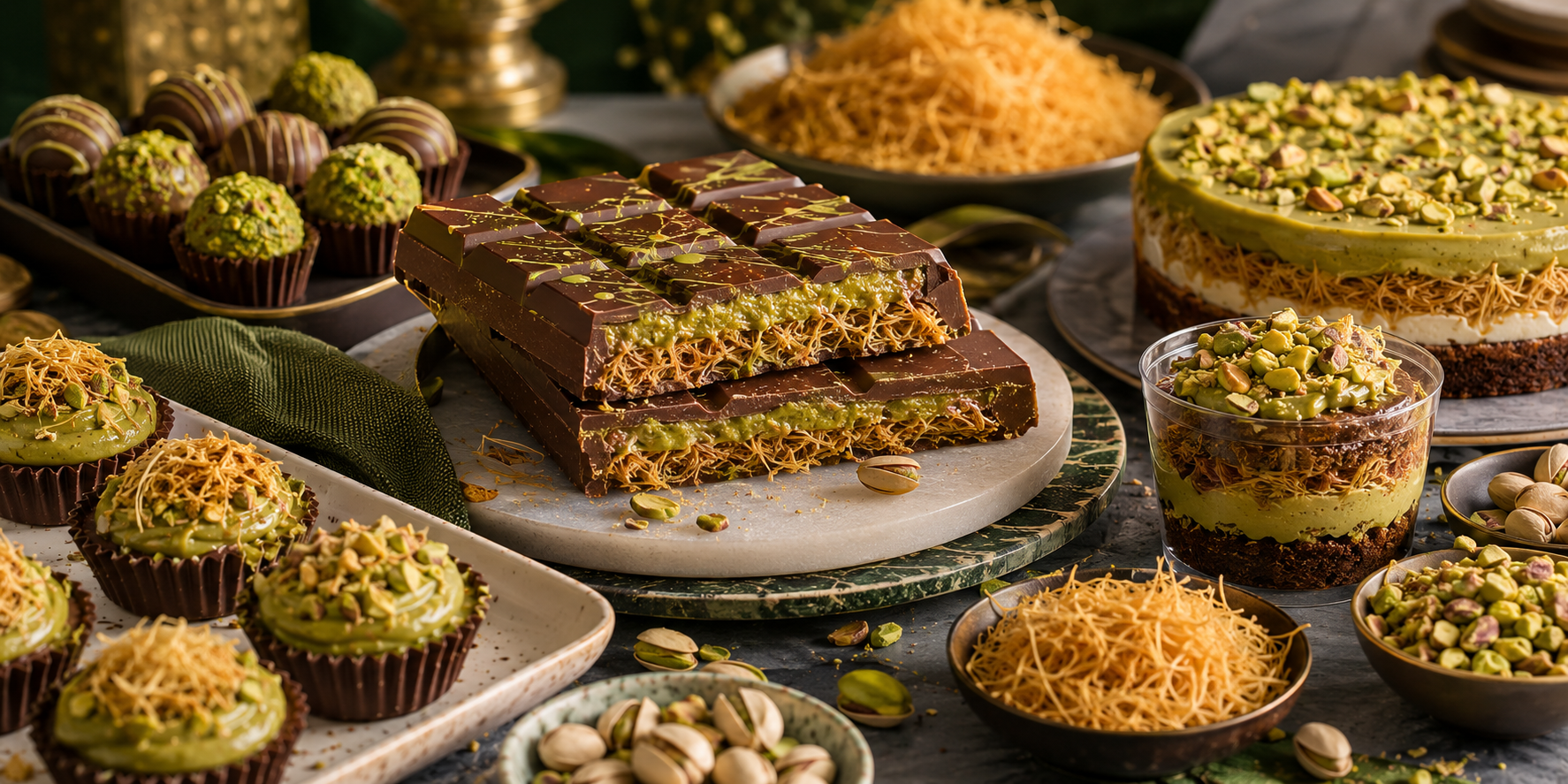
Pistachio and kunafa desserts combine three qualities customers immediately notice: a rich nutty filling, crisp golden pastry and a smooth chocolate or cream component. This contrast has made pistachio-kunafa combinations popular across chocolate bars, dessert cups, cakes, brownies, cookies, cheesecakes, pastries and premium gifting products.
However, creating a good pistachio and kunafa dessert involves more than mixing pistachio paste with pastry strands. The kataifi must remain crisp, the pistachio flavour must stay clear, the chocolate must complement rather than overpower the filling, and the final product must be packaged in a way that protects its texture.
This complete guide explains what kunafa and kataifi are, how pistachio-kunafa filling works, which chocolate to choose, how to create different dessert formats and how to package the finished product professionally. It is designed for home bakers, chocolate makers, dessert brands, cafés, cloud kitchens, gifting businesses and professional bakeries.
You can source the core ingredients and supporting supplies through Bakeyy’s Ingredients, Baking Ingredients, 2M Chocolate, Chocolate Moulds, Chocolate Bar Boxes, Chocolate Boxes and Oil Candy Colours collections.

Quick Answer: What Is a Pistachio and Kunafa Dessert?
A pistachio and kunafa dessert usually contains a creamy pistachio filling combined with roasted kataifi or shredded kunafa pastry. The filling may be placed inside a chocolate shell, layered in a dessert cup, spread between cake layers, used inside cookies or added to brownies and cheesecakes.
The appeal comes from contrast. Pistachio paste provides a smooth, nutty and creamy centre, while roasted kataifi adds a crisp texture. Chocolate, cream, sponge, cheesecake or pastry can then be used as the outer structure.
| Component | Main Purpose | Texture | Bakeyy Product Option |
|---|---|---|---|
| Pistachio paste | Provides the main pistachio flavour | Smooth and creamy | Micks Nutalia Pistachio Paste |
| Pistachio-kunafa paste | Provides a ready pistachio and kunafa combination | Creamy with textured pastry | Micks Nutalia Pistachio Paste with Kunafa |
| Roasted kataifi | Adds visible crunch and pastry texture | Crispy and delicate | Natuf Roasted Shredded Kataifi |
| Chocolate | Creates the shell, coating or balancing flavour | Firm, smooth or creamy | 2M Chocolate Collection |
| Mould | Shapes filled chocolate bars and individual portions | Creates the final structure | Chocolate Moulds |
| Packaging | Protects the product and improves presentation | Supports safe handling | Kunafa Chocolate Box with Window |
What Is Kunafa?
Kunafa, also written as knafeh, kanafeh or kunefe, is associated with desserts made using fine pastry strands, cheese or cream fillings and sweet syrup. In modern bakery and chocolate applications, the pastry component is often used separately to create a crisp layer inside chocolates, cookies, cakes and dessert cups.
The shredded pastry is commonly called kataifi. When toasted or roasted correctly, it becomes golden and crisp. It can then be combined with pistachio paste, hazelnut spread, chocolate, cream or other fillings.
Traditional kunafa and modern pistachio-kunafa chocolate are not exactly the same product. Traditional kunafa is usually served as a plated pastry dessert. Modern kunafa chocolate uses roasted pastry strands as a crunchy filling inside a chocolate shell. Both depend on the texture of the pastry, but the preparation and presentation are different.
What Is Kataifi?
Kataifi consists of thin pastry strands that resemble fine shredded threads. The strands are used in Middle Eastern and Mediterranean-style desserts. When roasted, they develop a crisp texture that works especially well with smooth nut pastes and chocolate.
Bakeyy’s Natuf Roasted Shredded Kataifi comes as crispy golden pastry strands in a 500g pack. Because it is already roasted, it can help reduce preparation time when making filled chocolates, dessert cups, layered desserts and fusion bakery products.

Kunafa vs Kataifi: Are They the Same?
The words are often used together, but they do not always refer to exactly the same thing. Kataifi commonly refers to the shredded pastry strands. Kunafa usually refers to the finished dessert or a preparation made using those strands.
| Term | Usually Refers To | How Bakers Use It |
|---|---|---|
| Kataifi | Fine shredded pastry strands | Roasted and added to fillings, bars, pastries and dessert cups |
| Kunafa | A finished dessert or dessert style | Used for plated pastry, cakes, chocolate bars and modern fusion desserts |
| Pistachio-kunafa filling | Pistachio paste combined with crisp pastry | Used inside chocolate bars, cookies, brownies and layered desserts |
Why Pistachio and Kunafa Work So Well Together
Pistachio has a rich, creamy and slightly earthy flavour. Kataifi is delicate and crisp. When combined, each ingredient improves the other. The pastry prevents the pistachio filling from feeling completely smooth or heavy, while the pistachio paste gives flavour and richness to the relatively neutral pastry.
Chocolate creates a third layer of contrast. Dark chocolate adds bitterness and depth. Milk chocolate adds sweetness and creaminess. White chocolate adds a mild dairy-style sweetness and allows green pistachio shades to remain visually prominent.
A strong pistachio-kunafa dessert therefore has three different experiences:
- A firm, soft or creamy outer structure
- A rich pistachio centre
- A clearly noticeable crisp pastry texture
Pistachio Paste vs Pistachio Paste with Kunafa
Bakeyy currently carries two relevant Micks products, and they serve different production needs.
Micks Nutalia Pistachio Paste | 1 Kg is a smooth pistachio paste. It gives bakers more control because the amount of kataifi can be adjusted separately. This is useful when you want a very crunchy bar, a smoother cake filling or a pistachio cream without pastry.
Micks Nutalia Pistachio Paste with Kunafa | 1 Kg already combines pistachio flavour with kunafa texture. It is useful when speed, consistency and simplified production are priorities.

Pistachio Product Selection Chart
| Your Production Goal | Better Starting Option | Reason |
|---|---|---|
| Maximum control over crunch | Plain pistachio paste plus separate roasted kataifi | You can adjust the pastry quantity independently |
| Fast chocolate-bar production | Pistachio paste with kunafa | Reduces the number of preparation steps |
| Smooth cake or mousse filling | Plain pistachio paste | No pastry strands interfere with a smooth finish |
| Very crunchy dessert cup layer | Plain pistachio paste plus extra kataifi | Allows a stronger textural layer |
| Consistent bulk production | Pistachio paste with kunafa | Helps keep the flavour and texture more uniform between batches |
How to Build a Pistachio-Kunafa Filling
A pistachio-kunafa filling needs enough pistachio paste to coat and bind the pastry, but not so much that the pastry loses all its crispness. The exact balance depends on whether the filling is being used in a chocolate shell, cake layer, cookie, brownie or dessert cup.
Begin with a small test batch. Fold roasted kataifi into the pistachio paste gradually. Stop when the filling holds together but the pastry remains visible. A chocolate-bar filling can usually be denser and more structured. A cake filling may need to be smoother and easier to spread. A dessert-cup layer can contain larger, more noticeable pastry pieces.
Illustrative Texture Balance Chart
The chart below is a product-development guide rather than a fixed recipe. Test the mixture with your selected ingredients before scaling production.
| Desired Result | Pistachio Component | Kataifi Component | Texture Description |
|---|---|---|---|
| Smooth cake filling | High | Low | Spreadable with a light crunch |
| Balanced chocolate-bar filling | Medium to high | Medium | Creamy but visibly textured |
| Extra-crunchy bar | Medium | High | Strong crisp bite with less heaviness |
| Dessert-cup crunch layer | Medium | High | Loose, spoonable and clearly layered |
| Cookie or brownie centre | High | Medium | Thick enough to stay inside the baked product |
How to Keep Kataifi Crisp
The most common problem in pistachio-kunafa desserts is loss of crunch. Kataifi absorbs moisture from cream, syrup, wet fillings and humid storage conditions. Once it absorbs too much moisture, it becomes soft and the dessert loses its main textural advantage.
Use roasted kataifi and keep it sealed until required. Mix it with the pistachio component close to production time when possible. Avoid adding unnecessary water-based ingredients to a chocolate-bar filling. Keep tools and containers dry. Do not leave roasted pastry uncovered in a humid work area.
When creating dessert cups, use the kataifi as a separate layer or coat it sufficiently with a fat-based filling. When using it inside cakes, place it where it has limited direct contact with very wet syrups or fruit fillings.
Crunch Retention Chart
| Application | Moisture Exposure | Crunch Risk | Suggested Approach |
|---|---|---|---|
| Filled chocolate bar | Low | Low | Use a dry shell and thick filling |
| Stuffed cookie | Medium | Medium | Use a thick centre and avoid excessive liquid |
| Brownie topping | Medium | Medium | Add the crisp layer after cooling where suitable |
| Cake filling | Medium to high | High | Protect from wet sponge syrup and soft cream |
| Dessert cup | High | High | Layer carefully and assemble as close to sale as practical |
Which Chocolate Is Best for Pistachio-Kunafa Desserts?
The best chocolate depends on the flavour, sweetness, colour and price point you want. Bakeyy carries both compound and higher-cocoa chocolate options that can be used for shells, coatings, drips and premium dessert applications.
The 2M Compound Bar is available in white, milk and dark variants. It is a practical option for chocolate shells, moulded bars, coating and everyday bakery production.
The Van Houten Professional Compound is also available in white, milk and dark variants. This gives bakers the flexibility to create different flavour and colour profiles from one product family.
For a deeper premium flavour, options such as 2M Tenero Rich Dark Chocolate with 57% Cocoa or Van Houten Professional Signature Dark Chocolate 46.5% can create a more intense chocolate contrast.


Chocolate Selection Chart
| Chocolate Type | Flavour Result | Visual Result | Best Applications |
|---|---|---|---|
| Dark compound | Stronger chocolate contrast | Deep brown shell | Chocolate bars, brownies, premium cookies |
| Milk compound | Sweeter and creamier | Classic milk-chocolate finish | Gift bars, children’s desserts, cakesicles |
| White compound | Mild and sweet | Can be tinted to match pistachio themes | Decorative bars, drips, themed desserts |
| 46.5% dark chocolate | Balanced premium cocoa flavour | Rich dark appearance | Premium bars, ganache and plated desserts |
| 57% dark chocolate | More intense and less sweet | Deep premium finish | Adult flavour profiles and luxury desserts |
Compound Chocolate vs Couverture-Style Chocolate
Compound chocolate is practical for many bakery businesses because it is easy to melt, mould and set. It is suitable for regular production, home bakers, gifting bars, decorations and products where convenient handling is important.
Higher-cocoa or couverture-style chocolate is useful when the flavour of the chocolate itself is a major part of the final product. It may be preferred for premium bars, refined dessert menus or products positioned at a higher price point.
Your choice should consider production skill, room conditions, transport, customer expectations, target selling price and the desired flavour. A well-made compound chocolate bar can be commercially successful when the filling, shell thickness and packaging are handled correctly.
How to Colour White Chocolate for a Pistachio Look
White compound can be tinted to create green pistachio-themed shells, drizzles and decorative details. Because chocolate is fat-based, use a compatible colour rather than adding regular water-based liquid colour.
Bakeyy’s Oil Candy Colour collection is designed for chocolate and other fat-based applications. Add colour gradually. A muted pistachio green generally looks more premium than an extremely bright neon shade.
You can combine a green shell with gold details, dark chocolate lines, chopped pistachio garnish or a contrasting cream-coloured drizzle. For more colour options, explore Bakeyy’s Food Colours collection, but always select a colour type appropriate for the product being coloured.
How to Make a Pistachio-Kunafa Chocolate Bar
A filled pistachio-kunafa chocolate bar has three main parts: the outer shell, the pistachio-kunafa filling and the final chocolate seal.
Step 1: Select the mould
Choose a deep chocolate-bar mould that leaves enough room for the filling. A shallow mould may not provide enough space for visible kataifi texture.
Bakeyy carries several relevant options, including the Mould 678 Dubai Kunafa Deep Bar Chocolate Mould, Mould 680 Dubai Kunafa Chocolate Mould and 1 Cavity Silicone Chocolate Bar Mould.

Step 2: Prepare the mould
Make sure the mould is clean and completely dry. Any moisture can affect the finish and handling of the chocolate. Polish suitable rigid moulds carefully if required for a cleaner shine.
Step 3: Create the chocolate shell
Melt the selected chocolate according to the product instructions. Add it to the mould and spread it across the base and sides. Remove excess chocolate where necessary so the shell does not become unnecessarily thick.
Allow the shell to set sufficiently before adding the filling. A shell that is too soft may break or mix with the centre.
Step 4: Add the filling
Add the pistachio-kunafa filling while leaving enough room for the final chocolate layer. Do not fill right up to the top edge. Press the filling gently enough to remove large air gaps without crushing all the pastry texture.
Step 5: Seal the bar
Cover the filling with chocolate and level the back. Allow the bar to set fully before demoulding. Follow the chocolate manufacturer’s handling instructions and test the process under your production conditions.
Step 6: Package the finished bar
Once the bar is fully set and clean, place it in packaging that fits without excessive movement. Bakeyy’s Kunafa Chocolate Box with Window is designed specifically for kunafa-style filled bars and is available in multiple colours.

Choosing a Kunafa Chocolate Mould
Different moulds create different product sizes, portion formats and selling opportunities. A large single-cavity mould works well for a premium sharing bar. A multi-cavity mould is useful for smaller individual bars. A heart mould can work for Valentine’s Day, anniversaries and wedding gifting.
| Mould Format | Best For | Commercial Advantage |
|---|---|---|
| Deep single bar | Premium filled chocolate bars | More room for a thick pistachio-kunafa centre |
| Five-cavity bar mould | Mini bars and assorted packs | Allows multiple portions in one production cycle |
| Segmented bar mould | Sharing bars | Customers can break the bar into smaller portions |
| Heart-shaped mould | Occasion gifting | Creates a higher perceived gifting value |
| Dual-design mould | Mixed collections | Allows multiple visual finishes |

Traditional-Style Kunafa Using an Aluminium Plate
Pistachio-kunafa does not have to be limited to chocolate bars. Bakers can also prepare round kunafa-style desserts using an aluminium plate. The finished dessert can be topped with pistachio paste, chopped pistachios, cream, syrup or chocolate.
Bakeyy’s Round Aluminium Kunafa Plate is available in 5.5-inch, 6.5-inch and 7.5-inch sizes. Different sizes allow bakeries to create individual, sharing or celebration-style portions.

Pistachio-Kunafa Dessert Cup Ideas
Dessert cups are useful for selling single portions and testing new flavour combinations without producing large cakes. A pistachio-kunafa cup can include layers of chocolate sponge, pistachio cream, roasted kataifi, chocolate ganache, cheesecake, mousse or whipped cream.
Explore Acrylic Dessert Cups for premium presentation and Dessert Cups for additional portion-packaging options.
Layering Ideas
| Dessert Cup Style | Bottom Layer | Middle Layer | Top Layer |
|---|---|---|---|
| Chocolate pistachio cup | Chocolate sponge | Pistachio-kunafa filling | Chocolate ganache and pistachio garnish |
| Kunafa cheesecake cup | Roasted kataifi | Cheesecake filling | Pistachio paste and crisp pastry |
| Pistachio mousse cup | Thin chocolate layer | Pistachio mousse | Kataifi crunch and chocolate drizzle |
| Brownie kunafa cup | Brownie pieces | Pistachio-kunafa filling | Milk or dark chocolate cream |
| White chocolate pistachio cup | Vanilla sponge | Pistachio cream | White chocolate and kataifi |
Pistachio-Kunafa Cake Ideas
Pistachio and kunafa can be used in celebration cakes, loaf cakes, entremets and individual pastries. The key is controlling moisture and keeping the crunchy layer protected.
A chocolate pistachio-kunafa cake can use chocolate sponge, a thin pistachio filling and a protected kataifi crunch layer. A vanilla pistachio cake can use lighter sponge and white chocolate. A pistachio cheesecake can use kataifi as part of the base or topping.
Once the cake is assembled, choose the correct Cake Base and Cake Box. The packaging should match the final base size and cake height rather than only the sponge diameter.
Cake Format Chart
| Cake Format | Best Pistachio Component | Best Kataifi Placement |
|---|---|---|
| Layer cake | Smooth pistachio paste or cream | Thin protected crunch layer |
| Cheesecake | Pistachio topping or swirl | Base or final garnish |
| Loaf cake | Pistachio glaze or centre | Crunch topping added after baking |
| Entremet | Pistachio mousse or insert | Structured crunch insert |
| Mini cake | Pistachio filling | Top garnish or protected centre |
Pistachio-Kunafa Brownies
Brownies provide a dense chocolate base that pairs naturally with pistachio. The pistachio-kunafa component can be used as a topping, centre layer or post-bake filling.
For a cleaner cut, allow the brownie to cool completely before adding or slicing through thick fillings. A very wet topping may soften the pastry, so a thicker pistachio component is usually more suitable than a loose sauce.
Package individual pieces or assorted brownie products using Bakeyy’s Brownie Boxes. For premium gifting, a chocolate cavity box or rigid gift box may also be appropriate depending on the product dimensions.
Pistachio-Kunafa Cookies
Stuffed cookies are another practical format for pistachio-kunafa filling. The centre should be thick enough to remain enclosed during shaping and baking. A very loose filling may leak, while an excessively dry filling may not give the desired creamy centre.
Test the filling with your dough because baking temperature, cookie size and dough structure affect the final result. The kataifi can be mixed into the centre or added as a finishing garnish after baking.
Cookies can be sold individually, in zip-lock pouches, paper boxes, tins or rigid gift boxes. The packaging should protect the cookie from breakage while helping preserve its intended texture.
Pistachio-Kunafa Cupcakes
Cupcakes allow the flavour to be offered in a familiar and affordable format. A cupcake can be cored and filled with pistachio-kunafa paste, topped with pistachio cream and finished with a small amount of roasted kataifi.
Avoid placing a large amount of exposed kataifi on very wet frosting too early, as it may soften. Add the final crunch close to display or dispatch where practical.
Use Bakeyy’s Cupcake Boxes to pack single or multiple cupcakes while protecting the topping during delivery.
Pistachio-Kunafa Cheesecake
Cheesecake works well with pistachio because the slight tang and creamy texture balance the rich nut paste. Kataifi can be used as a crisp base, middle layer or garnish.
For a whole cheesecake, a kataifi base can create a distinctive alternative to a regular biscuit base. For a dessert-cup cheesecake, use a small crisp layer at the bottom and another fresh layer near the top for stronger texture.
Pistachio-Kunafa Truffles and Bites
Small truffles or filled chocolate bites are useful for gifting boxes and mixed chocolate assortments. The filling can be rolled or portioned, coated with chocolate and decorated with pistachio crumbs or fine kataifi.
These products can be packed in cavity boxes from Bakeyy’s Chocolate Box collection. Select the cavity size after measuring the finished truffle rather than estimating from the uncoated centre.
Pistachio-Kunafa Falooda and Chilled Desserts
Pistachio flavours also work in falooda, milkshakes, ice cream desserts and chilled cups. Bakeyy’s Tiger Falooda Mix with Nuts and Jellies includes a pistachio variant. It can be used as part of a separate pistachio-themed beverage or dessert menu.
For chilled desserts, use kataifi as a topping or distinct layer rather than leaving it immersed in liquid for a long period. This helps maintain a more noticeable crunch.
Pistachio-Kunafa Menu Ideas for Bakeries
| Product | Suggested Format | Recommended Packaging |
|---|---|---|
| Premium kunafa chocolate bar | Large filled single bar | Kunafa Window Box |
| Mini kunafa bars | Multiple small bars | Chocolate Bar Boxes |
| Pistachio-kunafa dessert cup | Single-serve layered dessert | Acrylic Dessert Cups |
| Kunafa brownie | Individual square or assorted box | Brownie Boxes |
| Pistachio-kunafa cupcake | Single or multi-cavity pack | Cupcake Boxes |
| Kunafa celebration cake | Whole round or square cake | Cake Boxes and Cake Bases |
| Pistachio truffle assortment | 4, 9, 12 or 18-piece gift set | Chocolate Boxes |
Packaging Pistachio-Kunafa Chocolate Bars
Packaging is particularly important for filled chocolate bars. The bar should not move excessively inside the box, the shell should be protected from pressure and the packaging should present the product clearly.
Bakeyy’s dedicated Kunafa Chocolate Box with Window is available in red, pink, green and blue. The window allows the bar to remain visible, while the coloured exterior helps brands create flavour or occasion-based themes.
For other bar formats, explore the Chocolate Bar Box collection. For truffles, pralines and assorted bites, use the Chocolate Box collection.
Packaging Decision Chart
| Product Type | Primary Packaging Need | Recommended Format |
|---|---|---|
| Large filled bar | Protection from bending and impact | Fitted window chocolate-bar box |
| Mini bars | Separation and neat arrangement | Multi-product chocolate box or fitted bar box |
| Truffles | Prevent rolling and collision | Cavity chocolate box |
| Dessert cup | Leak resistance and product visibility | Lidded dessert cup |
| Whole kunafa dessert | Base support and surface protection | Suitable cake or dessert box |
| Gift assortment | Premium presentation | Rigid chocolate or hamper box |
How to Price Pistachio-Kunafa Desserts
Pistachio-based products are generally positioned as premium desserts because the filling, chocolate, packaging and production steps can cost more than basic flavours. Do not price only by comparing your product with a regular chocolate bar or brownie.
Calculate the cost of pistachio paste, kataifi, chocolate, colour, decoration, packaging, labour, wastage, electricity, delivery-related material and payment charges. Then add the profit margin required by your business.
Costing Chart
| Cost Component | What to Include |
|---|---|
| Ingredients | Chocolate, pistachio paste, kataifi, colours and garnish |
| Packaging | Inner wrap, fitted box, label, sticker and outer transport packaging |
| Labour | Roasting, mixing, moulding, setting, demoulding and packing |
| Wastage | Chocolate left on tools, damaged shells, broken bars and test batches |
| Operating cost | Electricity, equipment use, storage and cleaning |
| Selling cost | Platform fees, discounts, advertising and delivery support |
| Profit | The margin required for sustainable business growth |
Common Pistachio-Kunafa Dessert Mistakes
Using soft or stale kataifi
The dessert loses its main textural contrast when the pastry is already soft. Use properly roasted strands and store them carefully.
Adding too much filling
Overfilling a chocolate mould can prevent proper sealing and cause the shell to crack or leak. Leave enough room for the final chocolate layer.
Making the chocolate shell too thick
An extremely thick shell can overpower the pistachio filling and make the bar difficult to bite. Test shell thickness with the selected mould.
Making the chocolate shell too thin
A very thin shell can crack during demoulding, packing or transport. Deep filled bars need enough structure to support the centre.
Using the wrong colour in chocolate
Water-based colours may affect chocolate texture. Use a suitable oil-based or chocolate-compatible colour.
Allowing kataifi to sit in wet cream
Direct, long-term exposure to wet cream or syrup can soften the pastry. Use protected layers and assemble thoughtfully.
Using packaging that is too large
A bar that moves inside an oversized box is more likely to get damaged. Choose packaging based on the finished product dimensions.
Ignoring temperature during delivery
Chocolate products are sensitive to heat. Plan production, packaging and delivery according to your local conditions and follow the ingredient manufacturer’s handling guidance.
Storage and Production Planning
Keep unopened products according to the storage instructions provided on their packaging. Once opened, close pistachio paste, chocolate, kataifi and colours properly after each use. Use clean, dry tools to avoid introducing moisture or contamination.
Do not assume that every pistachio-kunafa product will have the same shelf life. A solid filled chocolate bar, chilled dessert cup, cream cake and cheesecake all behave differently. Test your complete recipe and packaging system before assigning a selling period.
| Product | Main Storage Concern | Production Focus |
|---|---|---|
| Chocolate bar | Heat, moisture and physical damage | Complete setting and fitted packaging |
| Dessert cup | Chilled handling and loss of crunch | Layer timing and secure lids |
| Cake | Cream stability and moisture migration | Protected crunch layer |
| Cookie | Filling leakage and texture change | Controlled filling quantity |
| Brownie | Topping softness and messy cutting | Cooling before filling or topping |
Bakeyy Products for Pistachio-Kunafa Desserts
| Product | Size or Format | Best Use | Shop |
|---|---|---|---|
| Micks Nutalia Pistachio Paste | 1 Kg | Custom fillings, cakes, cups and chocolates | View Product |
| Micks Nutalia Pistachio Paste with Kunafa | 1 Kg | Fast, consistent filled chocolate and dessert production | View Product |
| Natuf Roasted Shredded Kataifi | 500g | Crunch layers, fillings, toppings and plated kunafa | View Product |
| 2M Compound Bar | 500g; white, milk and dark variants | Shells, coatings and moulded bars | View Product |
| Van Houten Professional Compound | 500g; white, milk and dark variants | Shells, drizzles and chocolate decorations | View Product |
| Mould 678 Dubai Kunafa Deep Bar | 1 cavity | Large premium filled bars | View Product |
| 5 Cavity Silicone Chocolate Bar Mould | 5 cavities | Mini bars and assorted packs | View Product |
| Round Aluminium Kunafa Plate | 5.5, 6.5 and 7.5 inches | Round traditional-style kunafa desserts | View Product |
| Kunafa Chocolate Box with Window | Pack of 25; multiple colours | Filled chocolate-bar packaging | View Product |
Frequently Asked Questions
What is pistachio-kunafa filling made from?
Pistachio-kunafa filling is usually made from pistachio paste and roasted kataifi pastry. Depending on the recipe, it may also include chocolate, tahini, nut paste or another fat-based binder.
Is kataifi the same as kunafa?
Kataifi usually refers to the shredded pastry strands, while kunafa usually refers to a finished dessert or dessert style made using those strands.
Which pistachio paste is best for kunafa chocolate?
Use plain pistachio paste when you want to control the amount of kataifi yourself. Use a pistachio paste with kunafa when you want a faster and more consistent ready-combined filling.
Which chocolate is best for Dubai-style kunafa chocolate?
Dark, milk and white chocolate can all be used. Dark chocolate gives stronger contrast, milk chocolate gives a sweeter creamy profile and white chocolate creates a mild shell that can be coloured.
Can compound chocolate be used for pistachio-kunafa bars?
Yes. Compound chocolate is practical for moulding, coating and filled chocolate-bar production. Select a product that gives the flavour, handling and finish required by your business.
How do I keep kunafa crispy inside chocolate?
Use roasted kataifi, keep tools dry, avoid unnecessary water-based ingredients and protect the filling inside a fully set chocolate shell. Store the finished product according to the ingredient and packaging requirements.
Can I use pistachio-kunafa filling in cakes?
Yes. It can be used as a cake filling or crunch layer. Protect the kataifi from excessive contact with wet syrup or cream if you want it to remain crisp.
Can I make pistachio-kunafa dessert cups?
Yes. Layer pistachio cream or paste with roasted kataifi, chocolate, sponge, mousse, brownie or cheesecake filling. Use a lidded dessert cup suitable for the portion.
What mould should I use for kunafa chocolate?
Use a deep chocolate-bar mould with enough space for the filling. Single-cavity moulds work well for large premium bars, while multi-cavity moulds are useful for smaller products.
How should I package kunafa chocolate bars?
Use a fitted chocolate-bar box that prevents excessive movement and protects the shell from pressure. A window box can also help display the finished bar.
Where can I buy pistachio paste and kataifi online?
You can buy pistachio paste, pistachio paste with kunafa, roasted kataifi, chocolate, moulds and packaging through Bakeyy’s Ingredients, Chocolate Moulds and Chocolate Bar Boxes collections.
Final Recommendation
Start with the dessert format you want to sell. For premium filled chocolate bars, combine pistachio paste or pistachio-kunafa paste with roasted kataifi, a suitable chocolate shell, a deep mould and fitted packaging. For cakes and dessert cups, use plain pistachio paste when you need a smoother filling and add roasted kataifi as a controlled crunch layer.
Test small batches before scaling. Focus on shell thickness, filling consistency, kataifi crunch, product dimensions and packaging fit. These details matter more than simply copying the appearance of a popular dessert.
Shop the core products through Bakeyy’s Ingredients, 2M Chocolate, Chocolate Moulds, Oil Candy Colours, Chocolate Bar Boxes and Chocolate Boxes collections.