

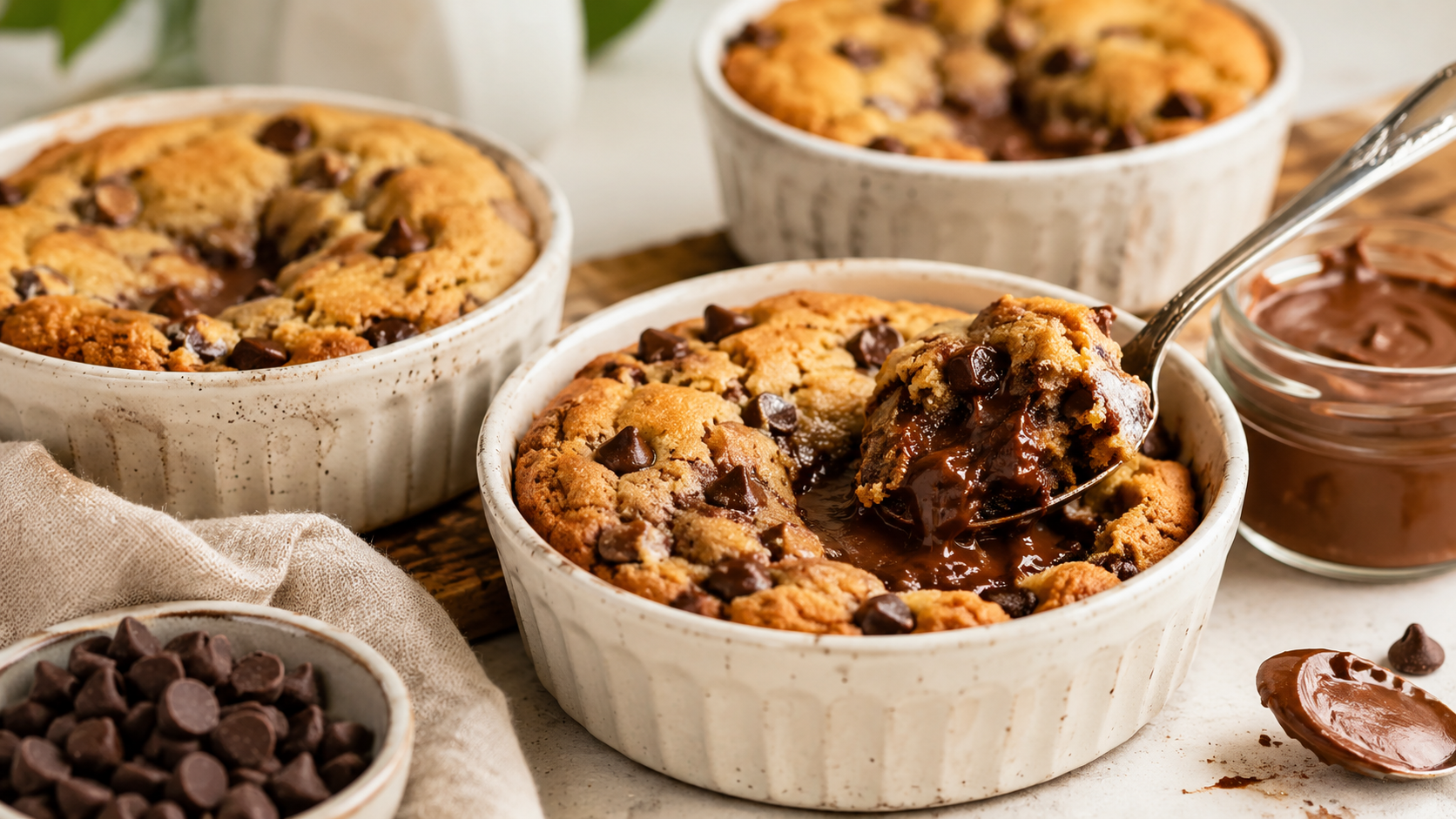
Scoop cookies are becoming one of 2026’s most exciting dessert trends. Imagine the crisp, caramelised edges of a freshly baked chocolate-chip cookie combined with a thick, molten, spoonable centre. Instead of shaping and baking individual cookies, the cookie dough is packed into a small baking dish or takeaway container, baked until the edges set while the middle remains soft, and served warm with a spoon.
The result sits somewhere between a skillet cookie, a warm cookie pudding and edible cookie dough. Customers can scoop through layers of buttery dough, melted chocolate chips, cookie spread, hazelnut filling, ice cream or sauces. It is indulgent, highly customisable and visually perfect for Instagram Reels, café videos and home-bakery menus.
For Indian home bakers, cloud kitchens, cafés and dessert businesses, scoop cookies offer another important advantage: they can be produced using familiar cookie ingredients and sold in individual portions using practical takeaway packaging. You do not need an elaborate pastry setup or advanced decoration skills. With a reliable dough, the correct container and controlled baking, scoop cookies can become a premium, high-margin addition to your menu.
This complete guide explains what a scoop cookie is, why it is trending, how to make it, how to select the right chocolate and fillings, which packaging works best, how to calculate the cost, how much to charge, how to deliver it and how to build a profitable scoop-cookie menu in India.
Quick answer: A scoop cookie is thick cookie dough baked closely together in a dish or container until the edges are cooked and the centre remains soft and gooey. It is served warm and eaten with a spoon, often with chocolate, spreads, sauces or ice cream.
What Is a Scoop Cookie?
A scoop cookie, also called a scoopable cookie, is a warm dessert made by baking a thick layer of cookie dough in a dish rather than separating the dough into individual cookie portions. Because the dough is packed together, the outside develops a baked cookie crust while the inside remains soft enough to scoop.
A well-made scoop cookie should not simply taste like raw cookie dough. The goal is contrast. The edges should feel slightly crisp or chewy, the upper surface should look baked and golden, and the centre should remain moist, rich and molten without tasting floury.
The dessert is usually served in the same container in which it is baked or reheated. Customers eat it with a spoon and may add vanilla ice cream, chocolate sauce, sea salt, crushed biscuits, nuts, caramel, fruit filling or a spoonful of cookie spread.
Traditional cookies are designed to hold their shape and be eaten by hand. Scoop cookies are deliberately softer and are designed as a plated or packaged dessert experience. This makes them suitable for cafés, delivery kitchens, dessert counters, parties and late-night home-bakery menus.
| Feature | Regular Cookie | Scoop Cookie |
|---|---|---|
| Shape | Individual round cookie | Thick layer baked in a dish |
| Texture | Set enough to hold | Crisp edges with a soft centre |
| Serving style | Eaten by hand | Eaten warm with a spoon |
| Packaging | Pouch or cookie box | Bowl, foil dish or dessert container |
| Best add-ons | Chocolate drizzle or filling | Ice cream, spread, sauce and toppings |
| Delivery format | Ready to eat | Warm delivery or reheat-at-home |
Why Scoop Cookies Are Trending in 2026
Scoop cookies combine several qualities that perform well in the current dessert market. They are familiar enough to understand immediately but different enough to feel new. Customers already love chocolate-chip cookies, molten chocolate desserts, brownies and cookie skillets. Scoop cookies bring these experiences together in a format that feels shareable, customisable and visually indulgent.
The spoonable centre is particularly effective for short-form video. A customer or creator can break through the baked surface, lift a scoop of warm cookie and show melted chocolate stretching through the centre. That single action communicates texture without requiring a lengthy explanation.
The format also suits Indian dessert businesses because it can be adapted to local preferences. A basic chocolate-chip scoop cookie can become a Biscoff-style cookie scoop, dark chocolate hazelnut scoop, brownie-cookie scoop, pistachio kunafa scoop, gulab jamun cookie scoop or festive dry-fruit scoop.
From a business perspective, scoop cookies can be sold as individual desserts, sharing tubs, DIY kits, party portions or café dine-in specials. The base dough can remain the same while fillings and toppings create multiple menu products. This reduces production complexity and helps control inventory.
Who Can Sell Scoop Cookies?
Scoop cookies can work for more than traditional bakeries. Home bakers can offer them for weekend delivery. Cafés can serve them warm with ice cream. Cloud kitchens can add them to late-night dessert menus. Chocolate businesses can use premium chocolate variants, while gifting brands can build reheatable dessert boxes.
The format is especially suitable for businesses that already sell cookies, brownies, dessert tubs, cheesecakes, cupcakes or chocolate desserts. Many of the same ingredients, packaging supplies and customers overlap.
Scoop cookies may be a good menu addition for:
• Home bakers who want a dessert with a high perceived value but simple decoration.
• Cafés looking for a warm made-to-order dessert.
• Cloud kitchens selling through delivery platforms.
• Brownie and cookie brands expanding beyond conventional boxes.
• Event caterers offering live or reheated dessert counters.
• Gifting businesses creating dessert-and-topping kits.
Essential Ingredients for Scoop Cookies
A good scoop cookie begins with a balanced cookie dough. The dough must be rich enough to stay moist but structured enough to form a baked crust. Excess butter or sugar can make the dessert greasy, while too much flour can turn the centre cakey or dry.
The basic ingredient roles are:
| Ingredient | Purpose | Common mistake |
|---|---|---|
| Butter | Flavour, richness and softness | Using melted butter while it is too hot |
| Brown sugar | Moisture, chewiness and caramel flavour | Replacing all of it with white sugar |
| White sugar | Spread and slightly crisp edges | Using too much and making the dessert overly sweet |
| Egg | Binding, moisture and structure | Adding too much egg and creating a cake-like texture |
| Flour | Structure | Over-measuring or overmixing |
| Baking soda | Browning and spread | Using too much and creating an alkaline taste |
| Chocolate chips | Molten pockets and visual appeal | Using chips that disappear completely into the dough |
| Salt | Balances sweetness | Skipping it in a rich dessert |
| Vanilla | Rounds out the butter and chocolate flavours | Using an overpowering quantity |
Chocolate Options Available at Bakeyy
The chocolate choice affects flavour, sweetness, melting and final appearance. Compound chips are practical for home bakers because they are convenient, affordable and available in dark, milk and white varieties. Premium couverture can provide a deeper cocoa flavour, but it may increase the portion cost.
For a dependable commercial scoop-cookie menu, start with dark compound chips and then test milk or white chocolate variants. Dark chocolate generally balances sweet cookie dough more effectively.
Morde Compound Chips – Dark, Milk and White, 500 g are suitable for cookies, brownies, muffins and dessert toppings. At the time this guide was prepared, the listed prices started at ₹250 for milk, ₹265 for dark and ₹380 for white.
2M Tenero Rich Dark Chocolate with 57% cocoa solids can be used when you want a more intense dark-chocolate profile. The live listed price was ₹693 for 500 g.
Prices and stock can change. Check the current product page before calculating your final selling price.

Image suggestion: Place this product image immediately after the chocolate-selection section so the ingredient recommendation is visually connected to the article.
Basic Scoop Cookie Recipe
This recipe produces approximately six medium individual scoop-cookie portions or three larger sharing portions, depending on the container size.
| Ingredient | Quantity |
|---|---|
| Unsalted butter | 150 g |
| Brown sugar | 130 g |
| White sugar | 60 g |
| Egg | 1 large |
| Vanilla | 1 teaspoon |
| Maida or all-purpose flour | 220 g |
| Baking soda | ½ teaspoon |
| Salt | ½ teaspoon |
| Chocolate chips or chunks | 150 g |
| Optional spread or filling | 60–90 g |
How to Make Scoop Cookies Step by Step
Step 1: Prepare the butter. Soften the butter until it can be pressed easily but is not melted or oily. Very cold butter will not mix properly, while fully melted hot butter may produce a greasy, flat dessert.
Step 2: Cream the butter and sugars. Beat the softened butter, brown sugar and white sugar until the mixture looks smooth and slightly lighter. You do not need to whip it excessively. The objective is even mixing rather than maximum aeration.
Step 3: Add the egg and vanilla. Mix until combined. Scrape the bowl so no unmixed butter remains around the sides.
Step 4: Combine the dry ingredients. In a separate bowl, mix the flour, baking soda and salt. Add this mixture to the butter base and fold only until no dry flour remains.
Step 5: Add the chocolate. Fold in most of the chocolate chips and reserve a small quantity for the surface. Visible chocolate on top improves the appearance and creates molten pockets customers can see.
Step 6: Portion the dough. Add enough dough to create a thick layer in the selected oven-safe dish. Do not fill the container to the top because the dough will spread and rise slightly.
Step 7: Add the centre filling. For a filled scoop cookie, spread half the dough in the dish, place a small spoonful of cookie cream or hazelnut filling in the centre, and cover it with the remaining dough. Keep the filling away from the outer edge to reduce leakage.
Step 8: Bake. Bake at approximately 170°C in a preheated oven. A medium individual portion may take around 10–15 minutes, while a deeper sharing portion may require more time. Exact timing depends on the container, dough depth and oven.
Step 9: Judge by appearance, not only time. The outer edge should look set, and the top should no longer look like wet dough. The centre may remain soft and slightly under-set because it continues cooking from residual heat.
Step 10: Rest briefly. Allow the dessert to rest for a few minutes before serving or closing the package. Packing it while aggressively steaming can create condensation.
How to Keep the Centre Gooey but Safe
“Gooey” should not mean raw. A customer should taste a soft baked centre rather than uncooked flour, separated butter or raw egg. The safest approach is to create softness through recipe balance, dough depth and controlled baking rather than drastically underbaking the product.
Use pasteurised or reliable ingredients, follow hygienic handling practices and avoid selling raw dough unless you have specifically developed an egg-free, heat-treated-flour edible cookie dough recipe. A standard scoop-cookie formula is intended to be baked.
The centre can remain soft because the dough is thick, contains brown sugar and butter, and is protected by the set outer layer. The filling also increases the molten effect without requiring the entire centre to remain uncooked.
Using Cookie Cream and Hazelnut Filling
Fillings can turn one base dough into several premium menu options. Keep the filling quantity controlled. Too much filling can prevent the centre from baking evenly, create leakage and make the dessert excessively sweet.
Bake & Shake Classic Cookie Cream Spread by Jindal Cocoa can be used to create a cookie-butter-style centre, drizzle or topping. The live listed price was ₹850 for 1 kg.
Tenero Choco Hazelnut Filling can be used for a chocolate-hazelnut scoop cookie. The live listed price was ₹573 for 1 kg.

A practical filling quantity for an individual portion is approximately 10–15 g. Test your exact dough and container before finalising the quantity.
Best Scoop Cookie Flavours to Sell in India
| Flavour | Base | Filling or topping | Positioning |
|---|---|---|---|
| Classic Chocolate Chip | Vanilla brown-sugar dough | Dark and milk chips | Entry-level bestseller |
| Triple Chocolate | Cocoa cookie dough | Dark, milk and white chips | Premium chocolate option |
| Cookie Cream | Classic dough | Cookie cream centre and biscuit crumbs | Social-media-friendly |
| Chocolate Hazelnut | Chocolate-chip dough | Hazelnut filling | Premium familiar flavour |
| Salted Caramel | Brown-sugar dough | Caramel centre and sea salt | Balanced adult flavour |
| Red Velvet White Chocolate | Red cocoa dough | White chips or cream-cheese-style centre | Celebration and gifting |
| Pistachio Kunafa | Chocolate dough | Pistachio filling and crisp kunafa | High-value trend flavour |
| Brownie Cookie | Half brownie, half cookie | Chocolate sauce | For brownie businesses |
| Rasmalai Fusion | Cardamom cookie dough | Reduced rasmalai-inspired topping | Indian festive fusion |
| Gulab Jamun Cookie | Cardamom dough | Mini gulab jamun added after baking | Festive and wedding menu |
Choosing the Right Scoop Cookie Portion Size
The right portion depends on how rich the recipe is and whether the dessert includes ice cream or additional toppings. A heavily filled triple-chocolate scoop cookie can feel satisfying in a smaller portion than a plain vanilla cookie.
| Format | Suggested dough weight | Customer type | Suggested menu use |
|---|---|---|---|
| Mini tasting portion | 60–80 g | Events and samplers | Assorted dessert box |
| Standard individual | 100–130 g | Single customer | Main delivery format |
| Loaded individual | 140–180 g | Premium indulgence | Ice cream or heavy filling |
| Sharing portion | 250–350 g | Two or three people | Café or family order |
| Party tray | 500 g or more | Groups | Celebration and catering |
Best Packaging for Scoop Cookies
Packaging is one of the most important decisions because the product may be baked, reheated, stored and served in the same dish. Do not assume that every attractive dessert tub is suitable for oven baking. Confirm the temperature rating and intended use of the container before placing it in an oven.
There are three practical business models:
1. Bake and serve in one oven-safe container: This reduces handling and protects the soft cookie. It is suitable when you have a verified oven-safe foil, paper or bake-and-serve product.
2. Bake in a mould and transfer after cooling: This allows you to use attractive takeaway containers that are not oven-safe. The cookie must be firm enough to transfer without breaking.
3. Sell as a ready-to-bake kit: Portion chilled dough into suitable food packaging with separate instructions. The customer bakes it at home in their own oven-safe dish.
Kraft Bowls for Warm Takeaway Presentation
350 ml Kraft Food Bowls with Lids provide a warm, casual café-style presentation. The product was listed at ₹545 for a pack of 50, which works out to approximately ₹10.90 per set before taxes, shipping or other costs.
These bowls are useful for serving a transferred scoop cookie, chilled cookie dessert, toppings or a reheated portion where the packaging material is confirmed suitable for the intended temperature. Do not place the bowl in an oven unless its specifications explicitly permit it.

Clear Dessert Containers for Premium Presentation
Clear containers allow customers to see the layers, chocolate and toppings. They are useful for chilled, pre-baked or transferred scoop cookies, especially when you want a premium dessert-tub appearance.
D-69 200 ml and D-62 400 ml Clear Square Dessert Containers can support individual and sharing formats. The live listings were ₹2,080 for 80 pieces of the 200 ml size and ₹1,920 for 64 pieces of the 400 ml size. This equals approximately ₹26 and ₹30 per container respectively before additional costs.
D-78 500 ml Clear Square Dessert Containers can be considered for larger loaded or sharing portions. The listed price was ₹360 for a pack of six, or approximately ₹60 per container.
These clear plastic containers should be treated as presentation and storage packaging unless the manufacturer confirms oven or microwave suitability.

Round Kraft Dessert Tubs for Sharing Portions
Disposable Round Kraft Containers with Lids are available in several capacities, including 250 ml, 500 ml, 750 ml, 1,000 ml and larger sizes. A 500 ml pack was listed at ₹819 for 50, or approximately ₹16.38 per container.
The 250 ml size can suit a standard individual portion, while the 500 ml size can work for loaded or sharing presentations. Again, verify temperature suitability before heating.
Packaging Cookie Add-Ons Separately
Ice cream, whipped cream and cold sauces should generally be separated from a warm scoop cookie during delivery. Combining them too early can melt the topping, soften the crust and create a messy package.
100 ml Round Clear PET Containers with Attached Dome Lids can be used for small cold toppings, mini dessert portions or garnish packs. The listed price was ₹225 for 50 pieces, or approximately ₹4.50 per piece.
Small sealed tubs can hold chocolate sauce, caramel, biscuit crumbs or nuts. Ice cream requires insulated cold-chain handling and must not be treated like a shelf-stable topping.
Packaging for Ready-to-Bake Scoop Cookie Kits
A ready-to-bake kit can solve the warm-delivery problem. The customer receives chilled dough, filling, toppings and instructions. They bake the dough shortly before eating and experience the molten texture at its best.
A kit may include:
• Portioned chilled cookie dough.
• A measured filling pouch or cup.
• Extra chocolate chips.
• Flaky salt or biscuit crumbs.
• Baking temperature and timing.
• Allergen and storage information.
• A clear “do not eat raw” instruction where applicable.
For individually wrapped cookie portions or add-on cookies, Kraft Window Cookie Pouches can provide a visible, heat-sealable presentation. The listed price was ₹550 for 100, or approximately ₹5.50 per pouch.

How to Prevent Condensation and Sogginess
A hot scoop cookie releases steam. If you close the lid immediately, the steam collects inside the package and returns to the surface as moisture. The crisp upper layer can become soft, and droplets may make the product look poorly handled.
Allow a short venting period before closing the lid, but do not leave the product uncovered in an unhygienic environment. Use a clean protected cooling area and establish a repeatable packing time.
For warm deliveries, consider using a lid that can be secured without pressing the cookie surface. Keep sauces separate and avoid adding ice cream until serving.
For reheatable products, the best experience may be achieved by delivering the dessert cooled with clear reheating instructions rather than attempting to keep it hot for a long journey.
How to Reheat a Scoop Cookie
The reheating method depends on the packaging. A customer should never place a plastic or unverified container in an oven.
| Method | Best for | Important note |
|---|---|---|
| Oven | Restoring crisp edges | Transfer to an oven-safe dish if required |
| Air fryer | Small portions | Use a suitable heat-safe dish |
| Microwave | Fast softening | May make the entire cookie softer |
| Café service | Fresh made-to-order portions | Bake or reheat immediately before serving |
A customer instruction could say: “Remove all cold toppings. Transfer the cookie to a heat-safe dish if the supplied container is not heat-safe. Warm until the centre becomes soft. Heating time varies by appliance and portion size.”
How to Calculate Scoop Cookie Cost
Do not price only from ingredient cost. The true cost includes packaging, labour, electricity, wastage, toppings, delivery handling, payment charges and business overhead.
Use this formula:
Total batch cost = ingredients + packaging + utilities + direct labour + wastage allowance + platform or payment costs.
Cost per portion = total batch cost ÷ number of saleable portions.
Selling price = cost per portion ÷ target food-cost percentage.
For example, if one finished portion costs ₹70 and you are targeting a 35% cost ratio:
₹70 ÷ 0.35 = ₹200 suggested selling price.
This does not mean every portion must be sold at ₹200. The final price also depends on local competition, portion size, brand positioning, toppings, delivery commissions and customer demand. The formula provides a rational starting point.
Illustrative Costing for a Standard Chocolate-Chip Scoop Cookie
The table below is an example only. Replace every value with your actual purchase price, recipe yield and labour cost.
| Cost component | Illustrative cost per portion |
|---|---|
| Cookie dough ingredients | ₹30 |
| Chocolate chips | ₹14 |
| Filling or sauce | ₹8 |
| Container and lid | ₹11 |
| Spoon, label and outer packing | ₹5 |
| Electricity and wastage | ₹5 |
| Direct labour allocation | ₹12 |
| Estimated total cost | ₹85 |
Illustrative Scoop Cookie Price Chart
| Menu format | Estimated cost | Possible direct-sale price | Approximate gross contribution before overhead |
|---|---|---|---|
| Mini scoop cookie | ₹45 | ₹109 | ₹64 |
| Classic individual | ₹70 | ₹169 | ₹99 |
| Filled premium individual | ₹85 | ₹219 | ₹134 |
| Loaded scoop with topping | ₹110 | ₹279 | ₹169 |
| Sharing scoop cookie | ₹175 | ₹449 | ₹274 |
Visual bar chart: possible selling price by format
| Mini |
₹109
|
| Classic individual |
₹169
|
| Filled premium |
₹219
|
| Loaded |
₹279
|
| Sharing |
₹449
|
The chart is illustrative and is not a statement of market pricing. Platform commissions, GST treatment, delivery discounts and promotional offers can significantly affect the final margin.
How Much Should You Charge?
A basic individual scoop cookie may be positioned between a premium cookie and an individual dessert tub. A filled or loaded variation can command more because it includes additional chocolate, spread, toppings and packaging.
A practical menu can use three price levels:
Entry: Classic chocolate chip with no expensive filling.
Core: Cookie cream, double chocolate or salted caramel.
Premium: Hazelnut, pistachio kunafa, ice-cream-loaded or sharing format.
Do not create ten flavours at launch. Start with three or four variants, track orders and then expand. A smaller menu reduces ingredient waste and helps customers decide faster.
Sample Scoop Cookie Menu
| Product | Description | Illustrative price |
|---|---|---|
| OG Chocolate Chip Scoop | Brown-sugar cookie dough with molten dark and milk chocolate | ₹169 |
| Cookie Cream Core | Classic scoop cookie with a cookie-cream centre and crumbs | ₹209 |
| Dark Hazelnut Melt | Dark chocolate dough with a hazelnut filling | ₹229 |
| Triple Chocolate Loaded | Cocoa dough with dark, milk and white chocolate | ₹239 |
| Scoop Cookie for Two | Large sharing cookie with two sauces and toppings | ₹449 |
How to Sell Scoop Cookies Online
The product must be shown in motion. A flat photograph can make a scoop cookie look like an ordinary baked surface. Use video to show the spoon breaking the edge, lifting the centre and revealing the filling.
Create content around:
• The first scoop from a warm container.
• Chocolate chips melting into the centre.
• A cross-section of the filled version.
• A hot cookie paired with cold ice cream.
• Side-by-side flavour comparisons.
• “Choose your centre” polls.
• Baking and packing behind the scenes.
• Reheating demonstrations.
The product title should clearly explain the format. Do not assume every customer knows the trend. Use wording such as “Warm Scoopable Chocolate-Chip Cookie Dessert” rather than only a creative flavour name.
SEO Keywords for a Scoop Cookie Page
Primary keyword: scoop cookies.
Related keywords: scoopable cookies, scoop cookie recipe, gooey cookie dessert, warm cookie tub, cookie skillet dessert, chocolate-chip scoop cookie, viral cookie trend 2026, scoop cookie India, scoop cookie packaging, scoop cookie price, scoop cookie business, cookie dessert for home bakers and warm cookie delivery.
Use keywords naturally. Repeating the exact phrase in every paragraph reduces readability and does not create a better customer experience.
AEO and GEO Structure for Scoop Cookie Content
Answer-engine optimisation and generative-engine optimisation depend heavily on clarity. Search engines and AI systems should be able to identify the definition, recipe, portion size, packaging recommendation, pricing method and storage guidance without interpreting vague promotional language.
Use:
• A direct definition near the top.
• Short answers before detailed explanations.
• Descriptive headings phrased like customer questions.
• Tables comparing formats and packaging.
• Exact units and clearly labelled examples.
• Honest notes where packaging suitability must be verified.
• Internal links to relevant product and collection pages.
• Product images placed beside the section they support.
Internal Links to Add Across Bakeyy.com
Customers reading this guide are likely to need more than one product. Interlink naturally to the following Bakeyy categories:
Shop Compounds and Couverture Chocolate for chips, compounds and premium baking chocolate.
Shop Spreads and Sauces for cookie cream, chocolate spread and dessert sauces.
Shop Fillings and Toppings for flavoured centres and finishing ingredients.
Shop Dessert Containers with Lids for individual and sharing portions.
Shop Dessert Tubs for takeaway dessert packaging.
Shop Bake N Serve Packaging for products intended to simplify baking and presentation. Confirm the temperature rating of the exact item before use.
Shop Cookie Boxes for add-on cookies, gifting and combo menus.
Shop Zip Lock Pouches for dry toppings, premixes and sealed ingredient kits.
Shop Baking Tools and Accessories for measuring, mixing, portioning and preparation.
How to Deliver Scoop Cookies
Scoop cookies are best when customers can experience the contrast between the warm centre and textured edge. Long delivery times can reduce that contrast, so businesses should select one of three clear delivery promises.
Fresh and warm: Suitable for a short local radius and immediate eating. Use secure, vented packing and separate cold toppings.
Ready to reheat: Bake, cool and pack with clear instructions. This is generally more reliable for longer deliveries.
Ready to bake: Deliver chilled dough and toppings as a kit. This provides the freshest result but requires clear food-safety and baking instructions.
Keep the package upright. Do not place heavy items on the lid. Use an outer carry bag or box that limits movement. Where the container has a loose lid, apply a secure tamper label without blocking necessary ventilation while the product is hot.
Storage and Shelf-Life Planning
Shelf life depends on the recipe, filling, hygiene, temperature and packaging. Do not copy a shelf-life claim from another bakery without testing your own product.
Unbaked dough containing egg and butter requires refrigeration. Cream-based toppings and ice cream require cold storage. Fruit fillings and sauces must be handled according to the manufacturer’s instructions.
Develop a written process for:
• Dough production date and time.
• Refrigerated storage temperature.
• Maximum holding time.
• Baking and cooling.
• Reheating.
• Allergen declaration.
• Disposal of unsold prepared portions.
Common Scoop Cookie Problems and Solutions
| Problem | Possible cause | Solution |
|---|---|---|
| Greasy surface | Butter too warm or insufficient flour | Cool the dough and verify measurements |
| Dry centre | Overbaking or shallow portion | Reduce baking time or increase dough depth |
| Raw flour taste | Centre genuinely underbaked | Increase baking and use filling for molten texture |
| Cakey texture | Too much egg, flour or aeration | Rebalance the formula and avoid overbeating |
| Filling leaks | Filling placed near edge or used excessively | Keep filling centred and reduce quantity |
| Soggy top after packing | Container closed while heavily steaming | Use a controlled venting period |
| Chocolate does not look molten | Wrong chip type or too few visible chips | Test the chocolate and reserve chips for the top |
| Container bends | Packaging unsuitable for heat | Never bake in unverified packaging |
Frequently Asked Questions About Scoop Cookies
What is a scoop cookie?
A scoop cookie is a thick cookie dessert baked in a dish until the outside sets while the centre remains soft and spoonable.
Is a scoop cookie the same as a skillet cookie?
They are closely related. A skillet cookie is usually baked and served in a skillet, often as a sharing dessert. Scoop cookies are commonly presented as individual tubs, bowls or takeaway portions and emphasise a very soft centre.
Can scoop cookies be delivered?
Yes. They can be delivered warm within a short radius, cooled with reheating instructions or as ready-to-bake kits. The last two formats usually provide more consistent results for longer journeys.
Can scoop cookies be baked in plastic dessert tubs?
Do not bake in a plastic container unless the manufacturer explicitly confirms that the exact product is oven-safe at the required temperature. Many clear dessert tubs are intended only for storage and presentation.
What size container should be used?
A 200–350 ml container can suit many individual portions, while 400–500 ml or larger containers can suit loaded or sharing formats. The correct size depends on dough weight, filling and headspace.
How much dough is needed for one scoop cookie?
A standard individual portion can begin around 100–130 g of dough. Mini portions may use less, while loaded and sharing formats require more.
How long should a scoop cookie be baked?
Baking time varies by dough weight, dish material, depth and oven. Use the appearance of the edge and surface as well as time. The outside should be baked while the centre remains soft but not raw.
Can the dough be prepared in advance?
Yes. Cookie dough can often be portioned and refrigerated or frozen, but you must test how storage changes spread, baking time and final texture.
What should be served with a scoop cookie?
Popular additions include vanilla ice cream, chocolate sauce, cookie spread, hazelnut filling, caramel, biscuit crumbs, nuts and flaky salt.
How much can a home baker charge?
The price depends on portion size, ingredients, packaging, location and sales channel. Calculate the full cost first and then apply a target cost ratio. Do not copy another seller’s price without checking your own margins.
Are scoop cookies profitable?
They can be profitable because one base dough can support several flavours and the product has a high perceived value. Profit still depends on controlling chocolate, fillings, packaging, labour and platform commissions.
Final Scoop Cookie Business Checklist
Before launching, confirm that you have:
• A recipe that stays soft without tasting raw.
• Exact dough weight for every portion.
• A tested container and confirmed heat suitability.
• Separate packaging for cold toppings.
• Costing that includes labour and overhead.
• Clear storage and reheating instructions.
• Allergen information for wheat, dairy, egg, nuts and soy where applicable.
• Three or four launch flavours rather than an oversized menu.
• Videos showing the scoop and molten centre.
• Reliable chocolate, filling and packaging inventory.
Conclusion
Scoop cookies are more than an unusual way to serve cookie dough. They turn a familiar bakery product into a warm, interactive dessert that customers can scoop, customise, share and film. That combination makes the format highly suitable for 2026’s experience-led dessert market.
For home bakers and cafés, the best strategy is to start with one dependable base dough, offer a classic and two premium flavours, select packaging according to the delivery model and calculate every component before setting the price. The product should be soft and molten, but it must still be baked, hygienically handled and securely packed.
Use chocolate chips for visible molten pockets, controlled fillings for premium centres and separate toppings to preserve texture during delivery. Build clear menu descriptions, reheating instructions and video content so customers understand exactly what makes a scoop cookie different from a normal cookie.
Explore chocolate compounds and couverture, spreads and sauces, fillings and toppings, dessert containers with lids, bake-and-serve supplies and baking tools at Bakeyy.com to begin developing your scoop-cookie menu.
Product prices, inventory and specifications mentioned in this guide were checked on July 18, 2026 and may change. Always review the current product page. Confirm oven, microwave, freezer and food-contact suitability for the exact packaging product before use. Cost and selling-price examples are illustrative and should be replaced with your actual business figures.