
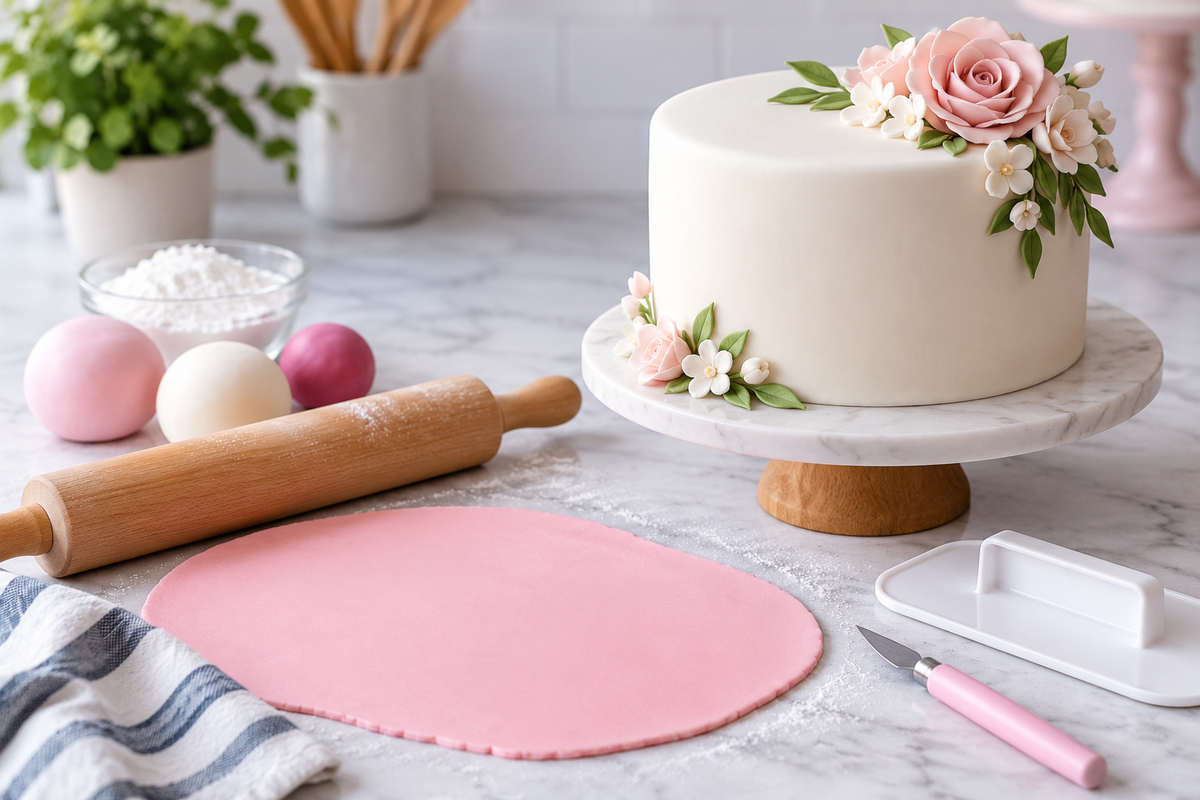
Fondant Guide for Beginners: Types, Rolling, Covering and Storage
There is a particular moment that trips up almost every baker the first time they reach for fondant. The cake is baked and levelled, the fondant is rolled out and looking promising, and then it goes over the cake and immediately tears, cracks or slides. It feels like the fondant is fighting you, when in truth it is usually a small and fixable thing, a slightly dry paste or a cake that was not quite ready. Fondant is far more forgiving once you understand how it behaves.
This guide takes you through fondant from the beginning, in the order you actually need it. You will learn what the different types are and when to use each, how much you need for a given cake, the handful of tools that make the job easier, and then the two skills that matter most, rolling it out evenly and covering a cake cleanly. It finishes with troubleshooting and storage, because knowing how to rescue a batch and keep your leftovers usable is what turns fondant from a stressful one time experiment into something you reach for confidently.
Quick answer: Fondant is a smooth, pliable sugar paste rolled into a thin sheet and draped over a cake for a flawless finish, or shaped into decorations and figures. For covering cakes you want rolled fondant, also sold as sugar paste, while firmer structure or modelling fondant is meant for figures that need to hold their shape. Roll it to about 3 to 4 mm on a surface lightly dusted with icing sugar or cornflour, lift it over a crumb coated cake, smooth from the top down, and trim the base. Store any leftover tightly wrapped in cling film inside an airtight box at room temperature, never in the fridge, and it will keep for months.
What fondant actually is
Fondant, in the sense most bakers mean it, is a dough like icing made mainly from sugar, with a little water, glucose or glycerine and a setting agent to give it stretch and structure. Rolled out thin it behaves a bit like edible fabric, soft enough to drape over curves and firm enough to hold a clean, matte surface once it settles. That smooth finish is the reason fondant became the standard for wedding cakes, themed birthday cakes and any design where buttercream alone cannot give a sharp, sculpted look.
In India you will also see fondant sold as sugar paste, and for covering cakes the two names describe the same thing. Ready to use tubs and packs have made it far easier for home bakers, since you no longer need to cook sugar and knead a batch from scratch to get a reliable result. You knead the ready made paste until it is soft, roll, and go.
The main types of fondant and when to use each
Not all fondant is meant for the same job, and picking the wrong type is one of the most common beginner mistakes. A paste built for covering a cake will slump if you try to sculpt a standing figure from it, and a firm modelling paste will crack if you stretch it over a large cake. The table below sorts out what each type is for, with the matching products from the Bakeyy fondant range.
| Type | Best for | How it behaves | Bakeyy option |
|---|---|---|---|
| Rolled fondant / sugar paste | Covering cakes and boards with a smooth finish | Soft and stretchy, drapes well, sets to a matte surface | Bake Haven Sugar Paste, Tropolite Fondant |
| Ready to use rolling fondant | Beginners and quick jobs, small cakes and toppers | Comes pre coloured and pre softened, minimal fuss | Sugarin Rolling Fondant, 225 g |
| Structure / modelling fondant | Figures, models and 3D decorations that must hold shape | Firmer, dries harder, holds fine detail | Sugarin Structure Fondant, 225 g |
| Coloured and metallic sugar paste | Deep shades and gold or silver accents without hand mixing | Pre coloured, saves kneading in gel for strong tones | Bake Haven Gold and Silver Sugar Paste |
For a first cake, a ready to use rolling fondant is the kindest place to start, because it removes two of the trickiest variables at once, softening the paste to the right consistency and getting an even colour. Once you are comfortable, moving to 1 kg sugar paste blocks in white and colouring your own becomes much more economical for larger or frequent bakes.

A quick word on price and portions
Fondant is one of the more affordable ways to lift a cake, which surprises people who assume the finish is expensive. As a reference from the current range, a 225 g pack of Sugarin ready to use fondant is around Rs 89, a versatile 1 kg block of Bake Haven sugar paste starts near Rs 150 with gold and silver from around Rs 280, and a 1 kg Tropolite fondant is about Rs 400. Since Bakeyy offers free shipping on orders above Rs 1,500, it is worth stocking a couple of colours and your tools together in one order.
How much fondant you need
Running short halfway through covering a cake is a frustration worth avoiding, because a join in a fresh sheet almost never blends invisibly. It is always better to roll a little extra than to stretch a piece that is too small. The quantities below are a safe starting point for covering a round, two layer cake along with a small allowance for the board, and you can scale up for taller tiers or square shapes, which need a bit more to reach the corners.
| Cake size | Fondant to roll | Good starting product |
|---|---|---|
| 6 inch round | 500 g | Two 225 g ready to use packs, or part of a 1 kg block |
| 7 inch round | 600 g | A 1 kg sugar paste block |
| 8 inch round | 750 g | A 1 kg sugar paste block |
| 9 inch round | 1000 g | A full 1 kg block, kept generous |
| 10 inch round | 1200 g | A 1 kg block plus a spare pack |
Square and tall cakes need roughly 15 to 20 percent more than the round figure for the same width, because the corners and extra height pull more paste. When in doubt, round up, since leftover fondant stores well and is never wasted.
Tools you need before you start
You do not need a large kit to get a clean result, but a few basics make the difference between fondant that behaves and fondant that fights you. Here is what is genuinely worth having within reach before you begin.
| Tool | Why it helps | Where to find it |
|---|---|---|
| Rolling pin and a clean, dry surface | An even roll is the foundation of an even finish | Baking tools |
| Icing sugar or cornflour for dusting | Stops the paste sticking without drying it out | Pantry staple |
| Fondant smoother or scraper | Presses out air and gives that sharp, flat surface | Scrapers and smoothers |
| Turntable | Lets you cover and trim evenly without leaning over the cake | Turntables |
| Modelling tool set | For shaping petals, figures and fine detail | Rolled Fondant Tool Set, around Rs 69 |
| Gel food colours | Tint white paste to any shade without making it sticky | Food colours |
| Cutters, moulds and stencils | Quick, repeatable decorations and textures | Cutters, moulds |
One tip on colouring, always use gel or paste food colours rather than liquid ones. Liquid colour adds water, which makes fondant sticky and hard to handle, while a small amount of gel gives a strong shade without changing the consistency. Knead it in a little at a time until the colour is even, and remember that fondant deepens slightly as it rests.
How to roll fondant evenly
Rolling is where most beginner problems are quietly created, long before the fondant reaches the cake. Paste that is unevenly rolled, too thin in places or too dry will tear during covering no matter how careful you are afterwards. Take your time here and the rest becomes much easier.
- Knead until soft and smooth. Work the fondant with clean hands until it is pliable and free of cracks. If it feels stiff, warmth from your hands will soften it, and a tiny smear of vegetable shortening helps a dry batch come back together.
- Dust your surface lightly. Scatter a little icing sugar or cornflour on the work surface so the paste does not stick. Use it sparingly, since too much dries the surface and encourages cracking.
- Roll from the centre outward. Turn the fondant a quarter after every few passes so it spreads evenly and does not stick underneath. Aim for a thickness of about 3 to 4 mm, thick enough to lift without tearing and thin enough to look neat.
- Check it is big enough. The sheet should cover the top of the cake plus the full height of both sides, with a little to spare all around. Measuring across the cake and adding twice its height gives you the diameter to roll to.
- Lift it with support. Drape the sheet over your rolling pin to move it, rather than picking it up by hand, which stretches and thins it in one spot.
How to cover a cake with fondant
With a well rolled sheet ready, covering is a calm and steady process rather than a race. The single most important preparation is the cake itself. A fondant finish is only as smooth as the surface underneath it, so a level, crumb coated cake with a thin, set layer of buttercream or ganache is essential. Lumps and crumbs will show straight through.

- Prepare the cake. Level the top, fill and stack the layers, then apply a thin crumb coat of buttercream or ganache and let it set until firm to the touch. A lightly tacky surface helps the fondant grip.
- Lift the fondant over. Using your rolling pin, drape the sheet over the cake so it is centred, with the overhang even on all sides.
- Smooth the top first. Using flat hands or a smoother, gently press the fondant onto the top of the cake, working from the centre outward to push out any trapped air.
- Work down the sides. Ease the fondant against the sides, lifting the skirt outward slightly as you go so it does not fold and pleat. Smooth as you work your way down.
- Trim the base. Once the sides are smooth, cut away the excess at the bottom with a sharp knife or a pizza wheel, leaving a clean edge where the cake meets the board.
- Finish the surface. Run the smoother over the whole cake once more for a flat, professional finish, then add your decorations, borders or figures.
Fixing common fondant problems
Every baker meets these issues, and the good news is that each has a clear cause and a simple fix. Keeping this table handy for your first few cakes will save a lot of guesswork.
| Problem | Why it happens | How to fix it |
|---|---|---|
| Cracking while rolling or covering | The paste is too dry or over dusted | Knead in a little shortening and warmth, and use less dusting sugar |
| Tearing over the edges | Rolled too thin, or lifted from one spot | Roll to 3 to 4 mm and always lift with the rolling pin |
| Air bubbles under the surface | Air trapped during smoothing | Prick gently with a fine pin and smooth the air out toward the hole |
| Elephant skin, a dry wrinkled look | The fondant dried out before smoothing | Work faster next time, and smooth with a touch of shortening on your palm |
| Fondant sliding or slumping | The crumb coat was too soft or too thick | Chill the cake until the coat is firm before covering |
| Sticky, hard to handle paste | Too much liquid colour or a humid room | Switch to gel colour and knead in a little icing sugar to firm it up |
| Colours fading or bleeding | Strong colours resting against light ones in humidity | Let coloured pieces dry before placing, and store finished cakes away from damp |
How to store fondant and fondant covered cakes
Storage is the part beginners most often get wrong, and it is worth learning properly because fondant keeps very well when treated right and spoils quickly when it is not. The golden rule is simple. Fondant hates air and it hates the fridge. Air dries it into a crumbly, unusable state, and the fridge introduces moisture and condensation that make the surface sticky and dull.
| Situation | How to store | Keeps for |
|---|---|---|
| Leftover fondant | Wrap tightly in cling film, then seal in an airtight box at room temperature | Several months |
| Coloured offcuts | Wrap each colour separately so shades do not transfer, then box together | Several months |
| Rolled but unused sheets | Cover with cling film to stop a skin forming, use the same day | Same day |
| Fondant covered cake, uncut | In a cool, dry place away from sunlight and damp, boxed but not sealed airtight | 2 to 3 days |
| Finished figures and toppers | Let them dry fully, then store in a box away from humidity | Weeks, if kept dry |
If your kitchen is very warm or humid, which much of India is for large parts of the year, keep fondant work away from open windows and running fans, and give coloured decorations extra drying time before they go onto a cake. Should stored fondant feel a little firm when you return to it, a short knead with the warmth of your hands usually brings it right back to a workable state.
Colouring, texture and finishing touches
Once covering feels comfortable, the fun of fondant is in the finishing, and this is where a small collection of extras pays off. Gel food colours let you mix any shade from a white base, lustre and petal dusts add a soft sheen or metallic glow to dried decorations, and silicone moulds and cutters turn plain paste into repeatable flowers, borders and shapes in seconds. A stencil pressed lightly onto fresh fondant adds pattern without any freehand skill at all.
None of this needs to happen at once. Start with a single covered cake in one colour, get the surface smooth, and add one type of decoration. Each cake teaches you something, and within a few attempts the whole process stops feeling delicate and starts feeling routine.
Frequently asked questions
What is the difference between fondant and sugar paste?
For covering cakes they are the same thing, and in India the two names are used interchangeably. The term sugar paste is simply more common on product labels, while fondant is the more familiar word for the finished technique.
What is the best fondant for beginners?
A ready to use rolling fondant that comes pre softened and pre coloured is the easiest starting point, because it removes the two trickiest steps for a first timer. The Sugarin ready to use rolling fondant is a good example. Once you are confident, 1 kg white sugar paste blocks that you colour yourself become more economical.
How thick should I roll fondant to cover a cake?
Aim for about 3 to 4 mm. Thinner than that and it tears over the edges, thicker and it looks heavy and can sag. An even thickness across the whole sheet matters more than the exact number.
Can I put a fondant covered cake in the fridge?
It is best avoided. The fridge introduces condensation that makes fondant sticky and dull, and can cause colours to bleed. Keep a fondant covered cake in a cool, dry place away from sunlight and humidity instead.
How long does fondant last once opened?
Wrapped tightly in cling film and sealed in an airtight box at room temperature, leftover fondant keeps for several months. Just knead it soft again before your next use.
Why does my fondant keep cracking?
Cracking almost always means the paste is too dry or has too much dusting sugar on it. Knead in a little vegetable shortening with the warmth of your hands, use less dusting sugar, and work a little faster so it does not dry out while you handle it.
Can I colour white fondant at home?
Yes, and it is the most economical way to get the shades you want. Use gel or paste food colours rather than liquid ones, knead a small amount in at a time until even, and let strong colours rest, since they deepen slightly as they settle.
Everything you need to start with fondant
From ready to use rolling fondant and 1 kg sugar paste blocks to smoothers, cutters, moulds and gel colours, the full fondant range is available at wholesale prices with free shipping on orders above Rs 1,500. Stock a couple of colours and your basic tools in one order and you are ready for your first covered cake. Browse the fondant and sugar paste collection and the gel food colours to get started.