

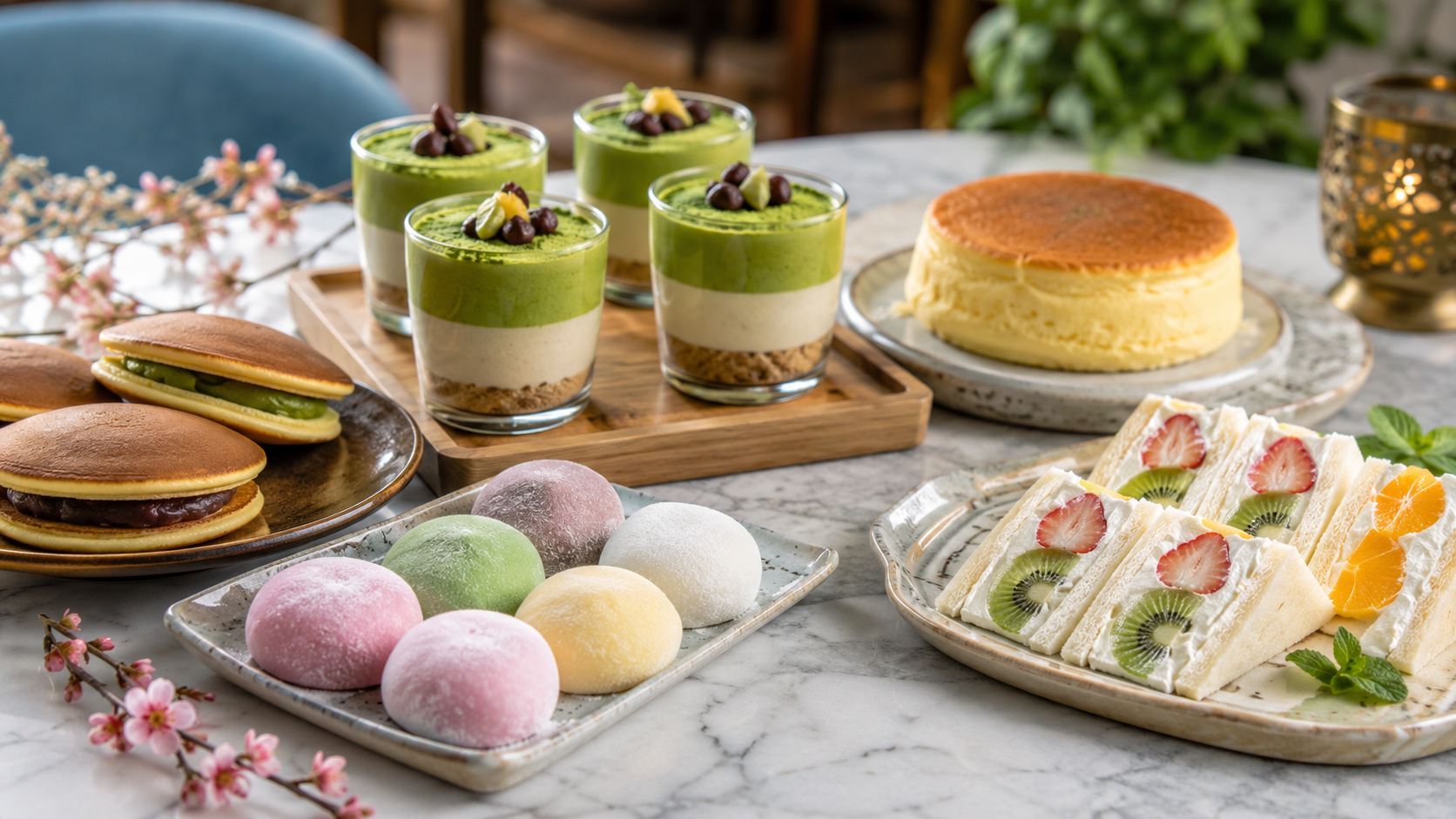
Japanese desserts are becoming increasingly visible across Indian cafés, home bakeries, cloud kitchens and social-media feeds. Matcha cakes, mochi, dorayaki, Japanese cheesecake, fruit sandos and minimalist dessert cups appeal to customers who want unfamiliar textures, refined flavours and visually distinctive presentation.
For Indian bakers, the opportunity is not limited to copying traditional Japanese sweets. The stronger commercial opportunity lies in understanding the original product, respecting its core texture and presentation, and then adapting it thoughtfully for Indian ingredients, climate, delivery conditions and customer preferences.
Matcha brings an earthy green-tea flavour and recognisable natural colour. Mochi offers a soft, chewy texture that differs completely from sponge cake. Dorayaki combines two fluffy pancake-like cakes with a sweet filling. Japanese cheesecake is known for its light, airy structure, while fruit sandos depend on neat fruit placement and clean cross-sections.
These products also require different packaging. Mochi needs protection from drying and sticking. Dorayaki needs a pouch or box that prevents crushing. Matcha desserts must be protected from strong light, odours and heat. Japanese cheesecake needs a supportive cake base and sufficient box height. Fruit sandos require refrigeration and a container that keeps the cut face visible without compressing the bread.
This detailed guide explains the main Japanese dessert categories, how Indian bakers can develop them, how to package them, how to calculate costs, how to set selling prices and which relevant products from Bakeyy.com can support production and presentation.
Quick answer: The best Japanese desserts for Indian home bakers to test are matcha cake cups, mango mochi, dorayaki, Japanese cheesecake, fruit sandos and mini matcha mousse cakes. Begin with two or three products, standardise portion sizes, use packaging that protects texture and clearly explain each dessert to customers unfamiliar with Japanese cuisine.
Why Japanese Desserts Are Growing in India in 2026
Japanese desserts combine novelty, strong visual identity, delicate presentation and distinctive textures. These qualities suit a dessert market increasingly influenced by short-form videos, café discovery, travel content, anime culture and premium international flavours.
Matcha has moved beyond tea and now appears in lattes, cookies, cheesecakes, tiramisu, mousse, brownies and soft-serve desserts. Its green colour is immediately recognisable, while the slight bitterness can balance white chocolate, cream, mango, strawberry and red-bean flavours.
Mochi attracts customers because its chewy outer layer is different from familiar Indian bakery textures. Mango mochi, strawberry mochi and ice-cream mochi are especially suitable for Indian flavour adaptation.
Dorayaki is commercially useful because it looks approachable. Customers can understand it as a soft filled pancake sandwich even when they have never tried Japanese desserts before.
Japanese cheesecake provides another entry point because customers already know cheesecake, yet the light and jiggly Japanese-style version offers a different eating experience.
Fruit sandos are driven by visual precision. The dessert looks simple from the outside, but the clean fruit pattern revealed after slicing gives it strong social-media value.
Indian bakers should avoid treating every green dessert as authentic matcha and every chewy dessert as traditional mochi. Clear descriptions build trust and help customers understand whether the product is traditional, inspired or adapted.
Most Popular Japanese Desserts for Indian Bakeries
| Dessert | Core texture | Best Indian adaptation | Packaging need |
|---|---|---|---|
| Matcha cake cup | Soft, creamy and slightly earthy | Matcha mango, strawberry or white chocolate | Clear lidded dessert cup |
| Mochi | Soft, stretchy and chewy | Mango, coconut, chocolate or strawberry | Shallow box with separators |
| Dorayaki | Fluffy pancake and smooth filling | Chocolate, mango, strawberry or red-bean-inspired | Pouch or compact pastry box |
| Japanese cheesecake | Light, airy and soufflé-like | Classic, matcha or mango | Cake base and supportive box |
| Fruit sando | Soft bread, cream and fresh fruit | Mango, strawberry, kiwi or mixed fruit | Clear rectangular container |
| Matcha mousse | Light, creamy and chilled | White chocolate, mango or strawberry | Transparent cup or dome box |
Traditional Japanese Desserts vs Japanese-Inspired Desserts
A traditional dessert follows the original ingredient, technique and cultural context closely. A Japanese-inspired dessert borrows flavours, textures or presentation while adapting the recipe.
For example, traditional mochi is made using glutinous rice. A rice-paper mango dessert may be described as mochi-inspired but should not be presented as identical to traditional mochi.
A classic dorayaki commonly uses a sweet red-bean filling. A chocolate-hazelnut dorayaki is an adapted version.
A traditional Japanese soufflé cheesecake differs from the viral yogurt-and-biscuit dessert sometimes called Japanese cheesecake online. The shortcut version may be useful for social-media menus, but the description should clarify that it is a no-bake, Japanese-inspired cheesecake cup.
This distinction does not reduce commercial value. Honest naming helps customers understand what they are buying and protects the bakery from disappointing people who expect a traditional product.
What Is Matcha?
Matcha is finely ground green-tea powder traditionally associated with Japanese tea culture. It has an earthy, grassy, slightly bitter flavour and a strong green colour.
In desserts, matcha works best when its bitterness is balanced rather than hidden completely. White chocolate, milk, cream, vanilla, mango, strawberry, coconut and sesame can complement it.
Low-quality green powder can create a dull colour and harsh taste. Bakers should source matcha from a reliable food-grade supplier and test the flavour before adding it to a commercial recipe.
Do not replace matcha with ordinary green food colour and describe the dessert as matcha. Colour can support presentation, but the defining ingredient is genuine matcha powder.
Matcha Dessert Ideas for Indian Bakers
| Product | Flavour pairing | Recommended format | Commercial difficulty |
|---|---|---|---|
| Matcha mousse cup | White chocolate | 90–150 ml clear cup | Easy to moderate |
| Matcha tiramisu | Vanilla and mascarpone-style cream | Layered dessert container | Moderate |
| Matcha mango cup | Mango fruit filling | Clear square cup | Easy |
| Matcha mini cake | Strawberry or white chocolate | Mini dome cake box | Moderate |
| Matcha cheesecake | Blueberry or strawberry | Slice box or small cake box | Moderate |
Basic Matcha White-Chocolate Mousse Cup Recipe
This is a Japanese-inspired commercial dessert cup, not a traditional wagashi recipe. It can be used as a starting point for approximately eight small portions.
| Ingredient | Illustrative quantity |
|---|---|
| White chocolate or white compound | 200 g |
| Whipping cream | 400 ml |
| Food-grade matcha | 8–12 g, adjusted after testing |
| Warm milk | 40 ml |
| Vanilla | Small quantity |
| Optional fruit filling | 80–120 g |
Step 1: Sift the matcha so no dry lumps remain.
Step 2: Whisk the powder into warm milk until smooth.
Step 3: Melt the white chocolate gently.
Step 4: Add part of the cream to the chocolate and combine.
Step 5: Mix in the matcha liquid.
Step 6: Whip the remaining cream to a soft-medium consistency.
Step 7: Fold the whipped cream into the matcha mixture.
Step 8: Pipe the mousse into clear cups and chill until set.
Step 9: Add a controlled mango, strawberry or blueberry layer where required.
Step 10: Close the lid only after the product is fully chilled.
White Chocolate for Matcha Desserts
Bakeyy’s 2M White Compound Royal, 500 g was listed at ₹200 when the catalogue was checked.
White compound can support matcha mousse, ganache, coated cookies and decorative elements. Because it is sweet, begin with a controlled quantity so it does not overpower the tea flavour.

Fruit Pairings for Matcha Desserts
Fruit can make matcha more approachable to first-time Indian customers. Use small quantities so the fruit does not completely dominate the tea flavour.
Bakeyy’s Mala’s Mango Fruit Filling was listed at ₹400 for 1 kg and can be used for matcha-mango mousse cups, mini cakes or cheesecake layers.

Other live Bakeyy fruit fillings included strawberry at ₹400, blueberry at ₹470, cherry at ₹470, orange at ₹400 and pineapple at ₹370 per kilogram.
Use these products as controlled bakery fillings, not as a substitute for fresh fruit where the recipe specifically requires fresh texture.
What Is Mochi?
Mochi is a Japanese rice-based food known for its soft, sticky and chewy texture. Dessert versions may be filled with sweet bean paste, fruit, cream, chocolate or ice cream.
The outer dough must remain flexible without becoming wet, gummy or excessively floury. Traditional preparation requires the correct type of glutinous rice or glutinous-rice flour.
Ordinary rice flour does not automatically produce the same texture. Bakers should confirm that the flour is suitable for mochi before developing the recipe.
Mochi must also be portioned thoughtfully. Its chewiness is part of its appeal, but customers should receive clear handling and serving instructions, especially when selling larger pieces.
Mochi Flavour Ideas for India
| Flavour | Filling | Target customer |
|---|---|---|
| Mango cream mochi | Mango filling and cream | Summer and first-time buyers |
| Strawberry mochi | Fresh strawberry or fruit filling | Premium and gifting |
| Chocolate mochi | Ganache or chocolate cream | Mainstream chocolate buyers |
| Matcha white-chocolate mochi | Matcha cream and white chocolate | Japanese-dessert enthusiasts |
| Coconut-jaggery mochi | Coconut and jaggery | Indian fusion menu |
| Gulab-jamun-inspired mochi | Reduced milk filling with cardamom | Festive experimental menu |
Basic Mochi Production Method
The exact recipe depends on the selected glutinous-rice flour, filling and cooking method. A commercial test should focus on texture after cooking, filling, chilling and packaging.
Step 1: Mix glutinous-rice flour with water or milk and sugar according to the tested formula.
Step 2: Cook the mixture until it becomes translucent, sticky and elastic.
Step 3: Dust the work surface with a suitable starch to reduce sticking.
Step 4: Divide the dough while it remains workable.
Step 5: Flatten each portion evenly.
Step 6: Add a measured filling in the centre.
Step 7: Seal carefully without trapping excessive air.
Step 8: Remove excess starch.
Step 9: Place each piece in a liner or separated cavity.
Step 10: Store according to the filling and tested product life.
Best Packaging for Mochi
Mochi packaging must prevent sticking, flattening and moisture loss.
Do not stack soft mochi directly on top of each other. Use small liners, cavities or separators.
A shallow transparent box works well because customers can see the colours and arrangement. Leave enough room so the lid does not press down on the pieces.
For a six-piece assortment, consider a compact rectangular PET dessert box. Bakeyy’s Rectangular PET Dessert and Cake Box with Clear Lid is available with gold or black bases.
The smaller 8 × 7 × 13.5 cm pack-of-25 option was listed at ₹345, approximately ₹13.80 per box. The larger 10 × 6 × 18 cm option was listed at ₹438, approximately ₹17.52 per box.

Measure the actual internal dimensions and add liners before confirming how many mochi pieces fit safely.
What Is Dorayaki?
Dorayaki is a Japanese sweet made with two small, soft, pancake-like cakes surrounding a filling. The classic filling is commonly sweet red-bean paste, but commercial adaptations may use chocolate, fruit, custard, cream or nut spreads.
A good dorayaki should have:
Even, round cakes.
A smooth golden-brown surface.
A soft and flexible crumb.
A filling that does not leak heavily.
Two halves that align neatly.
The product is suitable for home bakers because it does not require cake decoration. However, consistency in diameter, browning and filling weight is essential.
Basic Dorayaki Recipe for Testing
| Ingredient | Illustrative quantity |
|---|---|
| Eggs | 2 |
| Sugar | 80 g |
| Honey | 1 tablespoon |
| Maida | 120 g |
| Baking powder | ½ teaspoon |
| Water or milk | As required for batter consistency |
| Filling | Measured according to portion size |
Step 1: Whisk the eggs, sugar and honey until combined.
Step 2: Add sifted flour and baking powder.
Step 3: Adjust with a small quantity of water or milk.
Step 4: Rest the batter briefly.
Step 5: Cook measured portions on a lightly greased flat pan.
Step 6: Turn once bubbles appear and the first side is evenly coloured.
Step 7: Cool under protection so the cakes do not dry.
Step 8: Pair cakes of equal diameter.
Step 9: Add a measured filling and press gently.
Step 10: Wrap or box promptly.
Dorayaki Flavours for the Indian Market
Classic red-bean dorayaki: Best for customers seeking a recognisable Japanese flavour.
Chocolate dorayaki: The easiest mainstream entry product.
Matcha white-chocolate dorayaki: Suitable for premium Japanese dessert menus.
Mango-cream dorayaki: Familiar, seasonal and approachable.
Strawberry dorayaki: Useful for Valentine’s Day and gifting.
Rasmalai dorayaki: A fusion version using cardamom and saffron cream.
Pistachio dorayaki: Suitable for premium positioning.
How to Package Dorayaki
Dorayaki should remain soft without becoming wet or crushed.
For single pieces, use a food-safe pouch or small pastry container. For premium assortments, arrange four to six pieces in a shallow box.
A clear-lid rectangular box allows customers to see the even shape and branded sticker.
Do not place heavy products above dorayaki during delivery. The soft cakes can flatten easily.
If using a fresh dairy filling, maintain refrigeration and reduce the delivery radius.
What Is Japanese Cheesecake?
Traditional Japanese cheesecake is lighter and airier than dense New York-style cheesecake. It combines cheesecake richness with a soufflé-like texture.
The batter often includes whipped egg whites and is baked gently, commonly with controlled moisture. The structure is delicate and can shrink, crack or collapse when the mixing and cooling process is inconsistent.
A separate viral 2026 dessert also became known online as Japanese cheesecake. This shortcut version places biscuits inside thick yogurt and refrigerates them until they soften. It is easy and commercially interesting, but it should be described as a no-bake Japanese-inspired yogurt cheesecake rather than a replacement for traditional soufflé cheesecake.
Japanese Cheesecake Formats to Sell
| Format | Best packaging | Best sales use |
|---|---|---|
| Whole 5-inch soufflé cheesecake | Cake base and 7-inch box | Small celebrations |
| Mini cheesecake | Clear dome mini cake box | Premium individual order |
| Cheesecake slice | PET pastry container | Café and delivery menu |
| No-bake yogurt cup | Clear lidded dessert cup | Viral menu and breakfast dessert |
Mini Japanese Cheesecake Packaging
Bakeyy’s Square Mini Cake Box with Dome Lid and Fork was listed at ₹1,505 for 50, approximately ₹30.10 per box.
It can be considered for mini Japanese cheesecake, matcha mousse cake or other premium single-serve products.

Measure the final cake diameter and height before selecting the packaging. The dome should not touch the cake surface.
Cake Boxes for Whole Japanese Cheesecake
Bakeyy’s White Cake Box with Square Top Window is available in sizes including 4 × 4 × 3 inch, 5 × 5 × 3 inch, 6 × 6 × 4 inch and larger options.
The 6 × 6 × 4-inch pack-of-25 variant was listed at ₹500, approximately ₹20 per box.

Use a cake board slightly larger than the cheesecake and avoid excessive empty space inside the box.
What Is a Japanese Fruit Sando?
A fruit sando is a Japanese-style sandwich made with very soft bread, whipped cream and carefully arranged fresh fruit.
The visual attraction comes from the cut cross-section. Strawberries, kiwi, mango, grapes or oranges are positioned so that the sliced sandwich reveals a deliberate pattern.
The product requires:
Very soft bread.
Stable but light cream.
Dry, chilled fruit.
Accurate fruit placement.
Firm wrapping before slicing.
Cold storage.
Fruit sandos are highly perishable and should be prepared close to service.
How to Make a Fruit Sando
Step 1: Select evenly sliced soft bread.
Step 2: Wash and dry the fruit completely.
Step 3: Remove stems or peel where necessary.
Step 4: Spread a controlled layer of cream.
Step 5: Place the fruit according to the planned cutting line.
Step 6: Fill gaps with cream.
Step 7: Place the second bread slice and press very gently.
Step 8: Wrap firmly and mark the planned cutting direction.
Step 9: Chill before slicing.
Step 10: Cut with a clean sharp knife and pack immediately.
Best Packaging for Fruit Sandos
A clear rectangular container is ideal because it shows the cross-section and prevents the soft bread from being crushed.
Bakeyy’s 250 ml Disposable Rectangular Dessert Container was listed at ₹650 for 50, approximately ₹13 per set.

Test the internal dimensions using the actual sandwich. The lid should not press heavily on the bread or cream.
Dessert Cups for Japanese-Inspired Products
Clear cups are useful for matcha mousse, no-bake yogurt cheesecake, panna cotta, layered matcha cake and tasting portions.
Bakeyy’s 60 ml and 90 ml Transparent Dessert Cups with Lids were listed at ₹325 and ₹480 per 100 respectively.
This equals approximately ₹3.25 for the 60 ml size and ₹4.80 for the 90 ml size.

The 60 ml size can suit samplers, event portions and tasting menus. The 90 ml size can support a small premium dessert cup.
Bakeyy’s D-67 Clear Square Dessert Cup, 50 ml was listed at ₹500 for 135, approximately ₹3.70 per cup.

Serving Spoons for Mousse and Cheesecake Cups
Bakeyy’s Premium Dessert Spoon is available in transparent, black and matte-gold options.
The live listed price was ₹260 for 100, approximately ₹2.60 per spoon.

Include the spoon cost when calculating individual dessert pricing.
Piping Tools for Japanese Dessert Cups
Clean piping improves the appearance of mousse cups, cheesecake cups, fruit sandos and mini cakes.
Bakeyy’s 19-Inch Disposable Piping Bag Roll was listed at ₹440 for approximately 95–100 bags.

Japanese Dessert Portion and Packaging Guide
| Dessert | Suggested portion | Recommended package | Storage need |
|---|---|---|---|
| Matcha mousse | 60–150 ml | Clear lidded cup | Refrigerated |
| Mochi | 25–45 g per piece | Shallow box with liners | Depends on filling |
| Dorayaki | 60–100 g | Pouch or compact box | Depends on filling |
| Mini Japanese cheesecake | 150–300 g | Dome mini cake box | Refrigerated |
| Fruit sando | One sandwich | Clear rectangular box | Strict refrigeration |
Packaging Cost Comparison
| Bakeyy packaging product | Pack price | Approximate unit cost | Suggested use |
|---|---|---|---|
| 60 ml transparent cup | ₹325 per 100 | ₹3.25 | Matcha sampler |
| 90 ml transparent cup | ₹480 per 100 | ₹4.80 | Mousse or yogurt cheesecake |
| D-67 square cup | ₹500 per 135 | ₹3.70 | Tasting portions |
| Rectangular dessert box, small | ₹345 per 25 | ₹13.80 | Mochi or dorayaki assortment |
| 250 ml rectangular container | ₹650 per 50 | ₹13 | Fruit sando or cake slice |
| Square mini cake dome box | ₹1,505 per 50 | ₹30.10 | Mini Japanese cheesecake |
How to Calculate Japanese Dessert Costs
Japanese-inspired desserts often carry higher ingredient and labour costs than familiar bakery products. Matcha, fresh fruit, cream cheese, glutinous-rice flour and premium packaging can increase the final portion cost.
Use this formula:
Total batch cost = ingredients + filling + packaging + labour + utilities + wastage + delivery preparation.
Cost per piece = total batch cost ÷ saleable yield.
Do not calculate from theoretical yield alone. Record how many products are actually sellable after trimming, breakage, uneven cooking and assembly.
Illustrative Costing for Japanese Dessert Products
| Product | Illustrative production cost | Illustrative direct selling price |
|---|---|---|
| 60 ml matcha mousse sampler | ₹38 | ₹99 |
| 90 ml matcha mango cup | ₹58 | ₹159 |
| Single filled mochi | ₹32 | ₹89 |
| Box of six mochi | ₹215 | ₹549–₹649 |
| Single premium dorayaki | ₹42 | ₹119 |
| Fruit sando | ₹95 | ₹249–₹299 |
| Mini Japanese cheesecake | ₹145 | ₹399 |
These prices are illustrative only. Replace them with actual ingredient, labour, packaging, GST, platform and delivery costs.
Illustrative Production Cost Chart
| Single mochi |
₹32
|
| Matcha sampler |
₹38
|
| Dorayaki |
₹42
|
| Matcha mango cup |
₹58
|
| Fruit sando |
₹95
|
| Mini cheesecake |
₹145
|
How Much Should Indian Bakers Charge?
Japanese desserts should be priced according to the complete cost and required margin rather than treated as ordinary cupcakes or cookies.
Customers are paying for unfamiliar ingredients, precise preparation, controlled portioning, specialist textures, refrigeration and premium packaging.
Use three price levels:
Entry: Dorayaki, mini mousse cups and tasting portions.
Core: Matcha cake cups, fruit sandos and assorted mochi.
Premium: Mini Japanese cheesecake, premium matcha, fresh-strawberry mochi and gift assortments.
Charge separately for customised colours, fresh imported fruit, premium matcha, gift wrapping and long-distance cold delivery.
Sample Japanese Dessert Menu for an Indian Home Bakery
| Menu item | Description | Illustrative price |
|---|---|---|
| Matcha Mango Mousse | Matcha white-chocolate mousse with mango filling | ₹159 |
| Mango Cream Mochi | Chewy rice dough with mango cream | ₹89 |
| Chocolate Dorayaki | Soft pancake sandwich with chocolate filling | ₹119 |
| Strawberry Fruit Sando | Soft bread, cream and strawberry cross-section | ₹279 |
| Mini Matcha Cheesecake | Light Japanese-style cheesecake with matcha | ₹399 |
How to Launch a Japanese Dessert Menu
Start with three products rather than launching an oversized menu.
A practical first menu could include:
One matcha cup.
One mochi assortment.
One dorayaki flavour.
These products cover creamy, chewy and cake-like textures without requiring five unrelated production systems.
Run the launch as a limited weekend menu or preorder drop. This allows you to measure demand before investing heavily in specialist ingredients.
Use tasting boxes for customer education. A box may contain one mini matcha mousse, two mochi and one dorayaki.
Include a flavour card explaining each dessert. Customers may not know what anko, matcha or mochi means.
How to Market Japanese Desserts
Show texture, preparation and cross-sections.
For matcha, show the powder being sifted and the green mousse being piped.
For mochi, show the stretch and the filled centre.
For dorayaki, show the smooth pancake surface and filling.
For Japanese cheesecake, show the soft movement and light crumb.
For fruit sandos, show the sandwich before and after slicing.
Do not rely only on Japanese words. Include a clear English explanation in every product title.
Example:
Mango Cream Mochi – Soft Chewy Rice Dessert with Mango Filling.
Delivery and Cold-Chain Guidance
Japanese dessert delivery depends on the product rather than the cuisine category.
Fruit sandos, cream-filled mochi, mousse and cheesecake require reliable refrigeration.
Dorayaki with a shelf-stable filling may be easier to deliver, but shelf life still needs testing.
Use insulated transport for chilled desserts.
Keep products upright.
Separate ice packs from direct food contact.
Avoid long waiting times.
Ask customers to refrigerate products immediately.
Do not promise pan-India courier delivery for delicate fresh desserts unless the complete process has been professionally validated.
Common Japanese Dessert Business Mistakes
Using ordinary green colour instead of matcha: The product looks green but lacks matcha flavour.
Calling every rice-paper dessert mochi: The texture and ingredients differ from traditional mochi.
Using too much matcha: The dessert becomes harsh and excessively bitter.
Using too little matcha: White chocolate or cream completely hides the flavour.
Packaging mochi without separators: Pieces stick together and deform.
Overfilling dorayaki: Filling escapes and creates messy packaging.
Using wet fruit in sandos: Bread and cream become watery.
Slicing fruit sandos before chilling: The pattern moves and the cut looks untidy.
Using a tight cheesecake box: The soft surface touches the lid.
Launching too many unfamiliar products: Ingredients and labour become difficult to control.
Frequently Asked Questions About Japanese Desserts in India
Which Japanese dessert is easiest for a home baker? Dorayaki and matcha mousse cups are usually easier starting points than traditional mochi or soufflé cheesecake.
Is matcha the same as green-tea flavour? Matcha is a specific powdered green tea. Ordinary green-tea essence or green food colour does not create the same result.
Can I use normal rice flour for mochi? Traditional mochi texture requires the correct glutinous rice or glutinous-rice flour. Confirm the flour type before using it.
What is the best packaging for mochi? Use a shallow box with liners or separators so the pieces do not stick or flatten.
Can dorayaki be sold without refrigeration? It depends on the filling and tested shelf life. Fresh cream and dairy fillings require refrigeration.
What is the best fruit for fruit sandos? Firm strawberries, mango, kiwi, grapes and oranges can work when clean and thoroughly dried.
What cup size is suitable for matcha mousse? A 60–90 ml cup works for tasting or small portions, while 120–150 ml suits a more substantial dessert.
Can matcha mousse be frozen? Freezing may alter texture and colour. Test the complete recipe before offering frozen storage instructions.
Is Japanese cheesecake the same as normal cheesecake? Traditional Japanese cheesecake is lighter and more soufflé-like than dense New York cheesecake.
What is the viral two-ingredient Japanese cheesecake? It is a shortcut dessert made by placing biscuits inside thick yogurt and chilling them until soft. It is different from traditional baked Japanese cheesecake.
How much should I charge for mochi? Calculate flour, filling, labour, packaging, wastage and cold storage. Premium fresh-fruit or matcha mochi should be priced higher than basic flavours.
Can Japanese desserts be customised for Indian festivals? Yes. Mango, coconut, jaggery, saffron, cardamom and pistachio can be used thoughtfully in Japanese-inspired versions.
Where can I buy Japanese dessert packaging in India? Bakeyy supplies clear dessert cups, mini cake boxes, rectangular PET boxes, cake packaging, piping bags, fruit fillings, white compound and serving spoons suitable for Japanese-inspired bakery menus.
Relevant Bakeyy Collections
Explore Dessert Cups for matcha mousse, panna cotta and tasting portions.
Browse Dessert Containers with Lids for chilled Japanese-inspired desserts.
Use Acrylic Dessert Cups for premium event presentation.
Browse Pastry Containers for fruit sandos, cheesecake slices and dorayaki.
Explore Cake Boxes for Japanese cheesecake and mini celebration cakes.
Shop Cake Moulds for mini cheesecakes and matcha cakes.
Browse Fillings and Toppings for mango, strawberry, blueberry and other adapted flavours.
Explore Compounds and Couverture for white-chocolate and chocolate Japanese-inspired desserts.
Use Piping Bags for mousse, cream and clean layered presentation.
Browse Disposables for spoons and takeaway serving accessories.
Japanese Dessert Launch Checklist
Ingredient: Genuine matcha and correct glutinous-rice flour have been sourced.
Recipe: Texture remains acceptable after storage and delivery.
Portion: Every product has a fixed finished weight.
Packaging: The container protects the product without compression.
Cold chain: Cream, fruit and cheesecake products remain chilled.
Description: Traditional and inspired products are clearly distinguished.
Costing: Specialist ingredients and labour are included.
Menu: The launch contains only two or three manageable products.
Education: Customers receive simple flavour and texture explanations.
Content: Photography and video show the defining texture of each product.
Build a Japanese Dessert Menu That Works in India
Japanese desserts can give Indian bakeries a new premium category when they are introduced with technical care and clear customer education.
Matcha works well in mousse, cake, cheesecake and tiramisu-style cups. Mochi offers a unique chewy texture but requires the correct flour and careful packaging. Dorayaki provides an approachable entry product. Japanese cheesecake creates a premium celebration option, while fruit sandos offer strong visual appeal for seasonal café menus.
Begin with manageable portions, use accurate names, balance unfamiliar flavours with approachable pairings and select packaging based on texture rather than appearance alone.
Bakeyy’s dessert cups, PET boxes, mini cake packaging, fruit fillings, white compound, cake boxes, piping bags and serving accessories can support the production and presentation side of a Japanese-inspired dessert menu.
Explore Dessert Cups, Dessert Containers with Lids, Pastry Containers, Cake Boxes, Fillings and Toppings, Compounds and Couverture and Disposable Serving Supplies to begin testing and packaging a professional Japanese dessert range.
Product information, prices, variants and availability mentioned in this article were collected from Bakeyy’s connected Shopify catalogue on July 21, 2026. Prices and inventory may change. Verify the current product page before calculating costs. Ingredient and selling-price examples are illustrative. Test all recipes, storage conditions and packaging before commercial sale.