

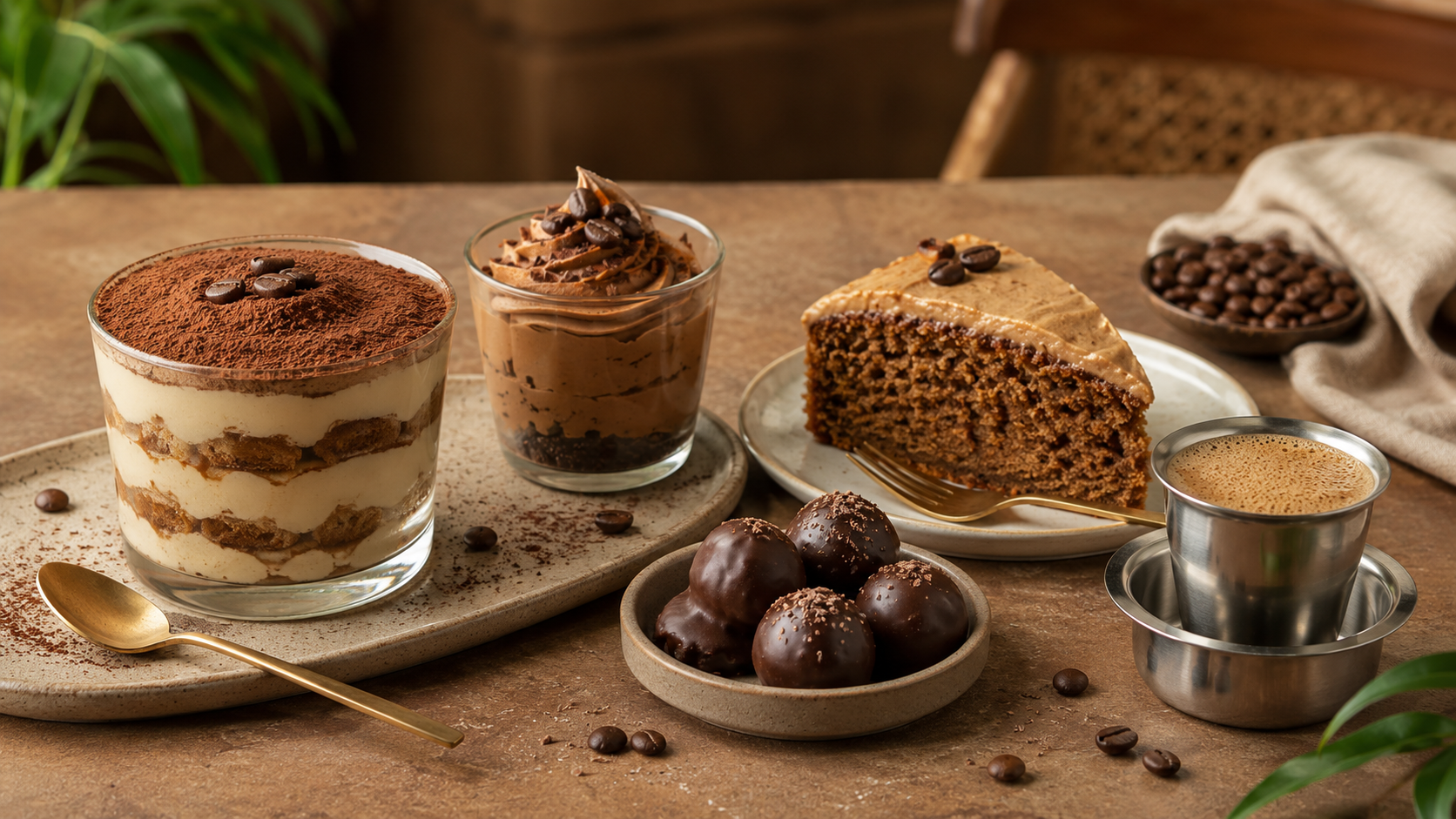
Filter coffee desserts are becoming one of the most exciting Indian-fusion opportunities for home bakers, cafés, cloud kitchens and chocolate businesses in 2026. The strong aroma of South Indian filter coffee, the roasted bitterness of coffee and chicory, and the familiarity of milk and sugar make it suitable for cakes, mousse cups, tiramisu, tres leches, chocolate truffles, brownies, tea cakes, cheesecakes and frozen desserts.
Filter coffee has traditionally been enjoyed as a hot beverage prepared using a metal coffee filter. A concentrated coffee decoction is mixed with hot milk and sugar before being poured between a tumbler and davara to create froth. Modern dessert businesses are now using the same flavour profile in cold and baked formats.
The opportunity is especially relevant for Indian bakers because filter coffee is already culturally familiar. Customers do not need to understand a completely foreign flavour. The innovation comes from changing the format: a traditional beverage becomes a layered tiramisu cup, chocolate mousse, milk-soaked cake, truffle, brownie or premium café dessert.
However, adding ordinary instant coffee to a cake does not automatically create an authentic filter coffee dessert. The product should retain the deeper roasted flavour and gentle chicory character associated with South Indian kaapi. Bakers must control the strength of the decoction, moisture in the recipe, sweetness, chocolate percentage, portion size and storage.
Packaging also changes by format. Tiramisu and mousse require clear cups with lids. Tres leches needs a leak-resistant container. Tea cakes require boxes that prevent drying. Chocolate truffles need cavity boxes or protective trays. Mini mousse cakes need dome packaging, while warm brownie-and-soft-serve combinations need separate hot and cold components.
This guide explains how to prepare filter coffee concentrate for desserts, which recipes work best, how to balance coffee with chocolate and caramel, how to package each product, how to calculate costs, how to set selling prices and which relevant products from Bakeyy.com can support your menu.
Quick answer: The easiest filter coffee desserts to sell are tiramisu cups, chocolate-coffee mousse, coffee tres leches, tea cake and chocolate truffles. Prepare a strong but balanced decoction, measure it accurately, keep chilled desserts refrigerated and select packaging according to moisture, portion size and delivery distance.
What Is South Indian Filter Coffee?
South Indian filter coffee is made by slowly brewing ground coffee in a traditional metal filter to produce a concentrated decoction. The decoction is commonly mixed with hot milk and sugar or jaggery.
Many commercial filter coffee blends contain robusta and chicory. Robusta provides intensity and body, while chicory contributes bitterness, depth and a recognisable roasted profile.
The decoction is stronger than a normal cup of prepared coffee because it is intended to be diluted with milk. This makes it useful for desserts, provided the baker understands that adding too much liquid can weaken the structure of a sponge, mousse, ganache or cream.
For dessert production, the goal is not simply to make drinking coffee and pour it into a recipe. Instead, prepare a concentrated decoction and add it in a measured quantity.
Why Filter Coffee Desserts Are Trending in 2026
Filter coffee desserts combine nostalgia with modern café presentation. Customers recognise the flavour, but experience it through a new texture or format.
A filter coffee soft serve can remind a customer of a traditional cup of kaapi while still feeling like a contemporary dessert. A tiramisu cup connects South Indian coffee with a globally familiar Italian dessert. A filter coffee chocolate truffle turns an everyday beverage into a premium gifting product.
The trend is commercially useful because it can serve several customer groups:
Traditional coffee drinkers: Customers who already appreciate strong filter coffee.
Younger café customers: Buyers looking for visually interesting, shareable desserts.
Home-bakery customers: People ordering individual dessert cups or celebration cakes.
Corporate buyers: Businesses seeking regionally relevant gifts.
Wedding and event customers: Clients interested in live coffee bars and fusion dessert counters.
Chocolate customers: Buyers looking for coffee-flavoured bonbons, bars and truffles.
The same coffee concentrate can be used across multiple products, which helps create a focused menu without maintaining many unrelated ingredients.
Filter Coffee vs Instant Coffee vs Espresso in Desserts
| Coffee format | Flavour | Main advantage | Main risk |
|---|---|---|---|
| Filter coffee decoction | Roasted, intense and potentially chicory-forward | Strong cultural identity and authentic kaapi profile | Adds moisture and can vary by batch |
| Instant coffee | Direct and easy to control | Convenient and consistent | May lack the depth expected from filter coffee |
| Espresso | Concentrated and aromatic | Excellent for classic tiramisu and café desserts | Different flavour identity from South Indian kaapi |
| Coffee essence | Highly concentrated flavouring | Adds limited liquid | Can taste artificial when overused |
For a product marketed specifically as a filter coffee dessert, use real decoction as the main flavour foundation. A small quantity of coffee essence or instant coffee may support consistency after testing, but it should not replace the character of the decoction completely.
How to Prepare Filter Coffee Decoction for Desserts
The ideal dessert decoction should be concentrated, aromatic and cooled completely before use.
Use your preferred commercial or household filter coffee blend and record the exact coffee-to-water ratio. Consistency matters because a stronger or weaker decoction can change both flavour and recipe moisture.
A practical testing method is:
Step 1: Add the measured coffee powder to the upper chamber of a clean metal filter.
Step 2: Press lightly with the filter disc. Do not compress so aggressively that water cannot pass.
Step 3: Add hot water in a measured quantity.
Step 4: Cover and allow the decoction to collect in the lower chamber.
Step 5: Transfer it to a clean container.
Step 6: Cool quickly and refrigerate when it is not being used immediately.
Step 7: Label the batch with the preparation date and time.
Step 8: Weigh the decoction used in every recipe rather than measuring by an unstandardised spoon.
Do not add milk or sugar to the master decoction unless the specific recipe requires it. Keeping the concentrate unsweetened gives better control over the final dessert.
Filter Coffee Strength Guide for Desserts
| Dessert | Coffee role | Recommended flavour intensity | Important control |
|---|---|---|---|
| Tiramisu | Soaking liquid | Strong | Do not oversoak the sponge |
| Mousse | Flavour in cream or ganache | Medium to strong | Limit extra liquid |
| Tres leches | Part of the milk soak | Medium | Balance milk, sugar and coffee |
| Tea cake | Part of the batter | Medium | Adjust other liquids |
| Chocolate truffle | Ganache flavour | Strong | Preserve ganache consistency |
| Buttercream | Flavouring | Strong concentrate in small quantity | Avoid splitting or softness |
Best Flavour Pairings with Filter Coffee
Filter coffee works best with flavours that support its roast, bitterness and milk-friendly character.
Dark chocolate: Creates an intense adult flavour suitable for mousse, brownies and truffles.
Milk chocolate: Produces a sweeter and more approachable dessert.
White chocolate: Adds sweetness and body to mousse and ganache, but can hide the coffee when used excessively.
Hazelnut: Complements roasted coffee and works well in cake cups and chocolate centres.
Caramel: Balances bitterness and supports café-style menu positioning.
Jaggery: Adds an Indian flavour identity and warm sweetness.
Coconut: Creates a South Indian-inspired pairing for tea cakes and desserts.
Cardamom: Adds familiarity but should be used carefully so the dessert does not taste like a generic spiced cake.
Orange: Works with dark chocolate and coffee in premium chocolate desserts.
Almond and cashew: Provide crunch and a traditional café-snack connection.
Best Filter Coffee Dessert Ideas for Indian Bakers
| Product | Main components | Best customer | Packaging |
|---|---|---|---|
| Filter coffee tiramisu | Coffee-soaked sponge, cream and cocoa | Café and premium home-bakery customer | Clear cup or rectangular container |
| Kaapi chocolate mousse | Dark chocolate, cream and decoction | Chocolate lovers | 100–200 ml dessert cup |
| Filter coffee tres leches | Sponge and coffee-milk soak | Loaded dessert and delivery customer | Leak-resistant rectangular container |
| Jaggery kaapi tea cake | Coffee sponge, jaggery and nuts | Everyday snacking and gifting | Bar cake box or pouch |
| Coffee hazelnut cake cup | Coffee sponge, cream and hazelnut filling | Premium dessert customer | Clear square or round cup |
| Filter coffee truffles | Chocolate ganache and coffee | Gifting and corporate orders | Chocolate cavity box |
| Filter coffee brownie | Chocolate brownie and coffee | Mainstream bakery customer | Brownie box or dessert tub |
| Coffee mousse dome | Coffee mousse, insert and glaze | Premium café customer | Clear dome box |
Filter Coffee Tiramisu Cups
Filter coffee tiramisu is one of the easiest products to use for introducing kaapi desserts. Customers already understand tiramisu, and the substitution of espresso with strong filter coffee provides a clear Indian identity.
A commercial cup may contain:
A thin layer of cream.
Cake sponge or biscuit briefly soaked in filter coffee decoction.
Another cream layer.
A second coffee-soaked layer.
A final smooth cream top.
Cocoa powder or chocolate decoration.
Do not soak the sponge until it breaks apart. Filter coffee decoction may be strong, but the cake should retain enough structure to create visible layers.
Basic Filter Coffee Tiramisu Cup Recipe
This formula is an eggless, commercial-style interpretation and not a traditional Italian tiramisu recipe. It can be tested for approximately eight 120–150 ml cups.
| Ingredient | Illustrative quantity |
|---|---|
| Vanilla sponge or suitable biscuits | According to cup size |
| Strong filter coffee decoction | 150–200 ml |
| Whipping cream | 500 ml |
| Cream cheese or mascarpone-style component | 250 g |
| Icing sugar | Adjusted to taste |
| Vanilla | Small quantity |
| Cocoa powder | For dusting |
Step 1: Prepare and cool the filter coffee decoction.
Step 2: Whip the cream to a soft-medium consistency.
Step 3: Smooth the cream cheese separately.
Step 4: Add icing sugar and vanilla.
Step 5: Fold the whipped cream into the cheese mixture.
Step 6: Cut the sponge to fit the cup.
Step 7: Brush or dip the sponge quickly in coffee.
Step 8: Assemble alternating cake and cream layers.
Step 9: Chill until stable.
Step 10: Dust with cocoa shortly before sale where possible.
Best Packaging for Filter Coffee Tiramisu
Use a transparent container that shows the cream and coffee layers. A tight lid is useful for takeaway, but it must not touch the cocoa or piped top.
Bakeyy’s 100 ml Round Clear PET Container with Attached Dome Lid was listed at ₹225 for 50, approximately ₹4.50 per container.

This size can suit a small premium portion, sampler or event dessert. For a larger café portion, use a 150–250 ml container after measuring the finished layers.
Filter Coffee Chocolate Mousse
Chocolate mousse is one of the strongest pairings for filter coffee because cocoa and roasted coffee reinforce each other.
Use dark chocolate for an intense, less-sweet dessert. Milk chocolate creates a softer profile, while white chocolate provides a creamy base where the coffee flavour needs to be added carefully.
A commercial mousse can be served in:
Small tasting cups.
Standard individual dessert containers.
Chocolate shells.
Mini mousse domes.
Layered brownie-and-mousse cups.
Basic Filter Coffee Dark-Chocolate Mousse
| Ingredient | Illustrative quantity |
|---|---|
| Dark compound or chocolate | 250 g |
| Whipping cream | 500 ml |
| Strong filter coffee decoction | 30–50 ml after testing |
| Sugar, optional | According to chocolate sweetness |
| Salt | Small pinch |
Step 1: Melt the chocolate gently.
Step 2: Warm a small portion of the cream.
Step 3: Add the coffee decoction to the warm cream.
Step 4: Combine the liquid with the melted chocolate to create a smooth ganache.
Step 5: Cool the ganache until it is no longer warm.
Step 6: Whip the remaining cream to soft peaks.
Step 7: Fold the whipped cream into the ganache gradually.
Step 8: Portion into containers.
Step 9: Chill until set.
Step 10: Add a chocolate garnish, cocoa dust or coffee bean decoration.
Chocolate Options from Bakeyy
Bakeyy’s Van Houten Professional Compound is available in dark, milk and white variants. The live listed prices were ₹166 for dark, ₹210 for milk and ₹223 for white, each in a 500 g pack.

For filter coffee mousse and truffles, dark compound can provide contrast against cream and sugar. Milk compound can support sweeter café-style desserts, while white compound can be used for coffee-white-chocolate mousse or decorative coffee bars.
Bakeyy’s Morde Compound Chips are available in dark, milk and white. The connected catalogue listed dark at ₹265, milk at ₹250 and white at ₹380 for 500 g.

Filter Coffee Hazelnut Dessert Cups
Hazelnut works naturally with roasted coffee and chocolate. A filter coffee hazelnut cup can contain coffee sponge, chocolate mousse, hazelnut filling and a crunchy biscuit layer.
Bakeyy’s Tenero Choco Hazelnut Filling, 1 kg was listed at ₹573.

A practical premium cup can include:
Coffee sponge at the base.
A thin hazelnut filling layer.
Filter coffee chocolate mousse.
A second sponge layer.
Coffee cream or ganache.
Chocolate chips or nut garnish.
Keep the filling layer controlled. Excess hazelnut cream can make the complete dessert overly sweet and hide the coffee.
Filter Coffee Tres Leches
Filter coffee tres leches combines soft sponge with a milk-and-coffee soak. It is suitable for Indian dessert menus because customers already understand milk cakes and coffee-flavoured sweets.
The sponge must absorb liquid without collapsing. Use a light but stable cake and add the soak gradually.
A practical soak may combine:
Milk.
Condensed milk or another sweet milk component.
Cream or evaporated milk according to the recipe.
Strong filter coffee decoction.
A small quantity of salt.
Do not add coffee blindly to a finished tres leches formula. Coffee decoction adds liquid, so reduce another liquid component where required.
Basic Filter Coffee Tres Leches Assembly
Step 1: Bake a light sponge in a shallow pan.
Step 2: Cool completely.
Step 3: Portion it into the final containers or keep it in a large tray.
Step 4: Prepare the milk soak and filter coffee separately.
Step 5: Combine after both are cool.
Step 6: Add the soak gradually to the sponge.
Step 7: Refrigerate to allow even absorption.
Step 8: Add whipped cream.
Step 9: Dust with cocoa or add chocolate decoration.
Step 10: Keep refrigerated until dispatch.
Best Packaging for Filter Coffee Tres Leches
Use a leak-resistant container with a lid that closes securely. A shallow rectangular format allows the sponge to absorb the coffee milk evenly and gives customers easy spoon access.
Bakeyy’s 250 ml Disposable Rectangle Dessert Container was listed at ₹650 for 50, approximately ₹13 per container.

The 250 ml size can support an individual loaded dessert. Test the sponge, soak quantity and required headspace before finalising the portion.
Jaggery Filter Coffee Tea Cake
A filter coffee tea cake is easier to transport than mousse or tres leches and can become an evergreen bakery product.
Jaggery can complement coffee with warm caramel-like notes. Coconut, cashew, almond or chocolate chips can be added in controlled quantities.
A tea cake should have:
A clear coffee aroma.
A moist but sliceable crumb.
Balanced sweetness.
Enough structure for transport.
A shelf life that has been tested using the actual recipe and packaging.
Basic Jaggery Filter Coffee Tea Cake Formula
| Ingredient | Illustrative quantity |
|---|---|
| Butter or neutral oil | 150 g |
| Powdered jaggery | 160–180 g |
| Eggs | 3, or tested eggless replacement |
| Maida | 210 g |
| Baking powder | 1½ teaspoons |
| Salt | ¼ teaspoon |
| Strong filter coffee decoction | 50–70 ml after testing |
| Milk | Adjusted according to batter |
| Chopped nuts or chocolate chips | 50–80 g |
Record the amount of decoction carefully. A watery decoction may require a different quantity from a concentrated one.
Bake-and-Serve Cups for Coffee Cakes
Bakeyy’s Dark Pink and Brown Matte Bake-and-Serve Cups are available in packs of 100 and were listed at ₹600, approximately ₹6 per cup.

The brown colour can complement the visual identity of coffee desserts. Confirm the exact capacity, baking temperature suitability and finished cake size before use.
Filter Coffee Chocolate Truffles
Filter coffee truffles are suitable for gifting, corporate orders and assorted chocolate boxes.
The centre can be made using chocolate, cream and a small quantity of concentrated decoction. Too much liquid can make the ganache too soft, shorten its usable life or affect coating.
A practical coffee truffle process is:
Step 1: Chop or melt the chocolate.
Step 2: Heat the cream gently.
Step 3: Add a measured quantity of coffee decoction.
Step 4: Pour over the chocolate.
Step 5: Emulsify until smooth.
Step 6: Allow the ganache to crystallise or firm.
Step 7: Portion and roll, pipe into shells or set in moulds.
Step 8: Coat or dust.
Step 9: Pack in individual cavities.
Step 10: Label with storage and allergen information.
Chocolate Mould for Coffee Bars and Decorations
Bakeyy’s Four-Design Silicone Chocolate Bar Mould was listed at ₹197.

This mould can be used for coffee-flavoured compound bars, chocolate garnishes or gift-tablet products. Always temper couverture correctly where applicable, or follow the melting and setting requirements of the selected compound.
Filter Coffee Brownies
Filter coffee brownies offer the easiest path for businesses that already sell brownies.
Add decoction in a measured amount and reduce another liquid where required. A coffee ganache, coffee buttercream or coffee-chocolate drizzle may provide a clearer flavour than adding large quantities of liquid to the brownie batter.
Possible versions include:
Classic dark-chocolate filter coffee brownie.
Filter coffee hazelnut brownie.
Jaggery kaapi brownie.
Coffee caramel brownie.
Filter coffee brownie with soft serve.
Brownie-and-coffee mousse cup.
A warm brownie and cold coffee soft serve should be packed separately for delivery. Combining them too early will melt the frozen component and soften the brownie surface.
Filter Coffee Mousse Domes
Mousse domes are suitable for premium café counters, events and plated desserts.
A filter coffee dome may include:
Chocolate sponge.
Filter coffee mousse.
Hazelnut or caramel insert.
Thin chocolate shell or glaze.
Chocolate garnish.
Bakeyy’s Five-Cavity Silicone Sphere Dome Mould was listed at ₹300.

The mould was shown as active in the connected catalogue, but live inventory was unavailable when checked. Verify availability before linking it prominently in the published article.
Filter Coffee Dessert Cup Size Guide
| Capacity | Best product | Menu use | Watch for |
|---|---|---|---|
| 50–70 ml | Mousse sampler or mini tiramisu | Events and tasting boxes | Very limited layering space |
| 90–120 ml | Standard mousse or tiramisu cup | Individual premium dessert | Use a narrow spoon that reaches the base |
| 150–200 ml | Layered tiramisu or coffee cake cup | Main delivery format | Control the cream-to-cake ratio |
| 250 ml | Tres leches and loaded dessert | Premium single portion | Can become heavy and expensive |
| 300–400 ml | Sharing tiramisu or brownie mousse tub | Two-person product | Must be priced as a sharing dessert |
Premium Clear Containers for Sharing Desserts
Bakeyy’s D-69 200 ml and D-62 400 ml Clear Square Dessert Containers can support premium filter coffee cake cups and sharing tiramisu.
The 200 ml option was listed at ₹2,080 for 80, approximately ₹26 per container. The 400 ml option was listed at ₹1,920 for 64, approximately ₹30 per container.

These containers were active but showed no available inventory when checked. Confirm stock before recommending them as the main packaging option.
Kraft Tubs for Coffee Brownies and Sharing Desserts
Bakeyy’s Disposable Round Kraft Containers with Lids are available in capacities including 250 ml, 500 ml, 750 ml and 1,000 ml.
The 250 ml option was listed at ₹520 for 50, approximately ₹10.40 each. The 500 ml option was listed at ₹819 for 50, approximately ₹16.38 each.

Kraft tubs provide a casual café-style appearance. Confirm whether the lid offers enough height for frosting and toppings.
Serving Spoons for Filter Coffee Dessert Cups
Bakeyy’s Premium Dessert Spoons are available in transparent, black and matte-gold options.
The pack of 100 was listed at ₹260, approximately ₹2.60 per spoon.

The black and matte-gold versions can complement the brown, cream and chocolate colour palette of coffee desserts.
Piping Bags for Coffee Cream and Mousse
Bakeyy’s 19-Inch Disposable Piping Bag Roll was listed at ₹440 for approximately 95–100 bags.

Use piping bags to create cleaner tiramisu layers, mousse cups, coffee buttercream and filled truffles.
Filter Coffee Dessert Packaging Comparison
| Packaging | Approximate unit cost | Best product | Advantage |
|---|---|---|---|
| 100 ml clear PET dome container | ₹4.50 | Mini tiramisu or mousse | Low-cost clear presentation |
| Brown bake-and-serve cup | ₹6 | Individual coffee tea cake | Bake and present in one format |
| 250 ml kraft tub | ₹10.40 | Brownie mousse or sharing cake | Casual café appearance |
| 250 ml rectangular container | ₹13 | Coffee tres leches | Shallow leak-resistant format |
| 500 ml kraft tub | ₹16.38 | Sharing dessert | Higher order value |
| 200 ml premium clear square container | ₹26 | Premium tiramisu or layered cake | Strong product visibility |
Storage and Shelf-Life Planning
Shelf life depends on the complete dessert, not only the coffee.
Filter coffee tiramisu, mousse, tres leches, cream cake and dairy-filled truffles require refrigeration.
Tea cakes and brownies may have a different storage requirement, but the added decoction can affect moisture and product life.
Develop a written process covering:
Decoction preparation time.
Refrigeration temperature.
Maximum holding time.
Dessert assembly date.
Delivery duration.
Customer storage instructions.
Unsold product disposal.
Do not publish a multi-day shelf-life claim without testing the exact product, ingredient batch, packaging and temperature conditions.
How to Deliver Filter Coffee Desserts
Chilled coffee desserts should remain cold and upright throughout delivery.
Use an insulated delivery bag.
Keep cups inside a fitted tray or outer box.
Do not place ice packs directly against delicate plastic cups where condensation can weaken labels.
Pack spoons separately.
Keep cocoa powder and dry garnish away from wet lids.
Deliver warm brownies separately from ice cream or soft serve.
Use tamper-evident stickers where appropriate.
Ask customers to refrigerate immediately.
Restrict the delivery radius for products containing whipped cream, mousse and milk soak.
How to Calculate Filter Coffee Dessert Costs
Calculate coffee desserts using actual weights, not assumptions.
Include:
Coffee powder and decoction yield.
Sponge or biscuit.
Chocolate.
Cream, milk and cheese.
Fillings and toppings.
Container and lid.
Spoon and label.
Labour.
Electricity and refrigeration.
Wastage.
Payment or delivery-platform charges.
Use the formula:
Total batch cost ÷ saleable portions = production cost per portion.
Selling price = total cost per portion ÷ target cost percentage.
For example, a dessert costing ₹75 at a target cost ratio of 35% gives:
₹75 ÷ 0.35 = approximately ₹214.
The final menu price might be ₹209, ₹219 or ₹229 depending on portion, city, positioning and sales channel.
Illustrative Costing for a Filter Coffee Tiramisu Cup
| Cost component | Example cost per cup |
|---|---|
| Cake or biscuit | ₹12 |
| Filter coffee decoction | ₹5 |
| Cream and cheese layer | ₹30 |
| Cocoa and decoration | ₹5 |
| Cup and lid | ₹8 |
| Spoon, sticker and outer packing | ₹5 |
| Labour allocation | ₹12 |
| Refrigeration, wastage and overhead | ₹8 |
| Illustrative total cost | ₹85 |
Illustrative Filter Coffee Dessert Price Chart
| Coffee truffle |
₹79
|
| Mini mousse cup |
₹129
|
| Tea cake |
₹169
|
| Tiramisu cup |
₹219
|
| Tres leches |
₹249
|
| Sharing tiramisu |
₹449
|
The prices above are illustrative direct-sale figures, not market guarantees. Replace them with your own costs and margin requirements.
Suggested Filter Coffee Dessert Menu Structure
| Menu item | Description | Illustrative price |
|---|---|---|
| Kaapi Chocolate Mousse | Dark chocolate mousse with strong filter coffee | ₹169 |
| Filter Coffee Tiramisu | Coffee-soaked cake with cream and cocoa | ₹219 |
| Kaapi Tres Leches | Coffee milk-soaked sponge with whipped cream | ₹249 |
| Jaggery Coffee Tea Cake | Coffee cake with jaggery and toasted nuts | ₹169 |
| Coffee Hazelnut Cup | Coffee sponge, mousse and hazelnut centre | ₹239 |
| Kaapi Truffle Box of Six | Dark chocolate coffee truffles | ₹449 |
Best Three Products to Launch First
Start with three formats that share ingredients but serve different needs.
1. Filter coffee tiramisu cup: This creates a premium chilled dessert with strong visual layers.
2. Jaggery filter coffee tea cake: This provides an easier-to-deliver baked product.
3. Filter coffee chocolate truffles: This opens gifting and corporate sales.
These three products use coffee, chocolate and packaging in different ways without requiring a complicated menu.
Filter Coffee Dessert Gift Boxes
Filter coffee has a strong regional identity, making it useful for Bengaluru, Chennai and South India-themed corporate gifts.
A gift box might contain:
Two filter coffee tea cakes.
Four kaapi chocolate truffles.
Filter coffee cookies.
A small coffee powder pack supplied by an appropriate partner.
A tumbler-and-davara-inspired serving element.
A printed flavour card explaining the dessert.
For refrigerated gifting, use local delivery only and keep chilled items separate from dry products.
How Cafés Can Use Filter Coffee Desserts
Cafés can use filter coffee desserts to increase orders beyond the morning beverage occasion.
Possible combinations include:
Filter coffee soft serve with brownie.
Kaapi tiramisu with hot filter coffee.
Jaggery tea cake with coffee.
Coffee mousse with a chocolate cookie.
Filter coffee truffle with a tasting flight.
Warm coffee brownie with cold cream.
A dessert should complement the beverage rather than repeat the exact sweetness and milk level. A strong unsweetened coffee may work with a sweeter dessert, while a sweet milky coffee requires a more balanced cake.
How to Market Filter Coffee Desserts
Use both cultural familiarity and modern dessert visuals.
Show the decoction dripping through the filter.
Show the coffee being poured into chocolate ganache.
Film the tiramisu layers.
Show the spoon cutting through mousse.
Show the milk soaking into tres leches.
Use a tumbler-and-davara element in photography without allowing props to overpower the dessert.
Explain the flavour clearly:
Filter Coffee Tiramisu – Strong South Indian Kaapi, Soft Cake, Cream and Cocoa.
Do not use only the word “kaapi” when targeting a pan-India audience. Pair it with a direct English product description.
SEO, AEO and GEO Strategy
The article should answer both recipe searches and commercial buying questions.
Use “filter coffee desserts” in the title, introduction, one heading and conclusion.
Include direct answers for:
What filter coffee dessert is.
How decoction differs from instant coffee.
How much decoction to use.
Which chocolate works best.
What cup size suits tiramisu.
How to package tres leches.
How to calculate selling price.
How to deliver mousse safely.
Use tables for comparison and clearly label illustrative figures.
Link images to products and use descriptive alt text.
Interlink this article with Bakeyy’s existing content on dessert cups, cake packaging, ingredients, chocolate, tiramisu and home-bakery costing where available.
Relevant Bakeyy Collections to Interlink
Explore Compounds and Couverture for chocolate mousse, ganache, truffles and brownies.
Browse Dessert Cups for tiramisu, mousse and tasting portions.
Use Dessert Containers with Lids for takeaway coffee desserts.
Explore Dessert Tubs for loaded and sharing portions.
Browse Bake N Serve for individual coffee cakes and brownies.
Use Cake Moulds for tea cakes, mousse domes and mini cakes.
Browse Spreads and Sauces for hazelnut, caramel and chocolate pairings.
Explore Fillings and Toppings for layered dessert variations.
Use Piping Bags for tiramisu cream, mousse and ganache.
Browse Disposable Serving Supplies for spoons, forks and takeaway accessories.
Explore Chocolate Boxes for filter coffee truffles and corporate gifting.
Common Filter Coffee Dessert Problems
| Problem | Possible cause | Solution |
|---|---|---|
| Coffee flavour is weak | Decoction is diluted or cream is too dominant | Use a stronger measured concentrate |
| Dessert is too bitter | Too much decoction or chicory-heavy blend | Reduce coffee and rebalance sweetness |
| Mousse is loose | Excess liquid or warm ganache | Reduce decoction and cool before folding |
| Tiramisu becomes soggy | Sponge was oversoaked | Brush or dip more briefly |
| Tres leches leaks | Too much soak or unsuitable container | Reduce soak and use a secure lidded box |
| Tea cake is dense | Excess liquid or poor mixing | Rebalance liquid and test mixing method |
| Ganache splits | Temperature imbalance or excess coffee | Add decoction through the cream and emulsify carefully |
Frequently Asked Questions About Filter Coffee Desserts
What are filter coffee desserts? Filter coffee desserts use South Indian filter coffee decoction to flavour cakes, mousse, tiramisu, chocolate, brownies, milk cakes and other sweets.
Can instant coffee be used instead? Instant coffee can be used in coffee desserts, but a product marketed as South Indian filter coffee should ideally contain genuine filter coffee decoction.
How strong should the decoction be? It should be concentrated enough to remain noticeable after mixing with cream, chocolate or milk. Standardise the coffee-to-water ratio and test each recipe.
Can filter coffee decoction be added directly to chocolate? It is safer to combine it with warm cream before emulsifying it with chocolate. Adding excessive water directly to chocolate can affect texture.
What chocolate goes best with filter coffee? Dark chocolate gives the strongest contrast, while milk chocolate is sweeter and more approachable. White chocolate works for creamy mousse but can overpower the coffee.
What is the easiest filter coffee dessert to sell? Tiramisu cups, tea cake and chocolate mousse are practical starting products.
Can filter coffee tiramisu be eggless? Yes. Use an eggless sponge or suitable biscuit and an eggless cream formula.
What cup size is best for tiramisu? A 100–150 ml cup suits a standard individual portion. Smaller cups work for events, while 200 ml or more creates a premium loaded dessert.
Can coffee tres leches be delivered? Yes, within a suitable local radius using a leak-resistant container, refrigeration and upright transport.
Can filter coffee tea cake be shipped? A stable tea cake is easier to transport than mousse or tres leches, but shelf life and courier suitability must be tested.
How much decoction should be added to cake batter? The quantity depends on concentration and recipe. Add a measured amount and reduce another liquid where necessary.
Can jaggery be used with filter coffee? Yes. Jaggery pairs well with coffee, coconut and nuts, but it may change moisture and cake structure.
How should coffee mousse be stored? Keep it covered and refrigerated according to the requirements of the chocolate, cream and complete recipe.
How much should a filter coffee tiramisu cup cost? Calculate ingredients, packaging, labour, overhead and delivery costs. The illustrative pricing in this guide should not replace actual costing.
Can filter coffee desserts be used for corporate gifting? Yes. Tea cakes, truffles, chocolate bars and dry cookies are especially suitable. Chilled products require local cold delivery.
Where can I buy packaging for filter coffee desserts? Bakeyy supplies dessert cups, tubs, rectangular containers, bake-and-serve cups, chocolate moulds, piping bags, compounds and disposable spoons for Indian bakeries and cafés.
Filter Coffee Dessert Launch Checklist
Decoction: The coffee-to-water ratio is standardised.
Flavour: Coffee remains noticeable after chilling.
Texture: Added decoction does not weaken mousse, sponge or ganache.
Portion: Every cup has a fixed weight.
Packaging: The container suits the dessert’s moisture and height.
Storage: The complete recipe has been tested under refrigeration.
Delivery: Cups remain upright and cold.
Costing: Chocolate, cream, coffee, packaging and labour are included.
Menu: The launch begins with no more than three to five products.
Marketing: The customer can clearly see the coffee connection.
Turn South Indian Filter Coffee into a Modern Dessert Menu
Filter coffee desserts allow Indian bakers to combine regional familiarity with contemporary café presentation. The flavour can move naturally into tiramisu, mousse, tres leches, tea cakes, brownies, truffles and premium cake cups.
The strongest commercial strategy is to prepare one standardised decoction and use it across a small product range. Begin with a chilled cup, a baked product and a gifting format. For example, launch filter coffee tiramisu, jaggery kaapi tea cake and dark-chocolate coffee truffles.
Control the coffee concentration carefully. Adding more decoction does not always create a better flavour. It can weaken mousse, split ganache, oversoak sponge and make cakes dense. Balance bitterness using milk, chocolate, caramel, jaggery or hazelnut without hiding the kaapi completely.
Select packaging based on the product rather than visual appeal alone. Tiramisu needs a clear cup, tres leches needs a secure shallow container, tea cakes need protection from drying and truffles need individual cavities.
Explore Bakeyy’s Compounds and Couverture, Dessert Cups, Dessert Containers with Lids, Dessert Tubs, Bake N Serve, Cake Moulds, Spreads and Sauces, Piping Bags, Chocolate Boxes and Disposable Serving Supplies to develop and package a professional filter coffee dessert range.
Product information, prices, variants and availability mentioned in this guide were collected from Bakeyy’s connected Shopify catalogue on July 24, 2026. Prices and stock may change. Confirm the live product page before calculating costs or ordering packaging. Recipe quantities and selling prices are illustrative and must be tested using your own ingredients, equipment, storage and delivery process.