

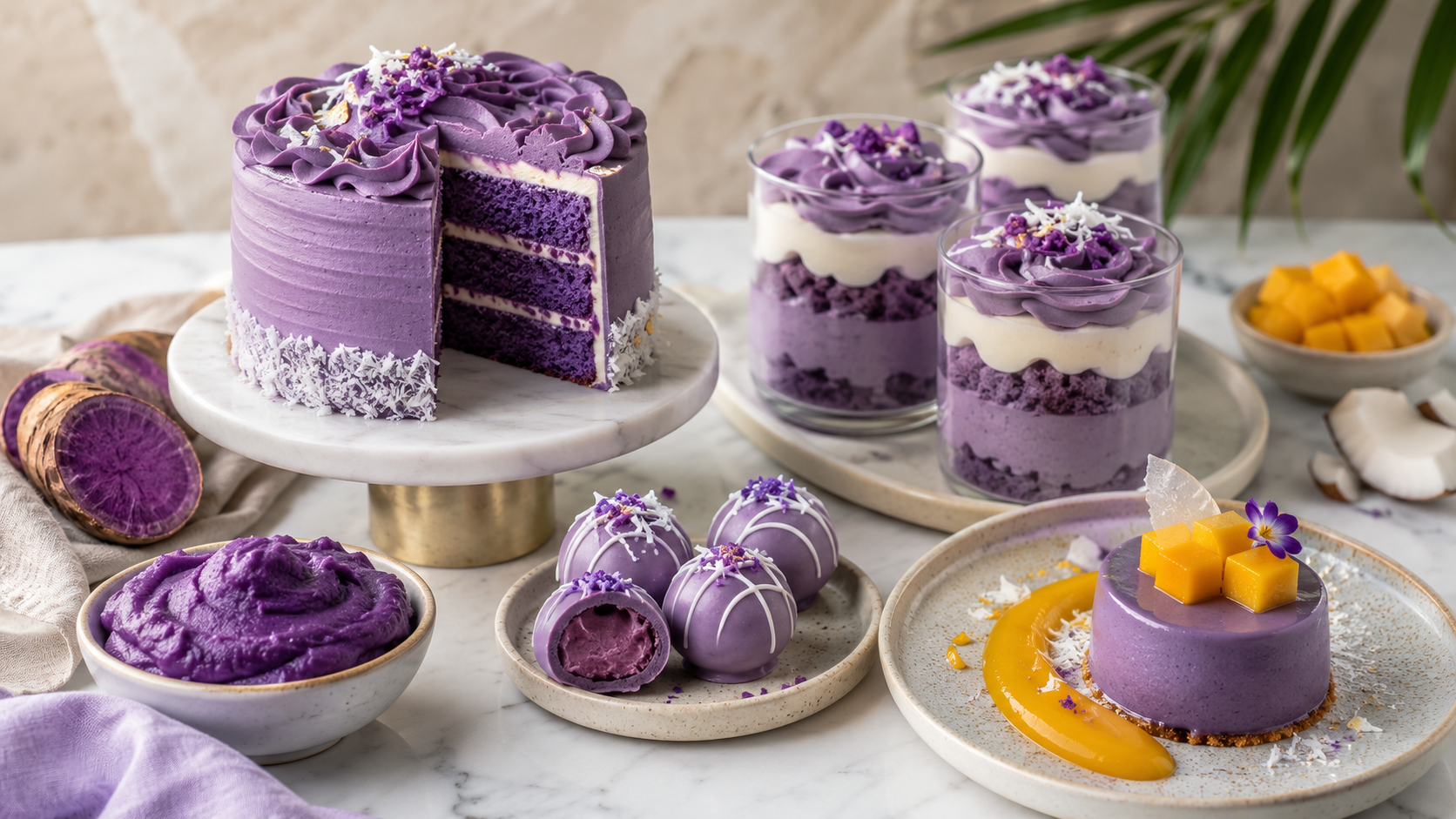
Last updated: 25 July 2026. Product prices and stock may change, so check the linked Bakeyy product page before ordering.
Ube desserts are emerging as one of 2026’s most visually recognisable café and bakery trends in India. Their vibrant violet colour immediately attracts attention, but genuine ube offers more than colour. It has a mild sweetness, a soft earthy character and flavour notes often described as nutty, creamy, vanilla-like and gently coconut-like when used in desserts.
Ube has long been part of Filipino food culture. It is traditionally used in products such as ube halaya, ice cream, cakes, breads and halo-halo. What is new is not the ingredient itself. What is new is the speed at which cafés and dessert brands outside the Philippines are adapting it into lattes, cheesecakes, mousse cups, cookies, brownies, doughnuts, chocolates and soft-serve products.
For Indian bakers, ube offers an opportunity to create a completely new colour and flavour family. It can be paired with coconut, mango, white chocolate, vanilla, cream cheese, condensed milk, pistachio, sesame and even familiar Indian flavours such as cardamom or jaggery.
However, the trend is also easy to misunderstand. Ube is not simply purple food colour. It is not taro. It is not the same botanical ingredient as purple sweet potato. A vanilla cake coloured purple may look like an ube cake, but it should not be sold as one unless it contains a genuine ube ingredient.
Commercial success therefore depends on five factors:
Authentic ingredient use: The dessert must contain genuine ube purée, powder, halaya or extract where advertised.
Recipe balance: The ube flavour should remain visible beside cream, sugar and chocolate.
Colour management: Natural ube colour can vary, and excessive artificial colour can make the product visually harsh.
Packaging: Purple creams, fillings and crumbs can mark lids, boards and light-coloured boxes.
Clear customer education: Buyers need to know what ube is, what it tastes like and how the dessert differs from taro or purple sweet potato products.
This detailed guide covers the ingredient’s cultural background, differences between ube and other purple tubers, ingredient formats, recipe development, colour stability, flavour pairings, product ideas, packaging, cost calculations, selling prices, storage, delivery and relevant products available from Bakeyy.com.
Quick answer: The most practical ube products for Indian home bakers to launch are ube mousse cups, ube mango cake cups, ube tres leches, ube crinkle cookies, ube white-chocolate truffles and small ube celebration cakes. Start with genuine ube powder, frozen purée, halaya or extract, test the strength carefully and never depend on purple food colour alone to create the flavour.
Related Ingredients, Tools and Packaging from Bakeyy
Use Bakeyy for the chocolate, colours, moulds and packaging needed to produce and sell the final desserts.
Compounds and couverture | Fillings and toppings | Food colours | Dessert containers with lids | Acrylic dessert cups | Cake boxes | Cake bases | Chocolate moulds | Chocolate boxes
What Is Ube?
Ube is a purple yam whose botanical name is Dioscorea alata. It is a true yam and is strongly associated with Filipino cuisine, although related purple-yam varieties are cultivated in several tropical regions.
The edible flesh may range from pale lavender to deep violet. Once cooked, it can become soft and creamy, making it useful for jams, fillings, cake batters, ice creams, breads and other sweet products.
Ube is usually cooked before it is eaten. Commercial bakers may encounter it in several forms:
Fresh purple yam.
Frozen grated ube.
Frozen ube purée.
Ube powder.
Ube halaya or purple-yam jam.
Ube flavouring or extract.
Ready-made ube paste.
Each form behaves differently in a recipe. Fresh purée brings moisture, starch and flavour. Powder adds less moisture but requires rehydration. Halaya contains sugar and often milk or fat. Extract adds aroma and colour but little physical body.
Is Ube the Same as Purple Sweet Potato?
No. Ube and purple sweet potato are different plants.
Ube belongs to the yam genus Dioscorea. Purple sweet potato belongs to the species Ipomoea batatas and is related to morning-glory plants.
Both can have purple flesh, but their flavour, texture, starch behaviour and cultural use differ. Purple sweet potato is often denser and more directly sweet-potato-like. Ube typically develops a creamier dessert profile and is strongly connected to Filipino sweets.
A baker may develop a purple sweet potato cake, but it should not automatically be called ube cake. Ingredient transparency matters, especially as more customers learn the difference.
Ube vs Taro vs Purple Sweet Potato
| Feature | Ube | Purple sweet potato | Taro |
|---|---|---|---|
| Botanical identity | Dioscorea alata, a true yam | Ipomoea batatas | Colocasia esculenta |
| Typical flesh | Purple to violet | Purple, depending on variety | Usually white or pale with purple flecks |
| Flavour | Mildly sweet, earthy, nutty and vanilla-like | Sweet and recognisably sweet-potato-like | Earthy, nutty and starch-forward |
| Cooked texture | Creamy and starchy | Dense, moist and starchy | Dry, starchy and sometimes sticky |
| Common dessert use | Halaya, cakes, ice cream and breads | Cakes, bread, pie and filling | Puddings, drinks, cakes and fillings |
Why Ube Desserts Are Trending in India in 2026
Ube offers the combination of visual novelty and approachable flavour. Unlike ingredients that require customers to appreciate strong bitterness, spice or fermentation, ube usually pairs comfortably with familiar sweet ingredients.
The purple colour provides instant recognition in photographs and videos. A café can create a full ube family containing lattes, cold coffees, cheesecake, cookies and mousse without the products looking identical.
Several broader consumer behaviours support the trend:
Colour-led discovery: Customers frequently discover food visually before reading its flavour description.
International café culture: Indian customers increasingly encounter Filipino, Japanese, Korean and Southeast Asian foods online.
Matcha-menu expansion: Cafés that successfully introduced matcha now understand the business value of a colour-recognisable ingredient.
Premium individual desserts: Customers may try a new flavour more easily in a small cup or cookie than in a full cake.
Fusion opportunities: Mango, coconut, white chocolate and condensed milk are already familiar to Indian consumers.
The trend still needs careful execution. A purple drink or cake may attract the first purchase, but repeat orders depend on texture, flavour, portion value and consistency.
Why Cultural Context Matters
Ube is not merely a fashionable purple flavour. It has deep cultural significance in Filipino households, bakeries and celebrations.
Ube halaya is a well-known preparation made by cooking purple yam with ingredients such as milk, sugar and fat until it becomes a thick, smooth jam. It may be eaten directly or used as a base for cakes, pastries and frozen desserts.
Indian bakeries can develop ube-inspired products while acknowledging the origin clearly. Good wording includes:
Filipino-inspired ube cake cup.
Ube halaya and coconut mousse.
Ube white-chocolate truffle inspired by Filipino purple-yam desserts.
Avoid wording that suggests the café invented ube, discovered it recently or created the original purple-yam dessert.
Fresh Ube, Powder, Halaya, Purée and Extract Compared
| Ube format | What it contributes | Recipe adjustment | Best use |
|---|---|---|---|
| Fresh cooked ube | Natural flavour, colour, starch and moisture | Reduce other liquids and blend very smoothly | Halaya, cake, bread and filling |
| Frozen grated ube or purée | Convenient flavour and body | Thaw, drain where required and record moisture | Commercial halaya and cake batter |
| Ube powder | Shelf stability and controlled solids | Rehydrate and test for graininess | Cookies, cake, bread and premixes |
| Ube halaya | Flavour, sweetness, colour and thick texture | Reduce sugar and account for dairy or fat | Fillings, swirls, cakes and mousse inserts |
| Ube extract | Concentrated aroma and usually colour | Use in drops and avoid overpowering flavour | Frosting, mousse, cake and drinks |
Can Food Colour Replace Ube?
No. Food colour can adjust appearance, but it cannot replace the flavour, starch or ingredient identity of ube.
A baker may use a small quantity of purple or violet gel colour to correct a pale batch made with genuine ube. However, the product should still contain a real ube ingredient.
A purple vanilla cake should be described as purple vanilla cake, not ube cake.
This distinction is important for:
Customer trust.
Ingredient declarations.
Cost transparency.
Cultural accuracy.
Repeat purchase.
Why Ube Colour Changes During Baking
Natural purple colour is influenced by the yam variety, ingredient format, heat, pH and surrounding ingredients.
Ube contains naturally occurring pigments, including anthocyanin-related compounds. The final cake may appear violet, muted purple, grey-purple or brownish depending on the recipe.
Factors that can reduce or alter colour include:
Long cooking.
Excessive heat.
An alkaline batter.
Dark brown sugar or jaggery.
Large quantities of cocoa.
Yellow egg yolks or butter.
Oxidation during storage.
A white-chocolate mousse or vanilla sponge normally displays ube colour more clearly than a dark chocolate cake. For chocolate products, treat ube mainly as a flavour and filling rather than expecting a bright purple crumb.
How to Create a Natural-Looking Purple Dessert
Begin with genuine ube and use added colour only as correction.
A reliable colour-development method is:
Step 1: Prepare the recipe without added food colour.
Step 2: Photograph the raw batter, baked product and chilled product under neutral light.
Step 3: Compare the colour after 2, 12 and 24 hours.
Step 4: Add a tiny amount of violet gel colour to the next batch only when necessary.
Step 5: Record the number of grams or drops per kilogram of batter.
Step 6: Avoid making every component identical purple. Contrast improves presentation.
For example, combine:
Purple ube sponge.
White coconut cream.
Yellow mango filling.
White-chocolate decoration.
This looks more premium than using dark purple sponge, purple cream, purple filling and purple garnish in one cup.
Bakeyy Food Colour for Controlled Colour Adjustment
Bakeyy’s Bake Haven Premium Icing Gel Colour, 20 g is available in multiple shades and was listed from ₹40 per jar when checked.

A concentrated gel colour generally adds less liquid than a thin liquid colour. It may therefore be more suitable for buttercream, ganache and cake batter. Check the available live shades and food-use instructions before ordering.
Use gel colour only to support genuine ube. Do not rely on it as the sole basis for an ube product.
Best Flavours to Pair with Ube
| Pairing | Why it works | Best product |
|---|---|---|
| Coconut | Reinforces the creamy tropical profile | Cake, mousse, tres leches and truffles |
| Mango | Adds acidity, familiarity and colour contrast | Cheesecake, cake cups and mousse |
| White chocolate | Adds body without hiding purple colour | Mousse, ganache and truffles |
| Cream cheese | Provides acidity and balances sweetness | Cheesecake and frosting |
| Vanilla | Supports ube without competing | Cake, cookies and mousse |
| Pistachio | Adds nutty flavour and premium positioning | Cake cups and truffles |
| Black sesame | Creates strong nutty contrast | Cookies, mousse and plated desserts |
Best Ube Products for Indian Bakers
Choose products that showcase ube without requiring customers to purchase a full-sized unfamiliar cake.
Recommended launch formats include:
Ube coconut mousse cup.
Ube mango cheesecake cup.
Ube tres leches.
Ube crinkle cookie.
Ube white-chocolate truffle.
Ube cake jar.
Ube mini cake.
Ube brownie or blondie.
Ube coconut tea cake.
Ube ice-cream sandwich.
Basic Ube Cake Recipe Framework
This is a commercial testing framework rather than a claim of being the traditional Filipino ube cake formula. The exact ube quantity depends on whether you use purée, powder, halaya or extract.
| Ingredient | Illustrative test quantity | Role |
|---|---|---|
| Maida | 220 g | Structure |
| Baking powder | 1½ teaspoons | Leavening |
| Salt | ¼ teaspoon | Flavour balance |
| Butter or neutral oil | 150 g | Moisture and richness |
| Sugar | 160–190 g | Sweetness and texture |
| Eggs | 3, or tested eggless system | Structure and emulsification |
| Ube purée | 120–180 g after testing | Flavour, colour and starch |
| Milk or coconut milk | Adjusted to batter | Hydration |
| Ube extract, optional | According to product strength | Aroma and colour correction |
How to Make Ube Cake
Step 1: Standardise the ube. Blend the cooked purée until completely smooth. Record its moisture and colour.
Step 2: Prepare the pans. Grease and line them so the purple crumb releases cleanly.
Step 3: Combine dry ingredients. Sift flour, baking powder and salt.
Step 4: Mix the fat and sugar. Cream butter and sugar or combine oil and sugar according to the selected cake method.
Step 5: Add eggs gradually. Maintain a smooth emulsion.
Step 6: Add ube purée. Mix until evenly distributed.
Step 7: Add dry ingredients and liquid. Alternate carefully and avoid overmixing.
Step 8: Evaluate colour. Add a tiny amount of gel colour only when the genuine ube batter is too pale for the intended presentation.
Step 9: Bake at a moderate temperature. High heat can create dark edges before the centre is fully cooked.
Step 10: Cool fully. Assess colour, crumb and flavour only after complete cooling.
Step 11: Chill a test portion. Ube cakes may taste and look different after refrigeration.
Step 12: Record yield. Weigh the final baked sponge for accurate costing.
Ube Coconut White-Chocolate Mousse Cups
Ube mousse cups are one of the safest first commercial formats because the colour remains visible and customers can purchase a small portion.
A practical mousse may include:
White chocolate.
Whipping cream.
Ube purée, halaya or rehydrated powder.
Coconut milk or coconut cream.
A small quantity of salt.
Optional ube extract.
The ube component must be smooth. Fibrous purée can create an unpleasant mousse texture.
Ube Coconut Mousse Test Formula
| Ingredient | Illustrative quantity |
|---|---|
| White compound or white chocolate | 200 g |
| Whipping cream | 450 ml |
| Smooth ube purée or halaya | 100–150 g after testing |
| Coconut milk | 30–50 ml |
| Salt | Small pinch |
Step 1: Melt the white chocolate gently.
Step 2: Warm part of the cream with coconut milk.
Step 3: Blend in the ube until smooth.
Step 4: Combine with white chocolate.
Step 5: Cool the mixture.
Step 6: Whip the remaining cream to soft peaks.
Step 7: Fold gradually.
Step 8: Pipe into clean containers.
Step 9: Chill until fully set.
Step 10: Add coconut, white-chocolate curls or mango filling.
White Chocolate and Compound from Bakeyy
Bakeyy’s Van Houten Professional Compound, 500 g is available in dark, milk and white variants. The white variant was listed at ₹223 when checked.

White compound can support ube mousse, ganache, truffle coatings and decorations. Keep the quantity controlled because heavy sweetness can weaken the ube flavour.
Bakeyy’s 2M White Compound Royal, 500 g was listed at ₹200.

Ube Mango Cheesecake Cups
Ube and mango create one of the strongest flavour and colour combinations for the Indian market.
The mango provides acidity and familiar tropical flavour. Ube provides creamy, mild nuttiness. A white cheesecake or cream layer separates the purple and yellow components visually.
A practical cup can contain:
Biscuit or sponge base.
Ube cheesecake layer.
Thin mango filling layer.
White cream layer.
Ube crumb or white-chocolate garnish.
Do not mix all components completely. Clear layers help customers understand the product.
Mango Filling from Bakeyy
Bakeyy’s Mala’s Mango Fruit Filling, 1 kg contains 50% real fruit and was listed at ₹400 when checked.

Use the filling as a measured layer, swirl or centre. Excess mango can overpower ube and add too much moisture.
Ube Tres Leches
Ube tres leches combines purple-yam sponge with a milk-based soak and provides a strong visual product for individual delivery.
The main technical risk is excess moisture. Ube purée already contributes water and starch. The milk soak must therefore be adjusted to the actual cake.
A practical version may include:
Ube sponge.
Milk, condensed milk and cream-based soak.
Coconut milk.
Ube extract or purée in a controlled quantity.
Whipped cream.
Toasted coconut or white-chocolate garnish.
Apply the soak gradually. Record how many grams the sponge absorbs without releasing liquid into the package.
Packaging Ube Tres Leches
Bakeyy’s 250 ml Disposable Rectangle Dessert Container was listed at ₹650 for 50, approximately ₹13 per set.

The shallow rectangular shape supports even soaking and easy spoon access. Confirm the lid closure and delivery performance before accepting bulk orders.
Ube Crinkle Cookies
Ube crinkle cookies are easier to deliver than mousse and allow customers to try the flavour at a lower price.
The cookie should have:
A clear ube aroma.
A soft or chewy centre.
A controlled purple colour.
A visible white icing-sugar crack pattern.
Enough structure for pouch or box packaging.
Ube powder or halaya can affect hydration. Do not add it to a standard cookie recipe without adjusting flour, sugar and fat.
Ube Brownies or Ube Blondies?
An ube blondie usually displays the purple colour better than a cocoa brownie.
A traditional dark brownie contains cocoa or dark chocolate, which can hide the ube colour and compete with its mild flavour.
Better options include:
Ube white-chocolate blondies.
Ube cheesecake bars.
Ube coconut bars.
Marbled ube and vanilla brownies.
Dark chocolate brownies with an ube cheesecake swirl.
Describe the product according to its actual composition. A dense white-chocolate bar can be called an ube blondie rather than forcing the word brownie.
Ube White-Chocolate Truffles
Ube truffles create a premium gifting format and require less space than cakes.
The centre may use:
White chocolate.
Cream.
Ube halaya or concentrated purée.
Coconut.
Salt.
Ube extract.
The moisture level must be controlled. Fresh purée can make ganache softer and may reduce stability. Conduct proper storage and shelf-life testing before selling large gift boxes.
Chocolate Mould for Ube Truffles and Bars
Bakeyy’s Four-Design Silicone Chocolate Bar Mould was listed at ₹197.

This can support white-chocolate ube bars, filled slabs and cake decorations. Test the ube filling for moisture before sealing it inside chocolate.
Ube Dessert Portion Guide
| Product | Suggested portion | Best package | Main cost driver |
|---|---|---|---|
| Ube mousse sampler | 50–70 ml | Small clear cup | Ube and cream |
| Standard mousse cup | 90–150 ml | Lidded dessert cup | White chocolate and packaging |
| Ube tres leches | 200–250 ml | Rectangular lidded container | Dairy and cold chain |
| Ube mini cake | 250–450 g | Bento or mini dome box | Decoration and labour |
| Ube truffle | 12–18 g | Cavity chocolate box | Chocolate and gift packaging |
Clear Dessert Cups for Ube Mousse
Bakeyy’s Transparent Dessert Cups with Lids are available in 60 ml and 90 ml sizes.
The 60 ml pack-of-100 variant was listed at ₹325, approximately ₹3.25 per cup. The 90 ml pack-of-100 variant was listed at ₹480, approximately ₹4.80 per cup.

The 60 ml size suits events and tasting boxes. The 90 ml size can support a small premium mousse or cheesecake portion.
Dome Dessert Cups for Layered Ube Products
Bakeyy’s Clear Dome Dessert Cup with Lid is available in 50 ml and 130 ml sizes.
The 50 ml pack-of-100 variant was listed at ₹1,050, approximately ₹10.50 per cup. The 130 ml pack-of-100 variant was listed at ₹1,425, approximately ₹14.25 per cup.

The 130 ml size is suitable for layered ube mango cheesecake or mousse. The dome shape provides decorative headspace, but check the lid clearance with the complete garnish.
Mini Cake Packaging for Ube Celebration Cakes
Bakeyy’s Bento Cake Container with Clear Dome Lid is available with gold and black bases.
The pack of 100 was listed at ₹1,400, approximately ₹14 per container.

A black base creates strong contrast with pale purple cake, while a gold base supports premium gifting. Measure the cake diameter and total height before confirming suitability.
Purple Packaging for Ube Truffle Gifts
Bakeyy’s Four-Cavity Big Rigid Chocolate Box in Purple was listed at ₹92 per box and showed available inventory when checked.

This packaging creates a complete purple visual story for ube chocolate gifts. Use food-safe liners or individual truffle cups according to the product design.
Unique Packaging Problems with Ube Desserts
Ube products can leave purple marks that become highly visible on white packaging.
Common issues include:
Purple cream touching the lid.
Ube crumbs marking white cake boards.
Condensation creating violet streaks.
Soft mousse moving during transport.
Colour transferring to labels or inserts.
Dark packaging hiding the product colour.
Transparent packaging is often useful because it showcases the purple layers. However, use sufficient headspace and chill the product before closing the lid.
Ube Dessert Packaging Comparison
| Packaging | Approximate unit cost | Best product | Main advantage |
|---|---|---|---|
| 60 ml clear cup | ₹3.25 | Ube mousse sampler | Low-cost trial portion |
| 90 ml clear cup | ₹4.80 | Small cheesecake or mousse | Clear layered presentation |
| 50 ml dome cup | ₹10.50 | Premium sampler | Decorative headspace |
| 250 ml rectangular container | ₹13 | Ube tres leches | Leak-resistant shallow format |
| Bento cake dome container | ₹14 | Mini ube cake | Full product visibility |
| Purple rigid four-cavity box | ₹92 | Premium ube truffles | High-value gifting presentation |
Dessert Spoons for Ube Cups
Bakeyy’s Premium Dessert Spoon is available in transparent, black and matte-gold options.
The pack of 100 was listed at ₹260, approximately ₹2.60 per spoon.

Black spoons create a strong contrast against ube desserts. Matte-gold spoons support premium event or gifting presentation.
Piping Bags for Ube Cream and Mousse
Bakeyy’s 19-Inch Disposable Piping Bag Roll was listed at ₹440 for approximately 95–100 bags.

Use separate piping bags for white, mango and ube components to maintain clean layers.
How to Store Ube Desserts
Storage depends on the product format and the ube ingredient used.
Fresh purée, halaya, mousse, cheesecake, tres leches and dairy-filled truffles require controlled storage.
Important factors include:
Whether fresh dairy is present.
The moisture level of the ube purée.
The sugar level of halaya.
Whether the dessert is baked or chilled.
The container seal.
The delivery temperature.
Colour migration over time.
Do not borrow a shelf-life claim from another ube product. Test the exact recipe, packaging and storage process.
How to Deliver Ube Desserts
Keep chilled ube products cold, upright and protected from movement.
Use insulated transport for mousse, cheesecake and tres leches.
Chill products completely before packing.
Leave enough lid clearance.
Use fitted trays or separators.
Avoid placing ice packs directly against thin dessert cups.
Keep dry cookies and chilled cups in separate internal packaging.
Ask the customer to refrigerate the product immediately.
Restrict the delivery radius until the product has completed realistic road testing.
How to Calculate the Cost of an Ube Dessert
Imported or specialist ube ingredients can significantly affect the cost.
Include:
Ube purée, powder, extract or halaya.
Freight and sourcing cost.
Recipe testing loss.
White chocolate or compound.
Cream, milk and cheese.
Fruit filling.
Container and lid.
Spoon and label.
Labour.
Refrigeration.
Wastage.
Sales-platform charges.
Use the formula:
Total batch cost ÷ saleable portions = cost per portion.
Cost per portion ÷ target cost percentage = starting selling-price calculation.
Illustrative Costing for a 130 ml Ube Mango Mousse Cup
| Cost component | Illustrative cost per cup |
|---|---|
| Genuine ube ingredient | ₹22 |
| Cream and coconut component | ₹24 |
| White chocolate | ₹14 |
| Mango filling | ₹8 |
| Cup and lid | ₹14.25 |
| Spoon, label and outer packing | ₹6 |
| Labour | ₹14 |
| Refrigeration, testing and wastage | ₹10 |
| Illustrative total cost | ₹112.25 |
These figures are examples. Genuine ube sourcing costs can vary greatly, so replace the ₹22 ube cost with your actual landed cost.
Illustrative Ube Dessert Selling-Price Chart
| Ube crinkle cookie |
₹99
|
| Ube mousse sampler |
₹129
|
| Ube mango mousse |
₹279
|
| Ube tres leches |
₹299
|
| Mini ube cake |
₹499
|
The chart shows illustrative direct-sale prices only. It does not represent guaranteed market pricing. Use your actual food cost, packaging, city, delivery model and brand positioning.
Sample Ube Dessert Menu for India
| Menu item | Description | Illustrative price |
|---|---|---|
| Ube Coconut Cloud | Ube white-chocolate mousse with coconut cream | ₹239 |
| Ube Mango Cup | Purple-yam mousse, mango filling and vanilla cream | ₹279 |
| Ube Tres Leches | Ube sponge soaked with coconut milk mixture | ₹299 |
| Ube Crinkle Cookie | Soft purple-yam cookie with white crinkle coating | ₹99 |
| Ube White-Chocolate Truffles | Four-piece purple-yam and coconut chocolate box | ₹499 |
| Mini Ube Celebration Cake | Ube sponge, coconut cream and white-chocolate decoration | ₹499–₹699 |
How to Launch Ube Without Wasting Expensive Ingredients
Launch as a limited preorder menu rather than adding ten products immediately.
Begin with three products:
Ube crinkle cookie: A lower-price trial product with easier delivery.
Ube mango mousse cup: A visually strong premium product.
Ube white-chocolate truffle: A gifting format.
These products give customers three different textures while sharing ube, white chocolate and packaging supplies.
Track:
Number of first-time orders.
Repeat purchase rate.
Most requested flavour pairing.
Ingredient wastage.
Customer understanding of ube.
Delivery complaints.
Average order value.
How to Market Ube Desserts
Explain the flavour as clearly as the colour.
Useful content ideas include:
Cutting open a real purple yam.
Comparing ube with taro and purple sweet potato.
Showing purée being blended into cake batter.
Showing purple and mango layers through a clear cup.
Cutting through a white-chocolate ube truffle.
Showing the natural colour before gel adjustment.
Explaining the Filipino origin of ube halaya.
Using a “What does ube taste like?” tasting video.
Product titles should contain both the unfamiliar and familiar description:
Ube Mango Mousse – Filipino Purple Yam, Mango and White Chocolate.
This is more informative than simply naming it “Purple Dream.”
Common Ube Dessert Mistakes
| Mistake | Why it happens | Better approach |
|---|---|---|
| Using only purple colour | The baker focuses on appearance | Use genuine ube and colour only for correction |
| Calling purple sweet potato ube | The ingredients look similar | Declare the actual tuber used |
| Adding wet purée without adjustment | Moisture is not measured | Reduce other liquid and weigh the purée |
| Using too much white chocolate | It improves texture | Balance sweetness and preserve ube flavour |
| Making every layer purple | The colour is treated as the complete design | Use white, mango, coconut or chocolate contrast |
| Ignoring packaging stains | The lid touches the cream | Increase headspace and chill before packing |
| Underpricing the trend | Only basic ingredient cost is counted | Include landed ube cost, testing and wastage |
Frequently Asked Questions About Ube Desserts
What is ube? Ube is a purple yam, botanically identified as Dioscorea alata, strongly associated with Filipino cuisine and desserts.
How do you pronounce ube? It is commonly pronounced “oo-beh.”
Is ube the same as purple sweet potato? No. They are botanically different plants with different textures and flavour profiles.
Is ube the same as taro? No. Taro is a different root crop and is commonly pale with purple flecks rather than consistently violet inside.
What does ube taste like? Ube is mildly sweet, earthy, nutty and often described as having vanilla-like or coconut-like notes in desserts.
Can purple food colour create an ube cake? It can create a purple cake, but it cannot create genuine ube flavour or ingredient identity.
Can I use purple sweet potato instead of ube? It can be used in a purple sweet potato recipe, but the result should not be represented as identical to genuine ube.
What is ube halaya? Ube halaya is a thick Filipino purple-yam jam commonly made by cooking ube with sugar, milk and fat.
Which ube format is easiest for home bakers? Powder, frozen purée and commercially prepared halaya may be easier to standardise than fresh yam, depending on sourcing.
Why is my ube cake grey? Ube variety, pH, heat, brown ingredients and insufficient pigment can reduce the vivid purple colour.
What chocolate goes best with ube? White chocolate usually supports ube colour and mild flavour most effectively.
What fruit works with ube? Mango, strawberry and coconut-based combinations are approachable options.
What cup size is best for ube mousse? A 90–150 ml cup is suitable for many standard individual portions, while 50–70 ml works for samplers.
Can ube mousse be delivered? Yes, within a tested local radius using refrigeration, upright packing and suitable lid clearance.
Can ube cookies be shipped? Stable ube cookies are easier to ship than chilled mousse, but the recipe and packaging still require testing.
How much should an ube mousse cup cost? Calculate genuine ube, cream, chocolate, packaging, labour, refrigeration and wastage. Do not price it like an ordinary vanilla mousse.
Can ube desserts be made eggless? Yes. Use tested eggless cake, cookie, mousse or cheesecake systems rather than removing eggs without reformulation.
Are ube desserts naturally purple? Genuine ube can provide natural purple colour, but the shade varies. Many commercial products also use extract or permitted colour.
Where can Indian bakers buy ube dessert packaging? Bakeyy supplies clear cups, dessert containers, mini cake packaging, chocolate boxes, cake moulds, white compound, piping bags and serving spoons.
Ube Dessert Launch Checklist
Ingredient: Genuine ube purée, powder, halaya or extract has been verified.
Name: The product is not incorrectly described as taro or purple sweet potato.
Flavour: Ube remains noticeable after cream and chocolate are added.
Colour: Added food colour is used only as controlled adjustment.
Texture: Purée moisture has been included in the recipe calculation.
Portion: Every product has a fixed finished weight.
Packaging: The purple cream does not touch the lid.
Storage: Colour, texture and flavour have been checked over time.
Costing: Landed ube cost, testing loss and cold storage are included.
Education: The product description explains what ube is.
Turn the Ube Trend into a Credible Indian Bakery Product
Ube has genuine potential in India because it offers much more than an unusual colour. It carries Filipino cultural history, a distinctive mild flavour, creamy texture and enough versatility to work across cakes, mousse, cookies, milk desserts and chocolates.
The strongest approach is not to produce a purple version of every bakery product. Select formats where the ube flavour can remain visible and where the colour creates commercial value.
Begin with one dry product, one chilled cup and one gifting product. Ube crinkle cookies, ube mango mousse and ube white-chocolate truffles provide a balanced test menu.
Use genuine ube as the foundation. Purple food colour should correct appearance rather than create a false ingredient identity. Explain the difference between ube, taro and purple sweet potato clearly.
Control purée moisture, white-chocolate sweetness, colour migration and refrigeration. Use clear packaging for layered desserts and supportive dome packaging for mini cakes.
Explore Bakeyy’s Food Colours, Compounds and Couverture, Dessert Cups, Dessert Containers with Lids, Acrylic Dessert Cups, Cake Moulds, Fillings and Toppings, Cake Boxes, Chocolate Boxes, Piping Bags and Disposable Serving Supplies to prepare and package a professional ube dessert menu.