
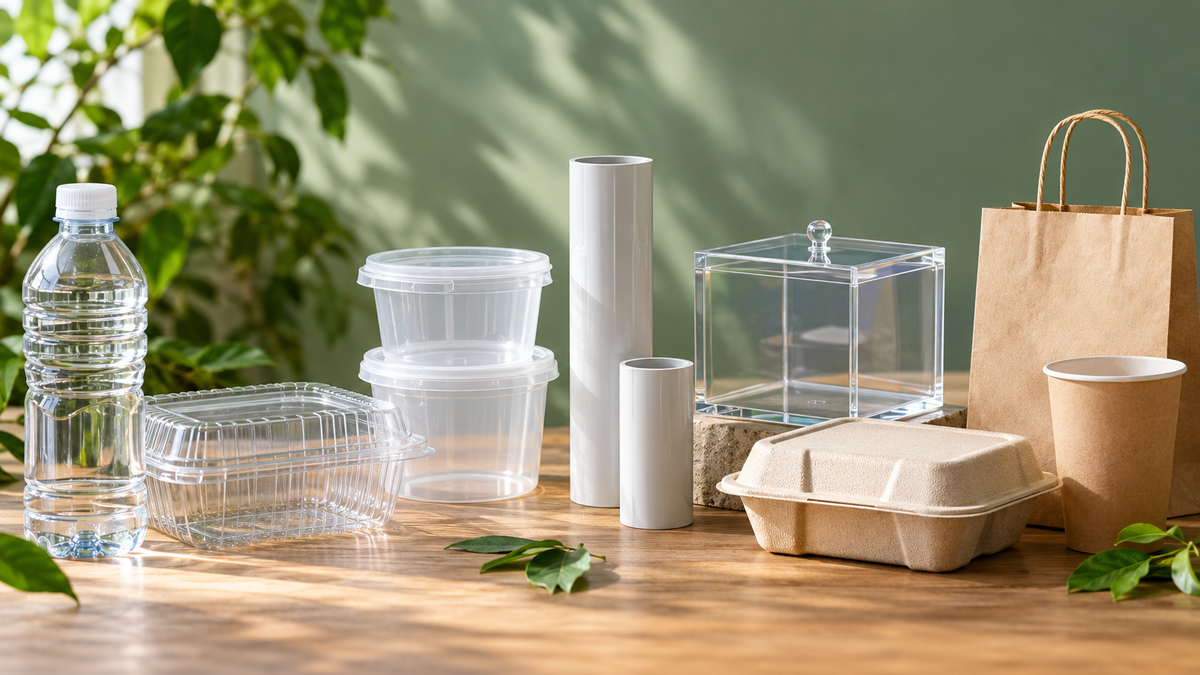
Choosing packaging should be easy. Then you start seeing terms such as PET, PP, PVC, acrylic, bagasse and paper, and suddenly a simple container becomes a material science decision.
If you run a home bakery, cloud kitchen, café, gifting business, dessert brand or food business, the material you choose affects much more than appearance. It can influence product visibility, handling, resistance to moisture, suitability for hot or cold food, delivery performance, presentation and even how customers perceive your brand.
The important point is that there is no single packaging material that is automatically “best”. A clear PET dessert cup and a kraft cake box are solving completely different problems. A bagasse takeaway box may make sense for one menu while a PP container may make much more sense for another.
This guide compares PET, PP, PVC, acrylic-style packaging, sugarcane bagasse and paper packaging in practical terms so you can choose according to the food, temperature, presentation, delivery method and customer experience you actually need.
Quick answer: PET is usually chosen when clarity and cold-food presentation matter. PP is widely used when a tougher, more heat-tolerant plastic format is required. PVC is commonly seen in clear display and gifting formats, although its suitability should always be checked for the specific food-contact application. Acrylic-style containers are chosen for premium rigid presentation. Bagasse works well for many takeaway applications where a natural fibre look is preferred. Paper and paperboard remain highly versatile for bakery boxes, cake packaging, gifting and dry-food presentation.
Before Comparing Materials: Packaging Material Is Only One Part of the Decision
Two containers made from the same broad material can behave differently.
The performance of packaging can change depending on:
- Material grade
- Thickness
- Container design
- Lid design
- Coatings or laminations
- Food temperature
- Oil and moisture content
- How long the food remains inside
- Whether the packaging is refrigerated
- Whether the container is intended for direct food contact
- Manufacturer specifications
So do not choose packaging only because a listing says “plastic”, “paper” or “eco-friendly”. Check the actual product specifications and intended use.
PET vs PP vs PVC vs Acrylic vs Bagasse vs Paper: Quick Comparison
| Material | Main Strength | Typical Appearance | Common Uses | Best Considered For |
|---|---|---|---|---|
| PET | Excellent clarity and lightweight structure | Very clear and glossy | Dessert cups, cold-food containers, clear lids, pastry packaging | Cold desserts and products where customers should see the food |
| PP | Practical durability and better tolerance for many warm-food applications | Clear, translucent or coloured | Meal containers, takeaway boxes, tubs, lids | Everyday food packaging where functionality matters |
| PVC | Flexible or rigid clear presentation depending on construction | Clear and glossy | Display boxes, goodie boxes, transparent gifting formats | Presentation-led applications when the specific format is suitable for its intended contents |
| Acrylic / Acrylic-Look | Premium rigid visual presentation | Crystal-clear, structured and premium | Dessert boxes, premium cups, mini cake containers, gifting | High-value presentation and premium desserts |
| Bagasse | Sturdy plant-fibre construction | White, off-white or natural fibre texture | Takeaway boxes, trays, clamshells, meals, bakery foods | Food businesses wanting a fibre-based takeaway format |
| Paper / Paperboard | Versatility, printability and structural packaging | Kraft, white, coloured or printed | Cake boxes, brownie boxes, pastry boxes, gifting, bags | Bakery packaging, gifting and products needing a box rather than a sealed container |
Simple Visual Comparison
| Material | Product Visibility | Premium Presentation | Moisture Handling | Suitable for Structural Boxes |
|---|---|---|---|---|
| PET | ★★★★★ | ★★★★☆ | ★★★★☆ | ★★☆☆☆ |
| PP | ★★★☆☆ | ★★★☆☆ | ★★★★☆ | ★★☆☆☆ |
| PVC | ★★★★☆ | ★★★★☆ | ★★★☆☆ | ★★★☆☆ |
| Acrylic / Acrylic-Look | ★★★★★ | ★★★★★ | ★★★★☆ | ★★★☆☆ |
| Bagasse | ★☆☆☆☆ | ★★★☆☆ | ★★★☆☆ | ★★★★☆ |
| Paper / Paperboard | ★☆☆☆☆ without a window | ★★★★☆ | ★★☆☆☆ | ★★★★★ |
These ratings are a practical comparison of common packaging formats, not a technical specification. Exact performance depends on the grade, thickness, coatings and container design.
1. What Is PET Packaging?
PET stands for polyethylene terephthalate. In food and bakery packaging, PET is especially popular because it can be made highly transparent while remaining relatively lightweight.
If you have purchased a crystal-clear dessert cup, transparent pastry lid, cold-food container or clear bakery clamshell, there is a good chance you have come across PET or a similar clear thermoplastic packaging format.

Why PET Is Popular for Desserts
Desserts are visual products. A customer buying tiramisu, mousse, panna cotta, pudding, fruit dessert or layered cheesecake often wants to see the product before opening it.
PET works particularly well for this because good-quality clear PET packaging can provide strong product visibility without requiring a heavy container.
That makes it useful for:
- Mousse cups
- Tiramisu containers
- Cold cheesecakes
- Fruit cups
- Parfaits
- Cold beverages
- Pastries
- Cookies and confectionery
- Cold dessert tubs
- Clear cake and pastry domes
Main Advantages of PET Packaging
1. Excellent transparency
PET is one of the strongest options when product visibility is important. Instead of relying only on a printed label or product photograph, the packaging allows the actual dessert to sell itself.
2. Lightweight
PET containers can provide useful rigidity without the weight associated with materials such as glass.
3. Professional presentation
Its glossy clear appearance works well for bakery counters, refrigerated displays, events and premium dessert orders.
4. Useful for portion packaging
PET is available in many shapes and capacities, making it useful for single-serve products and portion-controlled desserts.
5. Good fit for cold food presentation
For chilled desserts and similar applications, PET is commonly selected because clarity and presentation are major priorities.
Where PET Is Not Automatically the Right Choice
A common mistake is assuming that every plastic container can handle every temperature.
You should not select PET packaging for a hot application simply because it looks sturdy. Always check the manufacturer's recommended temperature and food-contact conditions for the specific container.
If your food is packed while very hot, reheated inside the container or used in a microwave, you need packaging specifically designed for that purpose.
Who Should Consider PET?
PET is worth considering if you sell a visually attractive chilled product and want customers to clearly see layers, toppings, colours and decoration.
For many dessert businesses, that visibility can be part of the branding.
2. What Is PP Packaging?
PP stands for polypropylene. It is widely used across food packaging because it can be manufactured into lightweight, flexible or rigid formats and is often selected for practical everyday containers.
While PET is frequently associated with exceptional transparency, PP is often chosen when functional performance and temperature tolerance become more important.
Common Uses of PP Packaging
- Takeaway food containers
- Meal boxes
- Plastic tubs
- Food storage containers
- Container lids
- Sauce containers
- Prepared food packaging
- Some bakery and dessert containers
Main Advantages of PP
1. Practical for everyday food packaging
PP is often used where the customer cares more about secure packaging, convenience and functionality than crystal-clear presentation.
2. Useful toughness
Depending on its design and thickness, PP can flex rather than crack easily, which can help in takeaway and delivery applications.
3. More suitable for certain warm-food applications
Many PP packaging formats are designed for warmer foods than standard clear PET dessert packaging. However, never assume microwave or high-temperature suitability unless the exact product is specified for it.
4. Available in many formats
PP does not have one fixed appearance. Containers can be transparent, cloudy, coloured, black, white or combined with clear lids.
PET vs PP: Which Is Better?
Neither is universally better.
| If Your Priority Is... | Usually Consider First |
|---|---|
| Crystal-clear dessert display | PET |
| Cold mousse, parfait or tiramisu | PET |
| Everyday takeaway meals | PP |
| Potentially warmer food | Appropriately rated PP |
| Visual premium presentation | PET |
| Functional meal container | PP |
The word appropriately rated matters. Material name alone is not enough to determine whether a container can go into a microwave, freezer or high-temperature environment.
3. What Is PVC Packaging?
PVC stands for polyvinyl chloride. In the packaging market, PVC can appear in different forms, including flexible transparent packaging and rigid clear presentation boxes.
For bakeries and gifting businesses, customers often encounter PVC in products such as transparent goodie boxes, display packaging, clear sleeves and decorative packaging.
Why Businesses Use Clear PVC-Style Packaging
The main reason is presentation.
A transparent goodie box can show:
- Cookies
- Chocolates
- Macarons
- Small gifts
- Return gifts
- Decorative products
- Festive items
Clear packaging is especially useful when the product design is more attractive than anything you could print on the outside of the box.
Important PVC Consideration
Do not treat every clear PVC package as interchangeable with a food container.
A decorative transparent gift box and a container designed for direct food contact are different products, even if both are visually clear.
For any food application, check whether the particular packaging is intended for direct food contact. If necessary, use an appropriate food-safe liner, wrapper, cavity, pouch or inner container based on the product design and supplier guidance.
Where PVC-Style Clear Packaging Makes Sense
PVC-style clear boxes can make sense when:
- Visual display is the main goal
- The product is dry
- The food already has suitable primary wrapping
- The packaging is being used as an outer gift box
- The supplier confirms suitability for the intended use
It is particularly common in gifting because it can create a premium showroom effect without hiding the product.
4. What Is Acrylic Packaging?
Acrylic is associated with a rigid, glass-like transparent appearance. In bakery and dessert packaging, the term acrylic box is also sometimes used commercially for rigid crystal-clear dessert boxes and cups that have an acrylic-like appearance.
This is important because the retail category name does not always tell you the exact polymer composition.
If the exact resin matters for temperature, recycling, food-contact documentation or a commercial specification, confirm it with the supplier rather than assuming every product called an “acrylic box” is manufactured from the same material.

Why Acrylic-Style Containers Look Premium
The combination of rigid walls, clean edges and high transparency can make a relatively simple dessert feel more structured and premium.
This works particularly well for:
- Tiramisu
- Mousse
- Layered desserts
- Mini cakes
- Puddings
- Premium sweets
- Party desserts
- Wedding dessert tables
- Corporate gifting
Acrylic-Style Packaging vs PET
| Feature | PET | Acrylic-Style Rigid Container |
|---|---|---|
| Clarity | Excellent | Excellent |
| Weight | Usually lighter | Often more substantial |
| Premium feel | High | Very high |
| Bulk economy | Often stronger | Often selected for higher-value presentation |
| Best use | Everyday clear dessert packaging | Premium dessert and gifting presentation |
If you are selling a ₹60 everyday dessert and a ₹250 premium layered dessert, you may reasonably choose different packaging even if both foods could physically fit inside the same capacity.
Packaging needs to make commercial sense relative to the value of the product.

5. What Is Sugarcane Bagasse Packaging?
Bagasse is the fibrous material remaining after sugarcane stalks are processed for their juice. That fibre can be formed into trays, bowls, plates and takeaway containers.
In packaging, bagasse typically has a white, off-white or natural fibre appearance rather than the shiny appearance of plastic.

Why Bagasse Is Popular
Bagasse packaging appeals to businesses looking for a fibre-based alternative to conventional plastic takeaway boxes.
Its tactile surface and moulded structure can also make packaging feel less industrial than conventional plastic.
Common Uses
- Takeaway meals
- Sandwiches
- Brownies
- Cakes and pastries
- Snacks
- Prepared foods
- Café orders
- Event food service
- Cloud kitchen packaging
Bagasse with a Clear Window
One compromise between natural-looking packaging and product visibility is a bagasse box with a transparent window.
This can be useful for bakeries because fully opaque fibre packaging hides the product. Adding a viewing window allows customers to see the cake, pastry or dessert without opening the container.
Advantages of Bagasse
1. Natural presentation
Bagasse immediately gives the package a fibre-based visual identity.
2. Sturdy moulded construction
Depending on the design, moulded fibre containers can provide good structure for takeaway food.
3. Useful for food service
Bagasse is widely associated with takeaway, catering, café and meal packaging formats.
4. Works well with minimal branding
A simple logo sticker or paper sleeve can look good against the neutral surface.
Limitations to Consider
Bagasse does not offer the same product visibility as PET or other transparent packaging.
The texture, surface and moisture behaviour are also different from plastic. For oily, wet or very hot products, check the specific container's stated suitability instead of making assumptions based on the word “bagasse”.
Also remember that a bagasse box with a transparent window is a multi-material format. When sustainability or disposal is a major purchasing factor, consider the complete package, not only the main fibre body.
6. What Is Paper and Paperboard Packaging?
Paper packaging covers a huge range of formats. In the baking industry, it may refer to kraft paper, white paperboard, coated board, corrugated board or decorative printed paper packaging.
Paper is probably one of the most versatile packaging materials available to a bakery because it can form structural boxes, sleeves, bags, wraps and inserts.

Typical Paper Packaging in a Bakery
- Cake boxes
- Cupcake boxes
- Brownie boxes
- Cookie boxes
- Pastry boxes
- Sweet boxes
- Hamper boxes
- Paper bags
- Food sleeves
- Window boxes
- Gift boxes
Why Paper Works So Well for Cakes
A cake does not necessarily need to be enclosed in a transparent plastic container.
What it needs during takeaway is enough structural space to avoid damaging:
- Frosting
- Piping
- Chocolate decorations
- Flowers
- Fondant details
- Cake toppers
A properly sized paper cake box creates a protective shell around the cake while remaining relatively easy to store flat before assembly.
Paper with a Window
One of the most useful hybrid packaging ideas is the paper box with a transparent window.
You get:
- The structure of paperboard
- A large printable branding area
- Some visibility of the food
- A bakery-style appearance
For cakes, cookies, brownies and gifting, this is often a strong middle ground between fully transparent plastic and fully closed paper packaging.
Which Material Gives the Best Product Visibility?
If visibility is your number-one concern, clear materials are the obvious starting point.
| Material | Visibility Level |
|---|---|
| PET | ██████████ Excellent |
| Acrylic / Acrylic-Look | ██████████ Excellent |
| PVC Clear Box | █████████ Very High |
| PP | ██████ Varies by format |
| Paper with Window | ████ Partial visibility |
| Bagasse with Window | ███ Partial visibility |
| Plain Paper / Bagasse | █ Opaque |
If you sell a dessert with beautiful layers, transparency can increase the perceived appeal of the food. If the product is visually plain or needs protection from light, full transparency may be less important.
Which Material Looks the Most Premium?
Premium does not always mean expensive.
Premium packaging is packaging that feels appropriate for the product and brand.
A rigid transparent cube can look premium for tiramisu. A natural kraft box can look premium for artisan cookies. A printed paper hamper box can feel premium for Diwali gifting. A moulded bagasse container can look premium for a modern café using minimal branding.
So instead of asking, “Which material is premium?”, ask:
“Which material makes my particular product look intentional?”
Which Packaging Should You Use for Cakes?
For most standard celebration cakes, paperboard cake boxes remain one of the most practical choices.
They provide:
- Useful height
- Protection from handling
- Space for decorations
- Easy labelling
- Large branding surfaces
- Reasonable storage before assembly
Clear dome containers can be useful for smaller cakes, pastries and desserts when presentation is important.
For very decorative cakes, box dimensions matter at least as much as material. Always allow enough clearance around the sides and top.
Which Packaging Should You Use for Brownies?
Brownies are flexible from a packaging perspective because they are relatively compact and stable compared with frosted cakes.
Depending on the format, you could use:
- Paper brownie boxes
- Window boxes
- Clear PET containers
- Bagasse clamshells
- Gift boxes with cavities
For everyday brownie delivery, practicality and stackability may matter most. For festive brownies or gifting, printed paper boxes may create a stronger presentation.
Which Packaging Should You Use for Cookies?
For cookies, think about moisture protection and breakage before choosing purely on appearance.
Common formats include:
- Paper cookie boxes
- Window boxes
- Clear containers
- Heat-sealed or resealable pouches
- Metal tins
If a paper box is mainly being used for presentation, an inner food-safe pouch or appropriate liner may be useful depending on the cookie and expected storage period.
Which Packaging Should You Use for Tiramisu?
Tiramisu benefits enormously from transparent packaging because the layers are part of the product experience.
PET and rigid acrylic-style dessert containers are therefore popular options.
Choose according to positioning:
| Type of Tiramisu | Packaging Direction |
|---|---|
| Economical individual serving | Clear PET cup or tub |
| Premium single serving | Rigid square or round clear container |
| Large sharing tiramisu | Larger transparent dessert container |
| Gift presentation | Premium rigid container combined with outer gifting packaging |
Which Packaging Should You Use for Mousse and Pudding?
Mousse and pudding are generally presentation-led products.
A clear container allows customers to see:
- Chocolate layers
- Fruit compote
- Crumb layers
- Cream
- Garnishes
- Sauces
PET or rigid clear dessert containers therefore tend to make sense for chilled mousse and pudding when approved for the intended food-contact conditions.
A dome lid can also help when the dessert has toppings extending above the fill line.
Which Packaging Should You Use for Hot Takeaway Food?
Hot food requires more caution.
Do not choose a container based only on how strong it feels in your hand.
Check:
- Permitted food-contact use
- Recommended temperature range
- Whether the lid is suitable for hot food
- Whether steam requires ventilation
- Oil resistance
- Leak resistance
- Whether reheating is permitted
Appropriately specified PP and moulded fibre containers are commonly considered for takeaway foods, but the exact product specification should decide the application.
Which Material Is Best for Delivery?
Delivery packaging has a different job from counter-display packaging.
A beautiful box that opens during a bike delivery is not good packaging.
When evaluating delivery packaging, consider:
- Lid security
- Stackability
- Rigidity
- Resistance to crushing
- Leak control
- Condensation
- Food movement inside the box
- Space for tamper seals
Practical Delivery Comparison
| Packaging | Delivery Strength | Main Watch-Out |
|---|---|---|
| PET dessert cup with fitted lid | Good for chilled desserts | Check lid lock and avoid crushing |
| PP takeaway tub | Strong practical option when correctly specified | Check heat and leak requirements |
| Acrylic-style rigid dessert box | Good premium protection | Usually higher packaging cost |
| Bagasse clamshell | Good for many takeaway applications | Check moisture and closure performance |
| Paper cake box | Excellent for cakes when correctly sized | Needs stable cake board and careful carrying |
| Clear PVC gift box | Useful for display and dry gifting | May need additional primary food packaging |
Do Not Confuse Packaging with Shelf Life
Packaging can help protect a product from handling, contamination, moisture exchange, odours and physical damage, but packaging alone does not make an unsafe food shelf-stable.
Shelf life still depends on factors such as:
- Recipe
- Water activity
- Ingredients
- Hygiene
- Processing
- Temperature
- Refrigeration
- Storage time
A sealed dessert cup does not mean a dairy dessert can be stored at room temperature.
Similarly, placing cookies in an attractive paper box does not automatically provide the same moisture barrier as a properly sealed pouch.
How to Choose Packaging in 7 Questions
If you are confused between materials, answer these questions in order.
1. Is the food hot, warm, chilled, frozen or room temperature?
This immediately removes unsuitable formats from consideration.
2. Does the customer need to see the food?
If yes, prioritise transparent packaging or a window.
3. Is the product wet, oily or dry?
A dry cookie and a creamy tiramisu need very different barriers.
4. Is the package for display, takeaway or long-distance delivery?
Display packaging can prioritise aesthetics. Delivery packaging has to prioritise closure and protection.
5. How premium is the product?
Your packaging cost should be proportionate to the selling price and customer expectations.
6. Does the box need custom branding?
Paperboard gives you a large branding surface. Clear containers often rely more heavily on labels, sleeves and stickers.
7. What happens after the customer opens it?
Think about convenience, resealing, portioning, storage and disposal.
Packaging Decision Chart for Bakers and Food Businesses
| Your Product | Good Starting Point | Why |
|---|---|---|
| Celebration cake | Paper cake box | Structure, height and transport protection |
| Mini cake | Paper box or clear dome | Choose protection or visibility depending on presentation |
| Tiramisu | PET or rigid clear container | Shows layers clearly |
| Mousse | PET or rigid clear dessert cup | Excellent product visibility |
| Brownies | Paper, PET or bagasse | Choice depends on gifting vs everyday delivery |
| Cookies | Paper box plus suitable inner packaging where required | Presentation and freshness can be managed separately |
| Hot meal | Appropriately specified PP or fibre container | Functional takeaway performance |
| Premium dessert | Rigid clear acrylic-style container | Premium display value |
| Gift hamper | Paperboard, rigid paper or clear display box | Large branding and presentation possibilities |
| Dry goodie packaging | Paper or suitable clear display packaging | Easy presentation and gifting |
What About Sustainability?
Sustainability is more complicated than simply labelling one material “good” and another “bad”.
Packaging impact can depend on:
- How much material is used
- How the material is produced
- Whether different materials are laminated together
- Whether the packaging is clean enough to recover
- Local waste collection systems
- Local recycling infrastructure
- Whether customers actually separate the packaging
- Transportation weight
- Product wastage prevented by the package
A very heavy package is not automatically better because it is reusable. A paper box is not automatically plastic-free if it contains a plastic film window or coating. A fibre-based container does not automatically disappear after use under every disposal condition.
For a small bakery, a sensible sustainability approach can be surprisingly practical:
- Avoid packaging that is much larger than the product
- Use the minimum packaging required to protect the food properly
- Choose materials appropriate to the actual food
- Avoid unnecessary decorative layers
- Use recyclable or recoverable formats where practical in your market
- Give customers clear disposal instructions when useful
- Prevent food damage and wastage during delivery
Is Paper Always More Sustainable Than Plastic?
No simple yes-or-no answer applies to every package.
Paper can offer strong advantages in many bakery applications, especially when it provides necessary structure with relatively simple construction.
However, some paper packaging contains windows, coatings, adhesives or laminations. Plastic packaging may sometimes use less material by weight or provide protection that prevents food waste.
Evaluate the complete packaging system instead of judging only by what the outside surface looks like.
Is Bagasse Better Than Paper?
They solve different problems.
Bagasse is moulded into trays and food containers. Paperboard is particularly good for folding cartons, boxes, sleeves and bags.
For a cake, a paperboard box is usually structurally more appropriate.
For a takeaway meal, a moulded bagasse clamshell may be more practical.
“Better” depends on the product.
Is PET Better Than Acrylic?
For everyday clear dessert packaging, PET can be more practical because it offers excellent visibility in lightweight formats.
For a high-value dessert where packaging is part of the premium experience, a rigid acrylic-style container may create a stronger visual impression.
The decision becomes easier if you calculate packaging as a percentage of your selling price.
Example
If Dessert A sells for ₹80 and Packaging A costs ₹16, packaging represents 20% of the selling price.
If Dessert B sells for ₹300 and a premium container costs ₹25, packaging represents only about 8.3% of the selling price.
The ₹25 box is more expensive in absolute terms but potentially easier to justify commercially on the premium dessert.
Do Customers Really Care About Packaging Material?
Customers may not know the technical name of the polymer, but they notice what packaging does.
They notice if:
- The dessert leaks
- The cake touches the lid
- The box collapses
- The food looks premium
- The packaging is difficult to open
- The container feels excessively wasteful
- The product arrives damaged
- The box looks gift-worthy
So instead of expecting customers to care whether a box is PET or PP, focus on how the material improves their experience.
Packaging Cost vs Product Value
Packaging should protect your margins as well as your food.
| Product Positioning | Packaging Strategy |
|---|---|
| Budget / high volume | Prioritise reliable, economical formats and efficient pack sizes |
| Mid-range | Balance presentation, reliability and unit cost |
| Premium | Packaging can become part of the overall product experience |
| Gifting | Presentation and unboxing may justify additional packaging cost |
Common Packaging Mistakes to Avoid
Mistake 1: Choosing Only by Appearance
A beautiful transparent box is useless if it cannot safely support the intended food conditions.
Mistake 2: Assuming All Plastics Are the Same
PET, PP, PVC and other polymers have different properties. Even containers made from the same polymer may have different specifications.
Mistake 3: Assuming “Acrylic” Is Always the Exact Polymer Name
In retail packaging, “acrylic” or “acrylic box” may sometimes describe the rigid crystal-clear appearance or product category. Confirm exact material specifications when technically important.
Mistake 4: Using a Paper Box as a Complete Moisture Barrier
Paperboard packaging may require an inner wrap, liner, cavity or pouch depending on the food and expected shelf life.
Mistake 5: Ignoring Lid Quality
The lid can be just as important as the base material.
A secure lid helps with:
- Delivery
- Stacking
- Spill protection
- Customer confidence
Mistake 6: Ordering Without Testing
Before switching 500 or 1,000 units of packaging, test the product under real conditions.
Pack the actual food. Refrigerate it. Transport it. Stack it. Open it after several hours. Check condensation. Check whether decorations touch the lid.
A real-world packing test can reveal problems that measurements alone cannot.
How to Test New Packaging Before Buying in Bulk
- Measure the food accurately.
- Leave enough top and side clearance.
- Pack the actual finished product.
- Apply your sticker or label.
- Store it at the required temperature.
- Transport it using the same method used for customer orders.
- Check for movement, leaking and condensation.
- Ask someone unfamiliar with the package to open it.
- Photograph it as a customer would receive it.
- Calculate the complete packaging cost per order.
Material Selection Cheat Sheet
| If You Need... | Start By Looking At... |
|---|---|
| Maximum transparency | PET or rigid clear acrylic-style packaging |
| A practical meal container | Appropriately specified PP |
| A natural fibre takeaway appearance | Bagasse |
| A bakery cake box | Paperboard |
| Large printable branding surface | Paper or paperboard |
| Premium crystal-clear dessert presentation | Rigid acrylic-style container |
| Clear gifting or outer display packaging | Suitable transparent display box such as PVC-style packaging |
| Visibility plus a fibre box | Paper or bagasse packaging with a window |
Frequently Asked Questions
What is the difference between PET and PP packaging?
PET is generally selected when high transparency and attractive cold-food presentation are priorities. PP is often chosen for practical takeaway applications and is available in formats intended for a wider range of food temperatures. Always follow the specifications of the exact container.
Is PET good for desserts?
Clear PET packaging is commonly used for chilled desserts because it allows customers to see layers, colours and toppings clearly. It can work well for mousse, tiramisu, parfaits, puddings and other cold desserts when the container is intended for the application.
Can PET containers be used for hot food?
Do not assume so. Use only packaging specifically rated by the manufacturer for the intended food temperature. Standard clear dessert PET packaging is generally selected for cold presentation rather than very hot filling.
What is PP packaging best for?
PP is commonly used for practical food containers, takeaway tubs and meal packaging. Specific PP formats may be suitable for warmer-food applications, but microwave and temperature suitability must be confirmed for the exact container.
What is bagasse packaging made from?
Bagasse packaging is made using fibrous material from sugarcane processing. The fibre can be moulded into trays, clamshells, bowls and takeaway containers.
Is bagasse packaging waterproof?
Do not assume every bagasse package has the same resistance to liquid, oil or prolonged food contact. Performance depends on the particular product, construction and intended use.
Is paper packaging suitable for cakes?
Yes. Paperboard cake boxes are widely used because they provide useful structure, height and protection while offering plenty of space for branding. Correct sizing is essential so decorations do not touch the box.
Which packaging is best for tiramisu?
A clear PET or rigid acrylic-style dessert container is a strong starting point because tiramisu benefits from visible layers. The right size depends on your serving quantity and price point.
Which packaging is best for brownies?
Paper boxes work well for gifting and branded bakery presentation. Clear PET containers can be useful when product visibility matters, while suitable fibre clamshells can work for everyday takeaway applications.
Which packaging is best for cookies?
Cookies can be packed in paper boxes, clear containers, pouches or tins. If freshness over a longer period is important, the barrier properties of the primary packaging should be considered separately from the outer presentation box.
Is acrylic better than PET for desserts?
Not necessarily. PET is an excellent everyday option for clear dessert presentation. Rigid acrylic-style containers may create a more premium appearance but can have a different cost structure. Choose according to the value and presentation of the dessert.
Is a transparent box better than a paper box?
Only when visibility is a priority. A paper box may provide more branding space, easier storage and better structural protection for products such as cakes. Transparent packaging is more useful when seeing the food increases its appeal.
Can I use PVC boxes for food?
Use a PVC or any other packaging format for direct food contact only when the particular product is intended and specified for that use. Some transparent PVC-style boxes are designed primarily as outer presentation or gifting packaging.
Which packaging material is cheapest?
There is no fixed cheapest material because pricing depends on dimensions, thickness, design, pack quantity, printing, lids and supplier. Compare the cost per packed product, not only the price of one box.
Which packaging looks most premium?
Rigid clear containers, printed paperboard boxes and well-designed kraft packaging can all look premium. The best choice depends on the food and brand positioning.
Which packaging material should a home baker use?
A home baker usually needs several materials rather than one. Paper cake boxes may be used for celebration cakes, PET or rigid clear containers for desserts, pouches for cookies and suitable takeaway containers for savoury products.
Final Comparison: What Should You Actually Use?
If you remember only one thing from this guide, remember this:
Choose packaging according to the food first and aesthetics second.
For clear chilled desserts, start by looking at PET or a rigid transparent dessert container.
For practical food tubs and certain warmer-food applications, investigate an appropriately specified PP container.
For transparent gifting and display, PVC-style clear packaging can be useful when the selected product is appropriate for its intended contents.
For premium dessert presentation, rigid acrylic-style packaging can make a simple dessert feel much more elevated.
For fibre-based takeaway packaging, consider sugarcane bagasse.
For cakes, brownies, cookies, bakery products and gifting where structure and branding are important, paper and paperboard packaging remain extremely versatile.
The right packaging is not the material with the longest list of benefits. It is the package that protects your food, works with its temperature and moisture, survives delivery, fits your budget and presents the product the way you want customers to experience it.
Shop Packaging by Requirement at Bakeyy
Bakeyy carries packaging for home bakers, bakeries, cafés, cloud kitchens, gifting businesses and food brands, including PET boxes, clear dessert containers, acrylic-style dessert boxes, cake boxes, bagasse packaging, paper packaging and other bakery packaging formats.
- Explore PET Boxes
- Explore Acrylic Boxes with Lid
- Explore Cake Boxes
- Explore Packaging Boxes
- Explore All Bakeyy Collections
Note: Product specifications, materials and suitability can vary by item. Always review the individual product description and selected variant before ordering packaging for a specific food, temperature or application.