
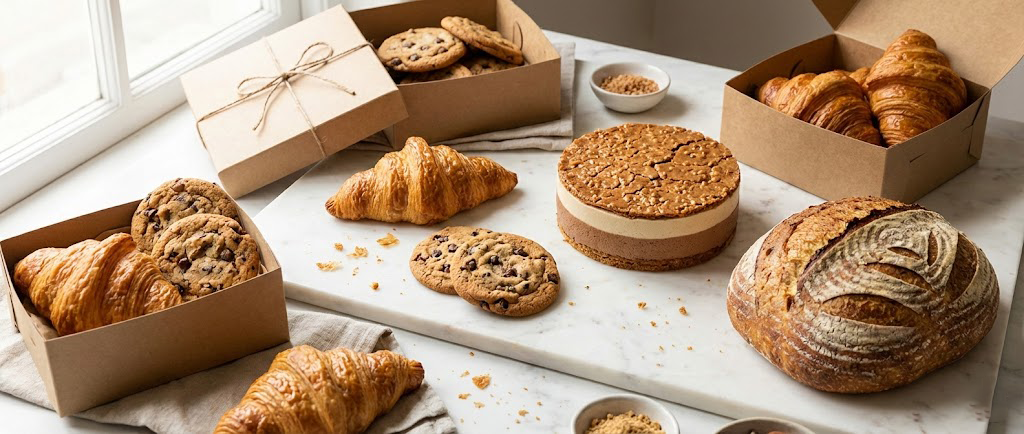
You spent two hours laminating croissant dough. Your cookie edges came out perfectly crisp. Your layered mousse cake has a crackly praline top sitting on a soft génoise base. And then — somewhere between your kitchen counter and the customer's hands — it all goes wrong. The croissant is soft and rubbery. The cookies taste stale. The praline is a soggy, sticky mess.
The bake was perfect. The packaging was an afterthought. That's the most common and most avoidable mistake bakers make.
Texture is what separates a good bake from a great one. It is the first sensation your customer experiences — the snap of a well-tempered chocolate shell, the crunch of a perfectly toasted biscuit base, the contrast of a crispy top on a gooey brownie. And unlike flavour, which is hard to evaluate before purchase, texture fails loudly and immediately the moment someone takes a bite. Bad texture means bad reviews, refund requests, and no repeat customers.
The good news: with the right packaging strategy, texture loss is almost entirely preventable. This guide breaks down exactly how to protect crunchy, crusty, and multi-texture baked goods — from the science behind why texture fails to the specific packaging solutions available at Bakeyy.com that will solve your problems.
Why Does Texture Fail? The Science in Plain English
Before you can fix a problem, you need to understand what is actually happening. Texture degradation in baked goods comes down to two culprits: moisture migration and gas exchange.
Moisture migration is the movement of water from one area to another — and it is relentless. A crispy cookie, once removed from the oven, begins absorbing moisture from the surrounding air almost immediately. In India's humid climate, this process is dramatically accelerated. A cookie that stays crisp for four hours in an air-conditioned bakery may turn soft within 45 minutes outside in Mumbai or Bangalore during monsoon season. When you package multiple components together — say, a crispy biscuit base with a moist mousse filling — moisture moves from the wet component to the dry one, destroying both textures simultaneously.
Gas exchange is what causes staling in crusty breads, baguettes, and sourdough loaves. Starches in bread retrogrades over time: the molecular structure reorganises, expelling water and causing the crumb to become dry and tough. A hard crust, meanwhile, softens as it absorbs moisture from both the interior crumb and the external environment. The result is the worst of both worlds — dry inside, leathery outside.
Understanding these two mechanisms tells you what to look for in packaging. You need materials that control moisture transfer, and structures that manage airflow — enough to prevent complete sealing (which traps steam and destroys crunch) but enough to protect from external humidity.
Packaging for Crunchy Goods: Cookies, Biscuits, and Crumbly Treats
Cookies, biscotti, shortbread, and crispy meringues all share the same packaging challenge: they need to stay dry. Any moisture is the enemy. This sounds simple until you realise that completely sealing them in an airtight environment also traps residual moisture from baking, which softens them from the inside.
The professional approach is to let freshly baked crunchy goods cool completely — and we mean completely, at least an hour at room temperature on a wire rack — before packaging. This allows residual steam to escape. Only then should you seal them.
For individual portions or small quantities, zip lock pouches from Bakeyy.com are excellent. The resealable zip top lets customers maintain freshness after opening, which significantly reduces complaints. The transparent front also lets the product sell itself — a beautiful cookie deserves to be seen.
For gift packaging or retail presentation, cookie boxes and brownie boxes offer a more premium feel. Choose boxes with a snug fit — too much air space inside a box allows humidity to settle around your product. If you are in a high-humidity region or packaging during monsoon, consider adding a small food-grade silica gel desiccant packet inside the box or pouch. Desiccants absorb ambient moisture and can extend the crunch life of cookies by two to three days, which matters enormously for D2C bakeries sending orders by courier.
For volume sales through bakery counters or wholesale, paper D-cut bags work well for cookies sold by weight or piece. Paper allows slight breathability, which prevents condensation buildup in hot weather. However, paper alone is not sufficient for extended storage — use it for same-day counter sales only.
A professional tip: never mix crunchy and moist items in the same package unless you have a physical barrier between them. A brownie and a macaroon in the same box will ruin each other within hours.
Packaging for Crusty Goods: Croissants, Bread, and Pastry
Crusty baked goods are the most difficult to protect because their texture depends on a precise balance of moisture. A sourdough crust is crispy because its surface has been dehydrated during baking. A croissant's shatter comes from the thin, dry laminated layers. The moment you put them in a sealed bag, the steam trapped inside begins to soften that crust from within.
This is why traditional bakers use paper bags for bread — paper breathes, allowing steam to escape while providing a barrier against dust and handling. Bakeyy's paper D-cut bags are ideal for artisan bread loaves, sourdough, and rustic rolls meant for same-day consumption. The paper structure lets your bread breathe without exposing it to the environment entirely.
For croissants and laminated pastries sold in cafés or cloud kitchens, the best approach is to package each item individually in a paper bag or wrap, then place them loosely in a pastry box with enough space that they are not crushed. Avoid plastic wrapping for croissants entirely — within 30 minutes, a plastic-wrapped croissant will have a completely soft, steamed crust.
If you are shipping croissants or need them to hold for 24+ hours (for hotel buffets or corporate orders, for example), consider a two-stage approach: pack the croissants in a partially open paper package inside a breathable outer box, and provide reheating instructions. A 5-minute refresh in a 180°C oven restores significant crunch, and customers who know this will rate their experience much higher. Include a simple instruction card in your packaging — this is a small touch that adds perceived value and builds loyalty.
For artisan bread sold wholesale or through subscription boxes, paper bags with a side gusset allow you to fit larger loaves while still maintaining breathability. Seal the top with a bread clip or twist tie rather than heat sealing, which traps steam.
The Multi-Texture Challenge: Protecting Contrast in Layered Desserts
Multi-texture desserts — entremets, tarts, cheesecakes with crumb bases, lava cakes, mille-feuille, and similar creations — are the pinnacle of bakery craft. They are also the most packaging-intensive because you are dealing with multiple components that each have different moisture levels, and your job is to prevent them from equalising during transit and storage.
The key principles for multi-texture packaging are:
Structural support first. A layered dessert that moves around in its box will deform. Components will separate, fillings will slide, crumb elements will shatter. Your packaging needs to hold the product firmly in place. Cake boards from Bakeyy.com are essential here — they provide a rigid base that prevents flex during handling. Choose a board that fits the footprint of your dessert precisely; a board that is too large allows movement, while one that is too small provides no protection at the edges.
Height matters. When choosing a box for a layered dessert, the interior height should be at least 1.5 to 2 cm taller than the product. This prevents the lid from pressing down on delicate top layers (crushing a praline decoration or smearing a ganache mirror glaze). Browse Bakeyy's full box range to find options with the right height for your specific products.
Separate moisture zones where possible. For desserts like tarts (crispy shell + moist filling), assemble as close to delivery time as possible. If you must pre-assemble, use a thin layer of tempered chocolate brushed onto the inside of the tart shell before adding filling — it acts as a moisture barrier and buys you several hours of texture protection. Similarly, crème brûlée toppings should be torched and packaged individually, then placed on the custard just before the customer receives it.
Use inserts and dividers. For boxes containing multiple different items — say, an assortment of cookies, a brownie, and a macaron — use physical dividers to prevent texture transfer and protect delicate items from being crushed by heavier ones. Bakeyy's gift box range includes options with inner compartments perfect for this purpose.
Packaging for Delivery: When Your Product Travels
Packaging for in-store pickup and packaging for delivery are fundamentally different problems. When a customer picks up from your counter, they are the last handler. When a product goes on a delivery bike or into a courier box, it will be jostled, tilted, stacked under other packages, and possibly left in a hot delivery bag for 40 minutes.
For delivery-specific packaging of texture-sensitive baked goods, consider the following upgrades:
First, always use a cake board under any product going out for delivery — even cookies and brownies. The board prevents the package from flexing, which is what causes crumbly items to break and cakes to crack.
Second, use boxes with tuck-in lids or auto-lock bases rather than simple tray-and-lid combinations. A box that requires force to open is also a box that resists being accidentally opened by a bump or by being placed upside down. Bakeyy's sturdy cake boxes are designed with this in mind.
Third, for anything with a crunch component on top (streusel, praline, crushed biscuit, tuile), add a small piece of parchment or butter paper between the product and the lid. This prevents the lid from dragging across the surface and destroying your carefully assembled texture contrast.
Fourth, consider your outer packaging for courier shipments. A regular bakery box is not designed to withstand being stacked in a vehicle or sorting facility. For courier orders, double-box: place your product box inside a slightly larger corrugated cardboard outer box with void fill around it. The air gap created by the corrugated outer box also provides thermal insulation, which reduces condensation on your product — a major cause of texture loss in refrigerated items shipped in the Indian summer.
Packaging for Indian Conditions: Humidity, Heat, and Festivals
Indian bakers face packaging challenges that most Western baking guides simply do not address. The combination of high humidity (especially in coastal cities and during monsoon), high temperatures (35°C+ in summer), and the unique demands of festive gifting requires specific strategies.
For humidity management, desiccants are your best friend. Small silica gel packets (food-grade, clearly labelled as non-edible) placed inside sealed pouches and boxes absorb ambient moisture and meaningfully extend the shelf life and texture quality of crunchy goods. Pair these with resealable zip lock pouches for maximum effect.
For high-temperature conditions, avoid packaging that traps heat. Dark-coloured boxes absorb heat from sunlight; where possible, use white or kraft-coloured boxes for products that will be transported in warm conditions. Bakeyy's kraft and white box options give you flexibility here.
For festive gifting — Diwali, Raksha Bandhan, Christmas, Eid — texture protection becomes doubly important because your products may sit in a hamper for several hours or even days before being opened. Use individually sealed inner packaging for each item, then place them in your decorative outer box. A beautifully packaged hamper that contains perfectly textured mithai, cookies, and cakes will be remembered; one where everything has gone soft and stale will not. Explore Bakeyy's gift box collection for premium outer packaging options that do not compromise on inner protection.
Choosing the Right Packaging Material: A Quick Reference
Not all packaging materials perform the same way for texture-sensitive goods. Here is a practical breakdown:
Cardboard boxes (white or kraft): Excellent structural support, moderate moisture resistance, breathable. Best for cakes, pastries, and multi-layer desserts. Shop Bakeyy's box range here.
Clear plastic/OPS boxes: High visual appeal, good moisture barrier, no breathability. Best for refrigerated desserts, mousse cups, and items where appearance drives the sale. Browse Bakeyy's dessert cups and clear containers.
Zip lock pouches: Airtight seal, resealable, transparent. Best for cookies, biscuits, macarons, and dry snack items. Shop Bakeyy's zip lock pouch range.
Paper bags: Breathable, eco-friendly, traditional. Best for crusty bread, croissants, and same-day counter sales. See Bakeyy's paper D-cut bag collection.
Aluminium/foil bags: Excellent moisture and oxygen barrier, good thermal insulation. Best for items requiring extended shelf life or that need temperature maintenance during delivery.
Cake boards: Not packaging in themselves, but essential structural support for any product in a box. Always use a correctly sized board. Find the right size at Bakeyy's cake board collection.
Practical Packaging Checklist for Texture-Sensitive Baked Goods
Before you pack any texture-sensitive product, run through this mental checklist:
Has the product cooled completely? Residual heat creates steam that softens crunchy textures and promotes condensation on cold items. Never rush this step.
Is the packaging size right? Too much empty space allows movement and humidity to accumulate. Too tight crushes delicate structures.
Are moist and dry components separated? If your product has both, either separate them with a barrier or assemble as close to delivery time as possible.
Does delivery packaging add a board and outer protection? A board prevents flex; an outer corrugated box handles the physical abuse of transit.
Have you communicated care instructions? A simple "best consumed within 24 hours" or "refresh in oven for 5 minutes" card inside the package manages expectations and improves the customer experience even if texture has softened slightly by the time they open it.
Final Word: Great Packaging Is Part of the Bake
The best bakers in the world treat packaging as an extension of the craft. You control every variable in the kitchen — hydration, temperature, timing, technique. Your packaging needs to protect all of that work from the moment your product leaves the oven to the moment it reaches your customer's hands.
Texture is the element most at risk during that journey. It is also the element most within your control with the right packaging decisions.
Whether you are a home baker sending monthly subscription boxes, a cloud kitchen managing 50 daily orders, or a wholesale bakery supplying cafés and restaurants, Bakeyy.com has the packaging infrastructure to protect your textures, your reputation, and your repeat business. From resealable pouches for cookies to structurally sound cake boxes, from professional cake boards to premium festive gift boxes — everything you need to send your bakes out into the world the way they deserve to arrive is here.
Shop Bakeyy's complete packaging range and find the right solution for every texture, every product, and every occasion at bakeyy.com/collections.