
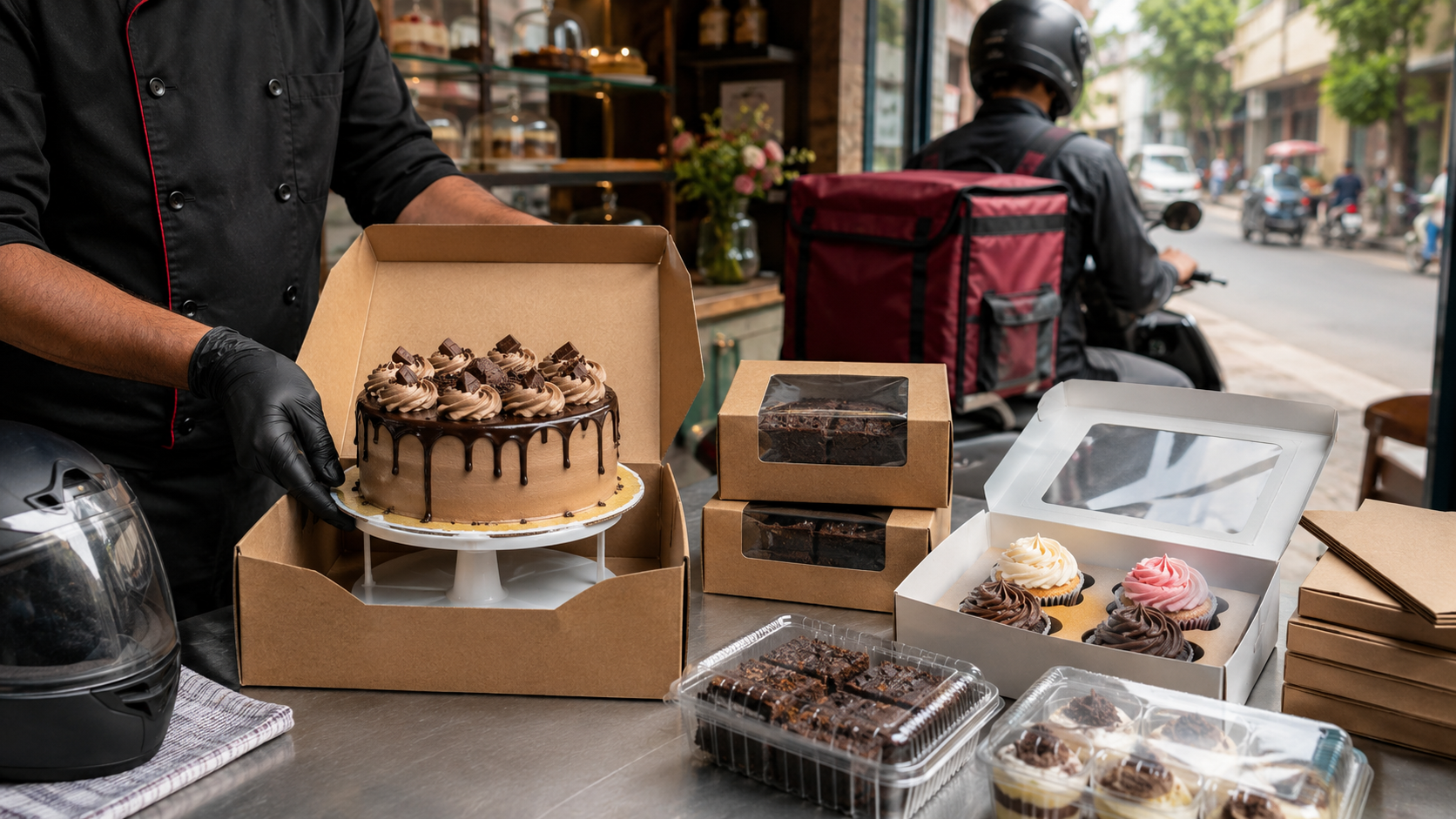
You finish a cake. The buttercream is smooth. The piping is sharp. The topper is straight. You photograph it, close the box and hand it to a delivery rider.
Twenty minutes later, the customer sends you a picture.
The cake has shifted to one side.
The frosting has touched the box.
The topper is leaning.
Or worse, the cake itself is no longer upright.
For a bakery, home baker, cloud kitchen or dessert business, this is one of the most frustrating parts of selling online. The product can be perfect when it leaves your kitchen and still arrive damaged because delivery packaging has to solve a completely different problem from display packaging.
A pretty box is not automatically a delivery-safe box.
Bike delivery introduces braking, acceleration, turns, potholes, speed breakers, uneven roads, handling, stacking and sometimes heat or humidity. Cakes respond differently to those forces than brownies. Cupcakes respond differently from tiramisu. Cheesecake packaging cannot be treated exactly like cookie packaging.
This guide explains how to build a bakery delivery packaging system for Indian conditions in 2026, including cakes, tall cakes, brownies, cupcakes, pastries, cheesecakes, tiramisu, mousse and other desserts.
We will also look at one small accessory that many bakers overlook: the Bakeyy Cake Stability Saver Stand, designed specifically to improve cake stability during transportation.
Quick Answer: What Is the Best Packaging for Bakery Delivery?
The safest bakery delivery setup is usually not one product. It is a system.
| Bakery Product | Main Delivery Risk | Recommended Packaging System |
|---|---|---|
| Buttercream Cake | Sliding, frosting contact, leaning | Rigid cake base + correctly fitted cake box + stability support + outer carry bag |
| Tall Cake | High centre of gravity, tipping, side contact | Strong base + tall cake box + additional stability measures + careful upright transport |
| Cupcakes | Tipping and frosting damage | Cupcake box with individual cavity insert |
| Brownies | Sliding, rubbing, broken corners | Close-fitting brownie box or cavity tray |
| Cheesecake | Movement, softening, condensation | Rigid base + close-fitting container + appropriate chilled handling |
| Tiramisu | Leakage and layer movement | Secure PET dessert container with properly fitted lid |
| Mousse | Spillage, topping contact | Individual dessert container with sufficient headroom |
| Cookies | Breakage and movement | Pouch or close-fitting cookie box with secondary protection |
The key idea is simple: stop the product from moving before trying to make the package look premium.
Why Bike Delivery Is Hard on Bakery Products
A bakery box sitting on a counter experiences almost no movement. The same box on a two-wheeler behaves very differently.
Every time the rider accelerates, brakes or turns, the contents inside the package experience movement. If there is free space around a cake board, cupcake, brownie or dessert container, the product can shift within that space.
This is why simply buying a stronger box does not automatically fix delivery damage.
Imagine placing a small cake board inside a much larger cake box. The outer box might be extremely sturdy, but the board still has room to travel from one side to another.
The problem is not only box strength.
It is movement management.
For most bakery deliveries, you are trying to control five things:
- Horizontal movement: sliding from side to side.
- Vertical movement: bouncing when the vehicle goes over uneven roads.
- Tilting: especially dangerous for tall cakes.
- Surface contact: frosting or decorations touching the box or lid.
- Temperature and moisture: especially relevant for chilled desserts and humidity-sensitive packaging.
The best packaging setup reduces several of these risks simultaneously.
The Bakery Delivery Risk Chart
Not every bake needs the same level of protection. A box of dense brownies can tolerate more movement than a tall buttercream cake.
Relative sensitivity during two-wheeler delivery:
Cookies ■■■□□□□□□□
Brownies ■■■■□□□□□□
Cupcakes ■■■■■■□□□□
Cheesecake ■■■■■■■□□□
Mousse ■■■■■■■■□□
Tall Cake ■■■■■■■■■■
This is a practical comparison rather than a regulatory rating. Actual risk changes with the recipe, frosting, cake height, weather, road conditions, packaging and delivery method.
Rule #1: A Cake Delivery System Starts Under the Cake
Many bakers spend most of their packaging budget on the box.
But the first packaging component supporting the cake is actually the cake base or cake board.
A weak or flexible base can allow movement even if the outer box is excellent. A strong cake base gives the finished product a stable platform for lifting, transferring, boxing and delivery.

Bakeyy's cake base collection includes options for different sizes and cake formats. For heavier cakes, the strength and rigidity of the base become particularly important.
Do not choose your board only because it visually matches the cake.
Ask:
- Is it sufficiently rigid for the cake's weight?
- Does it give the cake enough working space without being unnecessarily oversized?
- Will the board itself fit securely inside the chosen box?
- Can the cake be lifted without the base noticeably flexing?
The board, cake and box should be selected together rather than independently.
The Overlooked Delivery Accessory: Cake Saver Stands
If cake delivery is a regular part of your bakery business, the Bakeyy Cake Stability Saver Stand deserves more attention.

The Cake Stability Saver Stand is designed to add stability to a cake during transportation and help reduce unwanted shifting.
That makes it particularly relevant for bakers who frequently send celebration cakes through local delivery riders.
Think of it as another layer in the transport system:
Cake → stable support → strong cake board → well-fitted cake box → secure outer handling.
No accessory can make a badly fitted box or incorrectly supported cake completely delivery-proof. But when you are already using the right board and box, additional stability can address one of the most common delivery problems: movement.
This matters because cake damage often begins with a very small shift.
The cake moves.
Then a decoration touches the wall.
The rider brakes again.
The cake shifts farther.
A tall cake starts leaning.
By the time the order reaches the customer, what began as a few millimetres of movement can become visible damage.
When Should Bakers Consider a Cake Saver Stand?
A cake stability accessory is particularly worth considering when:
- You regularly send cakes through bike delivery.
- The cake has tall buttercream or ganache finishing.
- The order has detailed side decoration.
- The delivery route includes uneven roads or multiple turns.
- The cake is valuable enough that a damaged order would mean an expensive remake or refund.
- You frequently receive complaints about cakes shifting inside boxes.
For simple customer pickup where the cake travels a very short distance in a car on a flat surface, the requirement may be different.
Use additional stability where the delivery risk justifies it.
Explore the Bakeyy Cake Stability Saver Stand →
How to Choose a Cake Box for Delivery
A delivery box should provide adequate clearance around decorations while avoiding excessive unused space.
If the box is too small, frosting, ganache, piping or fondant decorations can touch the walls.
If it is unnecessarily large, the board may have more room to shift.
For detailed sizing guidance, also read Bakeyy's complete cake box size guide.
When selecting your delivery box, check three dimensions:
- Width
- Length
- Height
Height is particularly easy to underestimate.
A cake may be only six inches tall, but toppers, chocolate sails, flowers, macarons, fondant figures or acrylic toppers can significantly increase the total height required.
Tall Cake Boxes for Tall Cakes
Never force a tall cake into a standard-height box.
If the lid touches the topper or buttercream, even perfect bike handling will not save the presentation.

A tall-format box such as Bakeyy's White Cake Box with L-Shape Window gives bakers additional options for tall cakes and decorated desserts.
You can also browse the full Bakeyy cake box collection for different structures and sizes.
Why Tall Cakes Need More Than a Taller Box
A tall cake has a higher centre of mass than a short, wide cake.
That means tilting and sudden directional changes become increasingly important.
The solution is therefore not:
"Just buy a taller box."
The full setup should consider:
- Internal cake construction.
- A rigid supporting board.
- Appropriate cake stability accessories where required.
- Sufficient box height.
- Correct horizontal fit.
- Upright handling.
- Reduced unnecessary movement during handoff and transport.
The 5-Layer Cake Delivery System
| Layer | Purpose |
|---|---|
| 1. Cake structure | Keeps the product itself stable |
| 2. Cake base | Provides a rigid platform |
| 3. Stability support | Helps reduce unwanted movement |
| 4. Cake box | Protects from contact, dust and external handling |
| 5. Outer carry system | Makes handoff and transport easier |
If one of these layers is poorly matched, adding more decoration to the package will not fix the underlying problem.
Should You Chill a Cake Before Delivery?
Many bakeries allow suitable cakes to become properly set before dispatch because a firm finish can generally tolerate handling better than a freshly finished, very soft one.
However, food safety and storage requirements depend on the ingredients and recipe.
Cream, cream cheese, mousse, custard, dairy fillings and other temperature-sensitive components should be handled according to appropriate food-safety requirements rather than a generic internet rule.
Do not assume every cake has the same safe holding conditions.
Packaging Brownies for Bike Delivery
Brownies are easier to transport than tall cakes, but poor packaging can still create a disappointing order.
Common brownie delivery problems include:
- Pieces sliding over one another.
- Toppings sticking to the lid.
- Broken corners.
- Grease transferring onto unsuitable packaging.
- Decorative pieces rubbing together.
The biggest advantage brownies have is their low centre of gravity.
Use that advantage.
Instead of putting four brownies into a huge empty box, select packaging that keeps pieces neatly positioned.

Browse the Bakeyy brownie box collection for different capacities, window styles and presentation formats.
Brownie Delivery Rule: Empty Space Is Your Enemy
If brownies can move freely inside the box, they probably will.
You do not necessarily need to compress them tightly. Instead, choose a box or insert layout appropriate to the number and size of pieces being delivered.
For decorated brownies, also check vertical clearance.
A brownie with a piped ganache swirl, chocolate topper or festive decoration needs more lid clearance than a plain brownie slab.
How to Pack Cupcakes for Bike Delivery
Cupcakes have one major weakness: they are narrow at the bottom and often top-heavy after frosting.
A plain empty box gives a cupcake room to tip.
That is why a cupcake insert matters.

The insert keeps each cupcake in its intended position and prevents several cupcakes from sliding into one another during transport.
Browse Bakeyy's cupcake box collection for single and multi-cupcake formats.
Three Things to Check Before Closing a Cupcake Box
1. Cavity fit
The cavity should suit the cupcake format so the cupcake does not move excessively.
2. Frosting height
Make sure the lid has sufficient clearance above the tallest swirl or topper.
3. Box rigidity
A box that collapses inward can damage frosting even when the cupcake insert works perfectly.
Never Stack Cupcake Boxes Without Testing Them
Stacking saves delivery space, but only if the lower box can safely carry the weight placed above it.
Before using any cupcake packaging for regular delivery, build the box exactly as your staff would, fill it with representative product weight and test the stack.
Packaging specifications vary. Do not assume every paperboard cupcake box has identical compression strength.
Packaging Cheesecake for Delivery
Cheesecake combines several delivery challenges.
It can be relatively heavy, the surface can be delicate, and many recipes require chilled handling.
Use:
- A rigid base.
- A container or box that restricts unnecessary movement.
- A lid with sufficient clearance for toppings.
- Appropriate temperature-controlled handling where the recipe requires it.
Do not put a small cheesecake in a dramatically oversized box merely because that box is available.
The more room the board has to travel, the more difficult movement becomes to control.
Tiramisu, Mousse and Layered Dessert Delivery
For loose or spoonable desserts, box strength is not the first question.
Lid security is.
A dessert container must stay closed during normal handling and should provide enough headroom for toppings.

Transparent formats such as Bakeyy's Oval PET Transparent Food Box with Lid can also allow customers to see layered desserts without opening the packaging.
For additional formats, explore Bakeyy PET boxes and dessert containers with lids.
Flat Lid vs Dome Lid for Dessert Delivery
A flat lid works well where the food comfortably sits below the closure.
A dome lid becomes useful when the dessert includes toppings that extend above the main container.
Examples include:
- Piped cream.
- Chocolate garnishes.
- Fresh fruit.
- Macaron toppers.
- Cookie pieces.
- Decorative mousse finishes.
The mistake is choosing based only on how attractive the container looks.
Always compare the finished dessert height with the available internal height.
How to Package Mini Cakes and Bento Cakes
Mini cakes are shorter and lighter than many celebration cakes, but that does not make them immune to sliding.
The same logic applies:
Base fit + container fit + adequate headroom + stable outer transport.
A clear dome or appropriately sized cake box can work well where presentation is important, provided the product has sufficient protection and the lid does not touch decoration.
Bakeyy's PET packaging range includes several compact dessert and mini-cake formats.
What About Cake Bags?
The cake box protects the cake.
The cake bag helps the human carrying it.
These are different jobs.
A properly sized carry bag can make customer pickup and rider handoff easier because the box is less awkward to grip directly.
Browse Bakeyy's cake packaging bags if you want an additional carry layer around suitable cake boxes.
But remember: a carry bag does not correct movement inside a badly fitted cake box.
The Correct Order of Priorities
For delivery packaging, think in this order:
- Product stability
- Food-contact suitability
- Correct size
- Structural protection
- Closure security
- Ease of carrying
- Appearance and branding
You want beautiful packaging—but beauty should sit on top of good engineering.
Delivery Distance: 2 km vs 5 km vs 10 km
There is no universal kilometre at which a cake suddenly becomes unsafe to deliver. Road quality, traffic, weather, rider behaviour, cake construction and packaging all matter.
Still, distance is useful as an internal bakery planning variable.
| Delivery Type | Practical Approach |
|---|---|
| Short local delivery | Use your standard tested packaging system; do not reduce support simply because the destination is nearby. |
| Medium local delivery | Pay more attention to movement, box fit, stability and chilled handling where applicable. |
| Longer city delivery | Treat packaging, route, product choice and rider instructions as one system; consider whether highly fragile products are appropriate for the route at all. |
A ten-kilometre smooth ride can sometimes expose a package to less disturbance than a two-kilometre route filled with rough roads and sudden stops.
Distance alone is not the complete risk score.
Create a Delivery Difficulty Score for Your Bakery
Instead of asking only, "How far is the customer?", score the order using several factors.
| Factor | Lower Risk | Higher Risk |
|---|---|---|
| Product | Cookies / plain brownies | Tall decorated cake |
| Height | Low | Tall |
| Finish | Firm / protected | Soft / exposed |
| Packaging fit | Close and tested | Large unused space |
| Route | Smoother | Rough / many speed breakers |
| Weather exposure | Controlled | Hot, humid or rainy conditions |
| Delivery duration | Short | Extended |
If several columns fall into the higher-risk side, upgrade the delivery plan rather than simply adding more stickers to the box.
Summer Bakery Delivery in India
Heat can affect both food and packaging performance.
The correct response depends heavily on the recipe.
Do not publish one blanket temperature rule for every buttercream, ganache, mousse or cheesecake because ingredient formulations vary.
Instead:
- Know the storage requirements of your specific recipe.
- Minimise unnecessary time between packing and dispatch.
- Use suitable insulated or temperature-controlled transport when required.
- Avoid leaving temperature-sensitive orders waiting in direct sun.
- Give customers appropriate storage instructions.
Monsoon Bakery Delivery
Rain introduces a different problem: external moisture.
Paperboard packaging that becomes wet can lose rigidity, which is particularly undesirable for a cake box supporting a valuable order.
During rainy conditions, consider a secondary outer layer appropriate for the package and ensure the rider's delivery bag provides protection from direct rain exposure.
Do not allow an attractive paper box to become the only barrier between the product and heavy rain.
Condensation: The Packaging Problem Bakers Forget
A very cold dessert moved into warm, humid air can develop condensation on surfaces.
For clear packaging, this can also affect presentation.
Build your packing workflow around your actual product and storage process, and test what happens from refrigerator to dispatch to customer handoff.
Do not evaluate packaging only while it is sitting on your kitchen counter.
The 15-Minute Packaging Stress Test
Before buying hundreds of units of new packaging, test it.
You do not need a laboratory to identify obvious problems.
Prepare a representative product or weighted test item and package it exactly as it would leave your bakery.
Then check:
- Does the board move inside the box?
- Does the lid stay closed?
- Does the box deform when lifted?
- Does a cupcake leave its cavity?
- Does dessert touch the lid?
- Can the carry bag support the packed box comfortably?
- Does condensation weaken or obscure the packaging?
Then perform a controlled transport test on the type of route you actually serve.
A packaging sample that looks perfect on a table may behave very differently after real movement.
Test Before You Buy in Bulk
Wholesale packaging can reduce per-order cost, but the cheapest box is expensive if it causes remakes.
Before standardising a new box:
- Order or test the format.
- Assemble it using your normal staff process.
- Add the actual board or insert.
- Pack a representative product.
- Run a delivery test.
- Inspect the product immediately afterward.
- Only then decide whether to purchase larger quantities.
Packaging Cost Per Order: Calculate the Whole System
When bakers calculate packaging costs, many only count the box.
That understates the real cost.
Your packaging cost per cake may include:
- Cake base.
- Cake box.
- Cake stability accessory.
- Carry bag.
- Sticker or label.
- Tape or sealing material.
- Thank-you card.
- Insulation or secondary delivery packaging where required.
Use this formula:
Total packaging cost per order = primary packaging + support components + secondary packaging + branding materials.
Then compare that cost with the cost of a failed delivery.
A damaged premium cake can mean:
- Refunding the customer.
- Remaking the product.
- Sending a replacement.
- Paying a second delivery fee.
- Losing the customer's trust.
- Receiving a negative review.
This is why spending a small additional amount on appropriate stability and support can make economic sense for higher-risk orders.
Don't Over-Pack Everything
The opposite problem also exists.
Not every brownie needs the same packaging system as a ₹5,000 celebration cake.
Good packaging is not about adding as many layers as possible.
It is about matching protection to risk.
A simple cookie order might need an appropriate food-grade pouch and secondary bag.
A six-cupcake order benefits from a cavity insert.
A tall custom cake may justify a strong base, tall box, stability accessory and carefully planned delivery.
Packaging by Product: The Bakeyy Selector
| You Sell | Start Here |
|---|---|
| Celebration Cakes | Cake Boxes |
| Tall Cakes | Tall L-Shape Window Cake Box |
| Cakes Requiring Added Delivery Stability | Cake Stability Saver Stand |
| Cake Support | Cake Bases |
| Cupcakes | Cupcake Boxes |
| Brownies | Brownie Boxes |
| Tiramisu & Mousse | Dessert Containers |
| Clear Dessert Packaging | PET Boxes |
| Outer Cake Carry Packaging | Cake Bags |
Rider Handoff Matters More Than Bakers Think
You can design excellent packaging and still lose control at the final handoff.
When a rider arrives:
- Hand over the package upright.
- Clearly communicate that it contains a cake or fragile dessert.
- Avoid placing unrelated heavy orders on top.
- Check that the delivery bag can accommodate the package without forcing or tilting it.
- Do not dispatch if the package obviously cannot remain in the required orientation.
For highly valuable custom cakes, some bakeries choose dedicated delivery rather than treating the order like ordinary takeaway food.
That decision should depend on the value and fragility of the cake.
Create a "Fragile Cake" SOP for Staff
If you operate a growing bakery, do not leave delivery packaging entirely to individual judgement.
Create an internal standard operating procedure.
For example:
| Order Type | Required Packaging |
|---|---|
| Standard Cake | Approved board + matched cake box |
| Tall Cake | Heavy-duty base + tall box + stability review |
| Bike-Delivered Fragile Cake | Approved base + box + Cake Stability Saver + rider instruction |
| Cupcakes | Cavity box only |
| Liquid/Soft Dessert | Approved secure-lid container |
A checklist creates consistency even when different employees pack different orders.
Bakery Delivery Packing Checklist
Before the order leaves:
- Is the finished product sufficiently set for its intended handling?
- Is the cake or dessert on the correct support?
- Does the base fit the box?
- Is there enough clearance around frosting and decorations?
- Is there unnecessary empty space?
- Has appropriate additional stability been used where required?
- Is the lid fully closed?
- Is the box structurally sound?
- Are chilled products being handled appropriately?
- Is the outside of the package clean?
- Is the package protected from rain where necessary?
- Can the rider keep it upright?
- Has the rider been told that the package is fragile?
Food-Safety and Packaging Compliance in India
Packaging decisions are not purely aesthetic.
Under India's Food Safety and Standards (Packaging) Regulations, packaging materials that come into direct contact with food are required to be of food-grade quality. The regulations also require packaging to be suitable for the food, storage conditions and transportation conditions, and to withstand stresses encountered during normal transportation.
For bakery businesses, this reinforces a useful principle:
Do not choose food packaging solely because it looks attractive on Instagram.
Use materials intended and suitable for the food and the way it will be stored, handled and transported.
Food businesses should check the latest applicable FSSAI requirements and amendments for their operations rather than relying on old social-media packaging advice.
Common Bakery Delivery Packaging Mistakes
1. Using a Box That Is Much Too Large
More room does not always mean more protection.
Extra room can become movement space.
2. Using a Weak Cake Base
The outer box cannot compensate for a base that flexes under the product.
3. Ignoring Cake Height
Measure the topper and decoration, not only the sponge.
4. Sending Cupcakes Without Inserts
A beautiful cupcake cannot stay upright reliably if it can move freely around a large box.
5. Using a Loose Dessert Lid
A premium-looking container is useless if the closure is not appropriate for delivery.
6. Treating All Cakes the Same
A short tea cake and a tall buttercream celebration cake have different delivery risks.
7. Testing Packaging Only on a Table
Your customer is not receiving the order from your kitchen table.
Test the full journey.
8. Forgetting the Rider Handoff
The package needs to fit the actual delivery setup.
9. Spending on Branding Before Stability
A foil sticker cannot save a cake that has slid into the side of its box.
What Is the Best Packaging for a Cake Delivered on a Bike?
For most decorated cakes, start with a rigid cake base, select a properly sized cake box with adequate height, reduce unnecessary internal movement and add suitable stability measures for higher-risk deliveries.
For bakers dealing with frequent cake shifting, the Bakeyy Cake Stability Saver Stand can become part of this delivery system.
Does a Cake Saver Stand Replace a Cake Board?
No. They solve different parts of the transport problem.
The cake board provides the main platform supporting the cake. A cake stability accessory is an additional transport-support measure. Follow the intended product usage and build the complete packaging system around an appropriate cake base and box.
Should a Cake Box Be Tight Around the Cake?
The cake itself should not be pressed against the box.
You need clearance for frosting and decorations.
At the same time, the box should not be so oversized that the cake board has excessive room to move.
Think appropriate clearance, not "as tight as possible" or "as large as possible."
How Do I Stop Cupcakes From Falling Over During Delivery?
Use a cupcake box designed with individual cavities or inserts, select the correct cavity format and make sure the lid gives frosting enough vertical clearance.
Explore cupcake packaging at Bakeyy.
How Do I Deliver Brownies Without Them Moving?
Choose packaging close to the quantity and size of brownies being packed. Cavity boxes, dividers or correctly fitted brownie packaging can reduce movement and contact between pieces.
Explore brownie boxes.
Which Packaging Is Best for Tiramisu Delivery?
Tiramisu normally benefits from a rigid food-grade dessert container with a secure, appropriately fitted lid and suitable storage and temperature handling for the recipe.
Clear PET containers are popular when visible layers are part of the presentation.
Can I Send a Tall Cake Through Regular Bike Delivery?
It depends on the cake structure, packaging, route, weather, rider setup and overall risk.
A tall cake should receive more transport planning than an ordinary low-profile cake.
For particularly fragile or expensive cakes, dedicated delivery may be worth considering.
Is a Cake Bag Enough for Delivery?
No.
A cake bag is primarily an outer carrying layer. It does not replace the cake base, cake box or stability measures required inside the package.
What Should a Home Baker Keep in Stock for Delivery Orders?
A practical core delivery-packaging inventory can include:
- Your most frequently used cake box sizes.
- Matching cake bases.
- Tall cake boxes where required.
- Cake Stability Saver Stands for higher-risk cake deliveries.
- Cupcake boxes with inserts.
- Brownie boxes.
- Secure dessert containers.
- PET boxes.
- Cake carry bags.
- Tape, labels and branding materials.
Build a Packaging System, Not a Packaging Shelf
A bakery can own fifty different boxes and still have poor delivery packaging.
What matters is whether the products work together.
Your cake base needs to suit your cake.
Your cake box needs to suit the base.
Your box height needs to suit the decoration.
Your stability setup needs to suit the delivery risk.
Your carry packaging needs to suit the box.
Your rider needs to be able to transport the final package in the correct orientation.
When those pieces are selected as a system, delivery becomes much more predictable.
Final Takeaway
Customers do not see the cake when it leaves your kitchen.
They judge the cake that reaches their door.
That means delivery packaging is part of the product.
For cakes, start with structure, a strong cake base, a correctly sized box and additional stability where required. For cupcakes, use inserts. For brownies, control empty space. For mousse and tiramisu, prioritise secure closures and suitable food-contact packaging. For chilled desserts, build the delivery process around the requirements of the actual recipe.
And if cake shifting is a recurring problem in your delivery orders, do not focus only on buying a thicker box.
Look at the entire support system.
The Bakeyy Cake Stability Saver Stand is a simple addition designed specifically for secure cake transportation and can be paired with the right cake base and cake box to create a more complete delivery setup.
Shop bakery delivery packaging at Bakeyy:
- Cake Boxes
- Cake Bases
- Cake Stability Saver Stand
- Cupcake Boxes
- Brownie Boxes
- Dessert Containers
- PET Boxes
- Cake Bags
Whether you are a home baker, café, cloud kitchen or professional bakery, the goal is the same: make sure the product your customer opens looks as close as possible to the product you packed.