

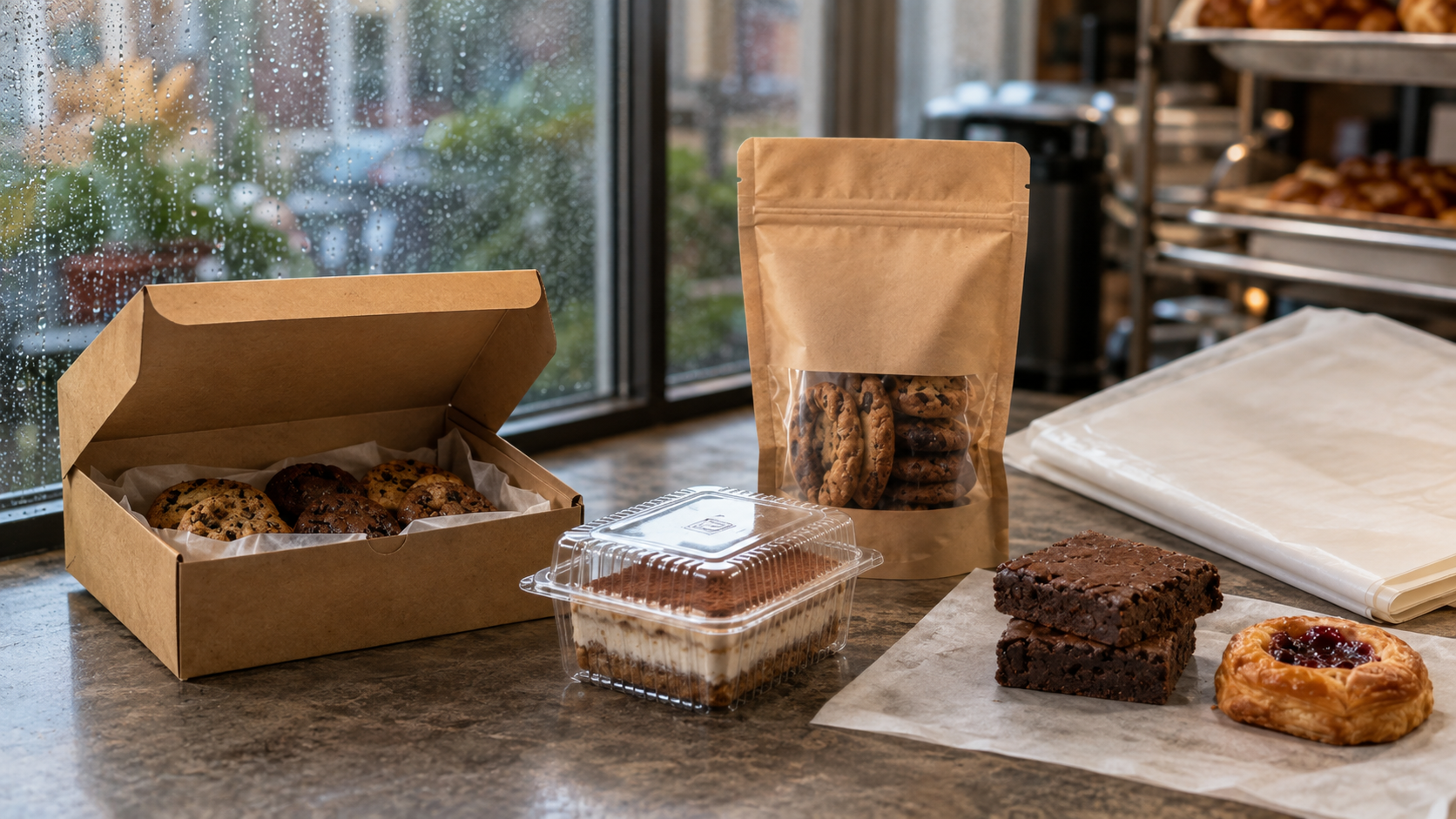
Quick answer: There is no single “best” bakery packaging material for the Indian monsoon. For dry, crisp products such as cookies, biscotti, granola and dry snacks, a properly closed multilayer pouch generally gives better protection from humid air than a plain kraft box or butter paper alone. Rigid PET containers are excellent when visibility, grease resistance and physical protection matter, but the lid and closure determine how much moisture exchange still occurs. Kraft boxes remain excellent secondary packaging for structure, presentation and gifting, while butter paper or parchment is best treated as an inner liner, separator or grease-resistant wrap rather than your only defence against monsoon humidity.
The most reliable monsoon system is therefore often layered packaging: the material touching or immediately enclosing the food manages grease and moisture, while the outer box manages structure, branding and delivery.
If your cookies turn soft within hours, brownie boxes develop oily marks, macarons lose their crisp shells, tea cakes feel damp on the outside, or paper boxes begin to soften during rainy-season storage, the problem may not be your recipe. It may be a mismatch between the food, the packaging material, the closure and the humidity around it.
This guide compares kraft paperboard boxes, rigid PET packaging, flexible multilayer pouches and butter/parchment paper specifically from the point of view of Indian home bakers, cafés, dessert brands, cloud kitchens and gifting businesses operating through humid or rainy conditions.
For a broader overview of bakery boxes, bags, gifting supplies and delivery packaging, first bookmark Bakeyy's Complete Guide to Bakery Packaging for Home Bakers in India. This article goes deeper into one problem: what changes when humidity becomes the enemy?
Important methodology note: The ratings and charts in this article are practical decision scores based on packaging-material behaviour, current Bakeyy product specifications and published packaging science. They are not fabricated laboratory WVTR measurements of Bakeyy products. Exact water-vapour transmission depends on material composition, thickness, coatings, seals, temperature, relative humidity and package construction. A repeatable bakery QC test is included later in this guide if you want to measure your own finished packs.
Why Indian Monsoon Humidity Changes Bakery Packaging
Bakery products constantly exchange moisture with their surroundings. A crisp cookie, brittle, wafer, cereal cluster or crunchy biscuit has a very different moisture profile from the air around it during humid weather. If the packaging allows enough water vapour to move through or enter through the closure, the product can absorb moisture and lose crispness.
At the other end of the spectrum, a warm or high-moisture product packed too quickly can release moisture inside a package. If that moisture cannot escape, it can condense on lids or surfaces. That is why “seal everything as tightly as possible” is not a complete monsoon strategy. The right packaging depends on whether you are trying to keep outside humidity away from a dry product, manage moisture released by the food itself, or do both.
Relative humidity also affects paper-based packaging itself. Cellulose-based kraft paper is naturally moisture-sensitive. Published research describes kraft paper as hygroscopic and porous, which is why untreated kraft alone is not an ideal water-vapour barrier in high-relative-humidity environments. Coatings, laminations and inner films can change that performance significantly.
This is one reason two packages that both look “kraft” can behave completely differently. A simple kraft brownie box and a three-layer laminated kraft pouch are not the same packaging system.
Similarly, “PET” tells you the main plastic material but not whether a finished container is hermetically sealed. A rigid PET box with a snap-on lid may resist direct wetting and provide a useful polymer barrier, but air and moisture can still move through an imperfect closure. A heat-sealed flexible pouch is different again.
The monsoon packaging question is therefore not:
“Is paper better than plastic?”
It is:
“What barrier, closure, structure and food-contact system does this particular bake require?”
Kraft vs PET vs Pouches vs Butter Paper: Quick Comparison
| Packaging Type | Monsoon Moisture Protection | Grease Handling | Physical Protection | Product Visibility | Best Role |
|---|---|---|---|---|---|
| Plain kraft paperboard box | Low when used alone | Low to moderate depending on coating/liner | Good | Low, or good with a window | Secondary box, presentation, delivery structure |
| Rigid PET container with fitted lid | Moderate to good; closure matters | Very good | Good | Excellent | Desserts, individual portions, display and transport |
| Multilayer resealable pouch | Good to very good when correctly closed; exact laminate matters | Very good | Low against crushing | Varies by window/design | Cookies, granola, dry snacks, dry fruits and individually packed bakes |
| Butter/parchment/greaseproof paper | Low as a standalone humidity barrier | Good for grease separation | Low | None | Inner wrap, liner, separator and presentation layer |
Important: These are application-level comparisons, not certified barrier values for every product sold under these material names. A coated paperboard, laminated paper pouch or specialised PET structure can perform differently from a basic version of the material.
Chart: Relative Monsoon Protection for a Dry Bakery Product
The following is an editorial decision chart for a typical dry, crisp bakery product exposed to humid ambient air. It is not a laboratory certification.
| Well-closed multilayer pouch | ████████░░ | 4/5 |
| Rigid PET container with well-fitting lid | ███████░░░ | 3.5/5 |
| Kraft paperboard box alone | ██░░░░░░░░ | 1/5 |
| Butter/parchment paper alone | ██░░░░░░░░ | 1/5 |
A better way to read this chart is: use pouches for moisture barrier, PET for visibility plus structure, kraft for secondary presentation and butter paper for food separation/grease management. Combining materials is often stronger than expecting one pack to solve every problem.
1. Kraft Packaging in the Monsoon: Beautiful, Strong, but Not a Moisture Barrier by Itself
Kraft packaging is popular for good reason. It looks warm, handmade and premium, works beautifully with stickers and ribbons, stacks well, and gives bakeries a natural visual identity. For brownies, cookies, tea cakes, cupcakes and festive gifting, kraft remains one of the most versatile packaging styles available.
But a kraft box should not automatically be treated as humidity-proof.
Paper fibres can absorb moisture from humid air. As the packaging takes up moisture, its feel, stiffness and dimensional stability can change. In practical bakery terms, a kraft box stored in a damp room may feel softer than the same box stored in a dry, air-conditioned room.
That does not make kraft “bad packaging.” It means kraft works best when you give it the correct job.
For example, brownies do not usually need the same external-humidity barrier as a crisp butter cookie. Brownies require structure, grease management, portion separation and an attractive presentation. A kraft brownie box combined with butter paper or a suitable inner wrap can work extremely well for same-day or short local delivery.
Cookies are different. If keeping them crisp for an extended period is important, putting bare cookies directly into a paperboard box and expecting that box to block humid air is a weaker strategy. A closed pouch or another suitable primary barrier inside the kraft box gives you a more robust system.
Bakeyy's Kraft Brownie Boxes with Top and L-Shape Window are made from food-grade kraft paperboard and are designed for brownie and dessert presentation. As checked on 14 August 2026, the live product includes multiple capacities, with stocked top-window 9-brownie and 12-brownie variants.

At the time of this fact check, the 9-brownie top-window variant was ₹550 for a pack of 25, or ₹22 per box before shipping, taxes or future price changes. The stocked 12-brownie top-window variant was ₹700 for 25, or ₹28 per box.
For a brownie brand, the monsoon upgrade is simple: use the kraft box as the structural and branding layer, then manage grease and exposed food surfaces with a suitable food-safe liner or individual inner wrap.
If brownies are one of your main products, interlink this article with Bakeyy's Complete Brownie Packaging Guide and the dedicated Brownie Box collection.
When Is Kraft the Best Choice During Monsoon?
Use kraft confidently when the main packaging job is structure, gifting, branding and local transport.
Good monsoon applications include brownie assortments, individually wrapped cookies arranged in a gift box, tea cakes with an inner wrap, dry cakes, cupcakes protected by cavities, chocolate assortments already protected by individual liners, festive hampers and secondary ecommerce packaging.
Be more cautious when a plain kraft box is the only thing separating a very crisp or moisture-sensitive product from humid ambient air for many hours or days.
And do not assume that every brown-coloured pack has the same sustainability profile. Windows, coatings, laminations, adhesives and liners can change recyclability and end-of-life options. “Kraft look” and “plastic-free” are not synonyms.
2. PET Packaging in the Monsoon: Excellent Visibility, Good Moisture Resistance, but Check the Closure
PET, or polyethylene terephthalate, is widely used in food packaging because it combines clarity, useful mechanical properties and barrier performance. In bakery applications, rigid clear PET packaging is especially useful for desserts where appearance sells the product before the lid is opened.
Think brownie singles, mini pastries, macarons, mousse portions, tiramisu, bento-style desserts, mithai-inspired desserts and café takeaway items.
The first monsoon advantage is obvious: a PET container does not absorb atmospheric moisture the way unprotected paperboard does. It remains visually clean around splashes and humid handling environments, and grease does not migrate into the wall of the container like it can with unlined paper.
The second advantage is visibility. During monsoon delivery, customers and delivery staff do not need to repeatedly open the package to inspect the product. A clear lid allows visual confirmation while the container stays closed.
But PET is not magic. The finished package is only as moisture-resistant as its entire closure system. A loose lid, vent hole, hinge gap or imperfect snap closure can allow humid air to exchange with the headspace. Therefore, do not describe every PET box as “airtight” unless that exact package has been validated for airtightness.
Bakeyy's 1 Brownie / Mini Muffin / Pastry Packaging Box uses a clear lid and food-grade PET packaging format for individual servings. The live Shopify product had Gold, Pink and Turquoise variants in stock when checked on 14 August 2026.

The current pack price was ₹500 for 50 pieces across the stocked colour variants, which works out to ₹10 per container before shipping, taxes or future price changes.
For mousse, tiramisu, cream desserts and other perishable foods, remember that PET packaging does not replace temperature control. Packaging protects the product physically; foods requiring refrigeration still require appropriate refrigerated storage and handling.
You can browse more formats through Bakeyy's Bakery Packaging collection.
When Should a Baker Choose PET in Humid Weather?
PET is especially useful when your priorities are visual presentation, portion control, stackability, grease resistance and protection from touching or crushing.
It is a strong choice for mini brownies, single pastries, cheesecakes, dessert cups, pudding, tiramisu, mousse, macarons that need rigid protection, mithai-style fusion desserts and products displayed in refrigerators.
However, crisp products intended for longer ambient storage may still benefit from an additional moisture-barrier strategy. A visually beautiful rigid container does not automatically provide the same protection as a validated sealed high-barrier package.
3. Multilayer Pouches in the Monsoon: Usually the Strongest Option for Crisp and Dry Products
For cookies, dry snacks, biscotti, granola, dry fruits, tea, coffee and similar low-moisture products, flexible pouches are often the most useful monsoon packaging category.
The reason is not simply “because they are plastic.” Flexible packaging can be built as a multilayer structure in which different layers perform different functions. One may provide printability or stiffness, another may improve barrier properties, and an inner layer may provide a suitable sealing or food-contact surface.
Bakeyy's catalogue is a good illustration of why you should read specifications rather than judging from appearance.
The Window Kraft Zip Lock Pouch looks like a kraft pack, but its current Shopify specification describes a durable three-layer construction, a transparent front window, a metallized barrier, resealable zip closure and 135-micron thickness across its listed sizes.

That is very different from a plain kraft paperboard box. The current product range includes sizes from 50 g through 3 kg, with multiple variants stocked at the time of checking.
The 50 g variant was ₹405 per nominal pack of approximately 98–100 pieces; the 100 g was ₹542; 250 g was ₹575; 500 g was ₹716; and 1 kg was ₹883. Because these packs are packed by weight and may contain approximately 98–100 pieces, per-piece costing should use your actual received count rather than assuming exactly 100.
For a bakery selling crisp cookies during monsoon, this kind of pouch can become the primary protection layer. Put the cookies in the pouch, remove unnecessary headspace without crushing the product, close the zipper carefully, and then place the pouch inside a kraft box if you want premium gifting presentation.
That combination gives each material the job it handles best.
Not Every Pouch Has the Same Barrier
Bakeyy also carries a Milky White Stand-Up Zip Lock Pouch. Its live specification states that it uses a two-layer construction with no foil inside, with thicknesses ranging from 110 to 120 microns depending on size.

As checked on 14 August 2026, its live prices were ₹290 for 100 g, ₹475 for 250 g, ₹570 for 500 g and ₹695 for 1 kg nominal pack sizes, again with approximately 98–100 pieces per pack because the product is packed by weight.
The important lesson is that the words “pouch”, “kraft pouch” and “zip lock” do not tell you the complete barrier story.
Ask:
- How many layers are present?
- Is there a metallized or foil barrier?
- What is the total thickness?
- Does the package have a window?
- Is there a zipper only, or can the package also be heat sealed?
- What food is being packed?
- How long must texture be maintained?
- At what temperature and humidity will it be stored?
A zipper is convenient for the consumer, but a resealable zipper should not automatically be described as a hermetic seal. If you require validated shelf life, test the finished package under your actual storage conditions.
Browse Bakeyy's full Zip Lock Pouches collection when building your dry-product packaging system.
Best Monsoon Uses for Pouches
Cookies: One of the strongest use cases. Let cookies cool completely before packing. For gifting, use the pouch as primary protection and a box as secondary presentation.
Biscotti and rusks: Strong candidates because crisp texture is central to the eating experience.
Granola: A multilayer pouch protects better against humid air than a paper box alone and is efficient to store and transport.
Dry fruits and nuts: Good fit, provided the selected pouch is food-grade and appropriate for the product.
Brownie singles: Useful where individual wrapping is needed, but choose a pouch large enough that the brownie is not compressed or smeared.
Chocolate: Barrier packaging can help protect the product from ambient moisture and odours, but it does not solve India's temperature challenge. Chocolate still needs appropriate heat management.
If preserving crunch is important to your menu, also read Bakeyy's Texture Is King: Packaging That Protects Crunchy, Crusty and Multi-Texture Baked Goods.
4. Butter Paper, Parchment and Greaseproof Paper: Essential Inner Packaging, Weak Standalone Humidity Protection
“Butter paper” is used loosely in the Indian market. Depending on the seller and product, the term may refer to parchment-style baking paper, greaseproof paper or other treated food-wrapping papers.
That distinction matters.
For this article, butter paper should be understood primarily as a food-contact liner, baking liner, separator or grease-resistant wrapper unless the specific product specification says otherwise.
Grease resistance and moisture-vapour resistance are not the same property.
A sheet can perform very well at keeping brownie oil away from the outer box while still allowing significant water-vapour movement compared with a high-barrier film.
Bakeyy's Non-Stick Baking Paper Roll is specified in the current Shopify catalogue as food-grade parchment paper, 30 cm wide and 10 metres long, designed for baking, lining, cooking and food wrapping.

When checked on 14 August 2026, this 10-metre roll was ₹110 and had substantial live inventory.
Bakeyy also carries Printed Butter Paper Sheets for Food Wrapping and Serving, which are especially useful when presentation matters.

At the time of checking, 10 × 10 inch sheets were ₹211 for a pack of 250 and 12 × 12 inch sheets were ₹305 for 250. That makes them useful for brownie wraps, sandwich-style bakery products, tray liners, cookie presentation and grease separation without adding a large packaging cost per order.
Where Butter Paper Works Best During Monsoon
Use butter/parchment paper when you want to prevent sticking, separate products, manage surface grease, keep the inside of the outer box cleaner or improve presentation.
Good applications include lining a kraft brownie box, wrapping individual brownies before placing them in a box, separating layers of cookies, lining pastry trays, placing under slices of tea cake, wrapping baked loaf portions and protecting decorative packaging from direct food contact where appropriate.
Do not rely on a simple paper wrap as your only long-duration humidity barrier for crisp cookies or similar moisture-sensitive products unless you have actually validated the shelf life in that exact system.
What Packaging Should You Use for Each Bakery Product in Monsoon?
| Bakery Product | Primary Monsoon Concern | Recommended Primary Pack | Recommended Secondary Pack |
|---|---|---|---|
| Crisp cookies | Moisture absorption and loss of crunch | Suitable multilayer pouch | Kraft cookie/gift box if needed |
| Biscotti / rusks | Loss of crispness | Barrier pouch | Optional box for gifting |
| Fudgy brownies | Grease, smearing, physical damage | Butter paper / individual food-safe wrap where appropriate | Kraft brownie box or PET single-serve container |
| Brownie gift assortment | Grease + presentation + delivery movement | Butter-paper liner / individual wraps | Structured brownie box |
| Macarons | Humidity + fragile shells | Rigid cavity or PET-style protection | Additional barrier system if long humid exposure is expected |
| Granola | Moisture uptake | Multilayer pouch | None required unless gifting |
| Dry fruits / nuts | Moisture, odour and quality protection | Suitable food-grade multilayer pouch | Gift box if required |
| Tea cake / loaf cake | Surface drying or dampness, grease | Suitable inner wrap | Loaf/kraft box |
| Mousse / tiramisu | Leakage, physical damage, temperature | Rigid PET container with lid | Cold delivery outer pack as required |
| Cupcakes | Smearing, tipping, condensation if packed warm | Cavity-supported cupcake packaging | Delivery bag/outer carton as needed |
| Celebration cake | Structure, cream damage, temperature | Cake board + suitable cake box | Protected delivery environment |
| Chocolate | Heat, moisture, odour transfer | Suitable barrier wrap/pouch or chocolate packaging | Gift box where needed |
The Best Monsoon Packaging Is Often a System, Not a Material
A common packaging mistake is asking one material to do everything.
Imagine you sell premium hazelnut cookies.
You want the pack to keep them crisp, stop breakage during delivery, display your branding and look gift-worthy.
A kraft gift box looks beautiful but is not your strongest moisture barrier.
A flexible pouch helps with moisture protection but does not stop a delivery bag from crushing the cookies.
Butter paper looks premium but does not provide the barrier or structure.
A rigid PET container protects the cookies physically but may not deliver the brand aesthetic you want.
So build a system:
Cookie → appropriate multilayer pouch → kraft presentation box → delivery bag.
Now each layer has a job.
The same principle works with brownies:
Brownie → grease-resistant liner/wrap → kraft brownie box → carry bag.
And chilled dessert:
Dessert → rigid PET container → chilled transport system where required → delivery bag.
Packaging becomes much easier once you stop searching for one universally perfect material.
Chart: Best-Fit Packaging by Bakery Goal
| Your Priority | Kraft Box | PET | Multilayer Pouch | Butter Paper |
|---|---|---|---|---|
| Keep dry cookies crisp | ★☆☆☆☆ | ★★★☆☆ | ★★★★☆ | ★☆☆☆☆ |
| Show the product clearly | ★★★☆☆ with window | ★★★★★ | ★★★☆☆ with window | ★☆☆☆☆ |
| Protect against crushing | ★★★★☆ | ★★★★☆ | ★★☆☆☆ | ★☆☆☆☆ |
| Manage brownie grease | ★★☆☆☆ alone | ★★★★★ | ★★★★☆ | ★★★★☆ |
| Premium rustic gifting | ★★★★★ | ★★★☆☆ | ★★★★☆ kraft-style | ★★★★☆ as inner presentation |
| Reseal after opening | ★☆☆☆☆ | ★★★☆☆ depending on lid | ★★★★★ with zipper | ★☆☆☆☆ |
Again, these stars are editorial selection scores for typical bakery use, not laboratory performance certificates.
Why Cookies Turn Soft During Monsoon Even When the Pouch Looks Closed
This is one of the most common home-bakery complaints during rainy weather.
There are several possible causes.
1. The cookies were packed warm. Warm baked goods can continue releasing water vapour. If they are enclosed too early, that moisture is trapped in the package.
2. The zipper was not fully closed. A tiny unclosed section can become a path for humid air.
3. The pouch has insufficient barrier performance for the intended shelf life. Not all transparent, paper-look or zipper pouches use the same laminate.
4. The package is repeatedly opened. Every opening exchanges the low-humidity package headspace with the room.
5. The cookies themselves contain more residual moisture than your previous batch. Packaging cannot compensate indefinitely for inconsistent baking or cooling.
6. The storage environment is extremely humid. A package that performs acceptably in an air-conditioned kitchen may behave differently in a non-air-conditioned storeroom during a wet week.
This is why commercial shelf life should be established using your own product, process, package and storage conditions rather than copied from another bakery's Instagram post.
Why Kraft Boxes Become Soft or Wavy During Rainy Weather
Paperboard interacts with ambient moisture. If flat-packed boxes are stored against a damp wall, near an open window, directly on a floor, beside a dishwashing area or in a room where humid air circulates continuously, their condition can change before you even assemble them.
For monsoon packaging inventory:
- Keep flat paper boxes in the driest practical storage area.
- Keep cartons raised off the floor.
- Avoid direct contact with walls that may develop dampness.
- Keep unused stock closed in its master packaging where practical.
- Use older inventory first.
- Do not pre-assemble weeks of boxes if your storage area is humid.
- Inspect windows, glue joints and folds before important bulk orders.
This connects directly with Bakeyy's broader Bakery Packaging Supplies Guide, which also recommends dry storage and inventory discipline.
Condensation Is a Packaging Problem Too
Monsoon conversations often focus only on moisture coming into a package, but moisture can also come from the food.
Pack a warm brownie, cake, bread or pastry into a closed container and water vapour can accumulate in the package headspace. If surfaces cool, visible condensation may form.
This can soften crusts, mark products and make a clear package look unattractive.
The first solution is not a more expensive box. It is good process control.
Cool products appropriately before final packing.
For products that must be chilled, follow the correct food-safety process for that food rather than leaving perishable products at ambient temperature simply to avoid condensation.
The packaging should support the food-safety process, not override it.
Can You Use Silica Gel or Desiccant Packs for Bakery Products?
Desiccants can be useful for certain sealed dry-food applications, but they should not be treated as a universal bakery hack.
Only use a sachet supplied and labelled for the intended food-packaging application, keep the sachet intact, ensure consumers cannot mistake it for food, and follow the supplier's directions and applicable food-contact requirements.
A desiccant may make sense for a dry cookie or snack system that has been properly validated. It makes far less sense to casually throw one beside a moist brownie, cheesecake or mousse.
And remember: a desiccant is not a substitute for a poor seal. If humid air continuously enters the pack, the sachet has to keep absorbing moisture from an effectively unlimited environment.
Monsoon Packaging Cost Comparison Using Live Bakeyy Products
Packaging performance matters, but home bakers also need the economics to work. The figures below were checked against Bakeyy's live Shopify catalogue on 14 August 2026. They are a snapshot, not permanent price promises.
| Bakeyy Product | Live Pack / Variant Example | Price Checked | Approx. Unit Cost | Best Monsoon Role |
|---|---|---|---|---|
| PET Brownie / Mini Pastry Box | Pack of 50 | ₹500 | ₹10 each | Single portions, visibility, structure |
| Kraft Brownie Box – 9 Brownie Top Window | Pack of 25 | ₹550 | ₹22 each | Gift box / secondary structured pack |
| Kraft Brownie Box – 12 Brownie Top Window | Pack of 25 | ₹700 | ₹28 each | Large brownie assortments |
| 3-Layer Kraft Window Pouch – 50 g | Approx. 98–100 pieces | ₹405 | Calculate from actual count | Cookies and dry products |
| 3-Layer Kraft Window Pouch – 500 g | Approx. 98–100 pieces | ₹716 | Calculate from actual count | Large cookie / granola packs |
| 2-Layer Milky White Pouch – 100 g | Approx. 98–100 pieces | ₹290 | Calculate from actual count | Economical dry-product packaging |
| Butter / Parchment Paper Roll | 30 cm × 10 m | ₹110 | Depends on cut size | Inner liner and wrapping |
| Printed Butter Paper – 10 × 10 inch | Pack of 250 | ₹211 | Approx. ₹0.84 per sheet | Grease separation and presentation |
Notice what the table reveals: humidity protection does not necessarily require abandoning beautiful packaging. A baker can spend a few rupees on a functional primary pouch, then reserve the more expensive kraft presentation box for orders where gifting value justifies it.
That is often better unit economics than trying to make every product use the same premium package.
Build a Monsoon Packaging SOP for Your Bakery
If you sell professionally, turn packaging into a standard operating procedure rather than choosing materials order by order.
Step 1: Classify the product. Is it crisp and dry, soft and oily, moist and perishable, fragile, or temperature-sensitive?
Step 2: Decide the primary packaging job. Moisture barrier? Grease resistance? Physical protection? Cold storage? Product visibility?
Step 3: Decide the secondary packaging job. Branding? Gifting? Delivery structure? Carry convenience?
Step 4: Standardise one approved packaging combination. For example, “200 g cookies = 250 g barrier pouch + medium cookie box for gift orders.”
Step 5: Record packaging cost per SKU. Include pouch, box, liner, sticker, ribbon and carry bag rather than counting only the visible box.
Step 6: Record packing conditions. If possible, put an inexpensive hygrometer in your packing room and note unusually humid days during QC testing.
Step 7: Photograph approved packing. Your staff or helpers should be able to reproduce the presentation without guessing.
Step 8: Re-test whenever you change the recipe, pack, supplier or portion size.
Bakeyy Monsoon Packaging Test: A Practical QC Protocol You Can Actually Run
Instead of claiming that one pack keeps a cookie crisp for a fixed number of days without testing, run your own small comparison.
You need one batch of identical cookies or another test product, four packaging systems, a digital kitchen scale, labels, a notebook, a room hygrometer if available, and enough product for duplicate samples.
Test A: Product in kraft box only.
Test B: Product in rigid PET container.
Test C: Product in your chosen closed pouch.
Test D: Product wrapped in butter paper and placed in the same kraft box used in Test A.
Pack all samples from the same batch at the same time after appropriate cooling.
Record:
- Date and time packed
- Room temperature if available
- Room relative humidity if available
- Package product and variant
- Initial product weight
- Visual appearance
- Aroma
- Surface feel
- Snap/crispness using the same internal scoring method
- Any condensation
- Any oil migration
- Any deformation of the package
Evaluate at predetermined intervals appropriate to the product, for example after 6 hours, 24 hours and subsequent days if your intended shelf life requires it.
Do not repeatedly open the same package for every reading if that would alter the test. Prepare separate packages for each evaluation point when possible.
If you want stronger data, weigh the product samples and record percentage mass change. For commercial shelf-life claims involving microbiological safety, sensory quality alone is not sufficient; use appropriate professional food-safety and laboratory support.
Once Bakeyy has genuine test results, this article can be updated with original photographs, measured humidity, sample weights and test outcomes. That would make the page substantially more valuable for search engines and AI answer systems because the data would be genuinely first-party.
Food Safety: What FSSAI Means for Bakery Packaging
India's food-packaging requirements are governed by the Food Safety and Standards Authority of India framework, including the Food Safety and Standards (Packaging) Regulations, 2018 and subsequent amendments and guidance.
For bakers, the practical rule is simple: packaging that comes into contact with food should be supplied as suitable food-contact packaging for its intended use. Do not substitute decorative craft paper, random printed paper, unknown plastic or repurposed non-food packaging for direct food contact simply because it looks attractive.
Also distinguish between primary packaging and secondary decoration. A decorative hamper, potli, flower, ribbon or shredded filler does not necessarily need to touch the food. Protect the food with an appropriate primary pack first.
PET packaging should likewise be selected as food-grade packaging intended for the relevant food application. FSSAI also maintains specific guidance around recycled PET used as food-contact material, so recycled-content claims should not be improvised.
For current regulatory information, refer to the official FSSAI regulations portal rather than relying on an old social-media checklist.
Packaging material is only one part of compliance. Packaged foods may also require appropriate labelling. Your packaging decision should leave enough usable surface area for the product name, ingredients, allergens, quantity, date information and other declarations that apply to your business and product.
Monsoon Packaging for Bengaluru, Mumbai, Chennai, Kochi, Goa, Kolkata, Hyderabad and Delhi
Do not build packaging rules around city stereotypes alone.
A baker in an air-conditioned Bengaluru production room may have a different packaging environment from another baker working in a naturally ventilated kitchen a few kilometres away. A Mumbai bakery near the coast may have different storage exposure from a temperature- and humidity-controlled commercial kitchen. The same applies across Chennai, Kochi, Goa, Kolkata, Hyderabad, Pune and Delhi.
The variable that matters operationally is the condition around your product during cooling, packing, storage and delivery.
A small digital hygrometer can therefore be more useful than saying “this packaging works in Bangalore.” Record your actual conditions and combine them with product testing.
Bengaluru-based businesses can also read Bakeyy's Bakery Packaging in Bangalore Guide for local sourcing and packaging considerations.
Monsoon Mistakes Home Bakers Should Stop Making
Mistake 1: Packing cookies while they are still warm.
Even excellent barrier packaging cannot undo moisture trapped from the product itself.
Mistake 2: Calling every zipper pouch “airtight.”
A zipper is a closure mechanism. Actual airtightness or hermeticity should not be claimed without validation.
Mistake 3: Assuming a kraft-looking pouch is plain paper.
Some kraft-style pouches are multilayer laminated structures. Read the specification.
Mistake 4: Assuming butter paper is a humidity barrier.
It is much more valuable as a grease-resistant liner, separator and wrap.
Mistake 5: Putting a premium box directly around loose crisp cookies for a three-day order.
The box may provide presentation but little protection from ambient moisture. Use an appropriate primary barrier.
Mistake 6: Packing chilled desserts beautifully but ignoring cold handling.
PET helps presentation and physical protection. It does not turn a perishable dessert into an ambient-stable product.
Mistake 7: Keeping cartons on the floor during monsoon.
Your packaging inventory should be protected from dampness before it ever touches an order.
Mistake 8: Copying another bakery's shelf life.
Shelf life depends on recipe, processing, hygiene, water activity, package, seal and storage conditions. Test your system.
Mistake 9: Mixing crisp and moist products in one unpartitioned pack.
Moisture can migrate within a package too. Keep products with incompatible moisture profiles separated.
Mistake 10: Choosing packaging purely by appearance.
Customers see the box. The food experiences the barrier.
Monsoon Packaging Decision Tree
Is the product crisp and dry? Start by evaluating a suitable multilayer pouch. Add kraft secondary packaging only when branding, gifting or crush protection requires it.
Is the product oily or fudgy? Prioritise grease-resistant food contact and physical protection. Butter/parchment paper plus a brownie box can be a practical system.
Is the product chilled and visually attractive? Consider rigid PET packaging with a secure lid, while maintaining the required cold chain.
Is the product fragile? Prioritise rigid structure or cavity support. Moisture barrier alone is useless if the product arrives crushed.
Is the package for gifting? Separate the functional primary pack from the decorative secondary pack. This gives you far more design freedom.
Will the order sit for multiple days? Do not guess. Validate the package with the exact product and storage conditions.
Frequently Asked Questions About Monsoon Bakery Packaging
What is the best packaging for cookies during monsoon in India?
For most crisp cookies, a suitable well-closed multilayer food-grade pouch is a stronger starting point than a plain paperboard box. If you want premium presentation, place the pouch inside a cookie or kraft gift box. Exact shelf life should still be tested with your recipe and chosen packaging.
Are kraft boxes moisture-proof?
Plain kraft paperboard should not be considered moisture-proof. Paper is hygroscopic and can absorb moisture from humid air. Coatings, laminations, inner films and liners can improve performance, so check the specification of the actual package.
Is PET better than kraft in monsoon?
For resistance to ambient moisture and product visibility, rigid PET generally has advantages over unprotected paperboard. Kraft has advantages in structure, branding, gifting aesthetics and paper-based presentation. The correct choice depends on the food and closure system.
Can I store brownies in a kraft box during monsoon?
Yes, a kraft brownie box can work well for brownies, especially for short local delivery, provided you manage grease and direct food contact appropriately with a suitable liner or wrap. If you require extended shelf life, validate the complete system rather than relying on the box alone.
Can butter paper keep cookies crisp?
Butter/parchment/greaseproof paper is not the same as a high moisture-barrier pouch. It is better used for grease control, separation and wrapping. For long crispness retention in humid conditions, evaluate a suitable barrier package.
Should I use PET boxes for macarons?
Rigid PET packaging can be useful because macarons are fragile and benefit from visibility and physical protection. However, humidity can affect macaron texture, so longer storage may require a more complete moisture-control strategy than a loose-fitting clear container alone.
Are zip-lock pouches airtight?
Do not automatically call every zip-lock pouch airtight. Zippers reduce exchange when properly closed, but actual airtight or hermetic performance depends on the package design and seal. Some commercial packaging systems also use a heat seal above the zipper for the first opening.
Should I use a desiccant packet with cookies?
Only consider desiccants intended for the relevant food-packaging application and follow supplier and regulatory instructions. They are not a substitute for the correct package and seal, and they are not appropriate for every bakery product.
Why do my cookies soften after I put them in a pouch?
Possible reasons include packing the cookies before they cooled, incomplete closure, repeated opening, a pouch with insufficient barrier for your target shelf life, high residual moisture in the cookies or very humid storage conditions.
Why does my PET dessert box have water droplets inside?
Condensation can occur when warm or moisture-releasing food is enclosed and the package subsequently cools. Review your cooling, filling and storage process. For chilled or perishable desserts, food safety and temperature control take priority.
What is the best packaging for brownies in rainy weather?
For gift boxes and local delivery, a grease-resistant liner or individual wrap combined with a structured brownie box is practical. PET individual containers are useful for single portions and strong visibility. If brownies are individually sold or transported for longer periods, test whether an additional primary barrier is beneficial.
Which Bakeyy collection should I browse for monsoon packaging?
Start with the Bakery Packaging collection, then narrow by application using the Zip Lock Pouches, Brownie Boxes, Cupcake Boxes and Cake Boxes collections.
The Final Verdict: Kraft vs PET vs Pouches vs Butter Paper
If you remember only one thing from this guide, remember this:
Monsoon packaging is about assigning the right job to the right layer.
Kraft paperboard is excellent for boxes, structure, branding, rustic presentation and gifting, but plain kraft alone is not your strongest defence against atmospheric moisture.
PET is excellent for clear product presentation, grease resistance and rigid physical protection. It is useful for individual desserts and chilled-display packaging, but closure quality still matters and PET packaging does not replace required temperature control.
Multilayer pouches are often the strongest practical choice for protecting dry and crisp bakery products from humid ambient air, particularly when the selected laminate and closure are suited to the product.
Butter paper, parchment and greaseproof paper are valuable food-contact tools for lining, wrapping, grease management and separation, but should normally be paired with another packaging layer when humidity protection is the primary goal.
For many Indian bakeries, the winning monsoon combinations will therefore look like this:
Crisp cookies: multilayer pouch + optional kraft gift box.
Brownies: butter-paper liner or individual wrap + kraft brownie box.
Premium brownie single: rigid PET dessert container.
Granola and dry snacks: multilayer pouch.
Tea cakes and loaf cakes: suitable inner wrap + structured outer box.
Macarons: rigid protection + validated moisture-control strategy for longer humid exposure.
Mousse, tiramisu and chilled desserts: rigid PET container + appropriate refrigeration and transport.
Most importantly, test your own food.
Do not copy a seven-day shelf-life claim from another bakery. Do not assume a kraft window box is waterproof. Do not call every zipper airtight. Do not buy five hundred pieces of a new package before packing an actual batch.
Run a small monsoon test, record the humidity, check the texture, look for condensation, calculate the cost per order and then standardise the combination that works for your bakery.
That is how packaging stops being decoration and becomes part of your product-quality system.
Ready to build your rainy-season packaging setup? Browse Bakeyy's complete bakery packaging range, compare zip lock pouches, explore brownie boxes and choose packaging based on what your food actually needs—not just what looks good in a photograph.