

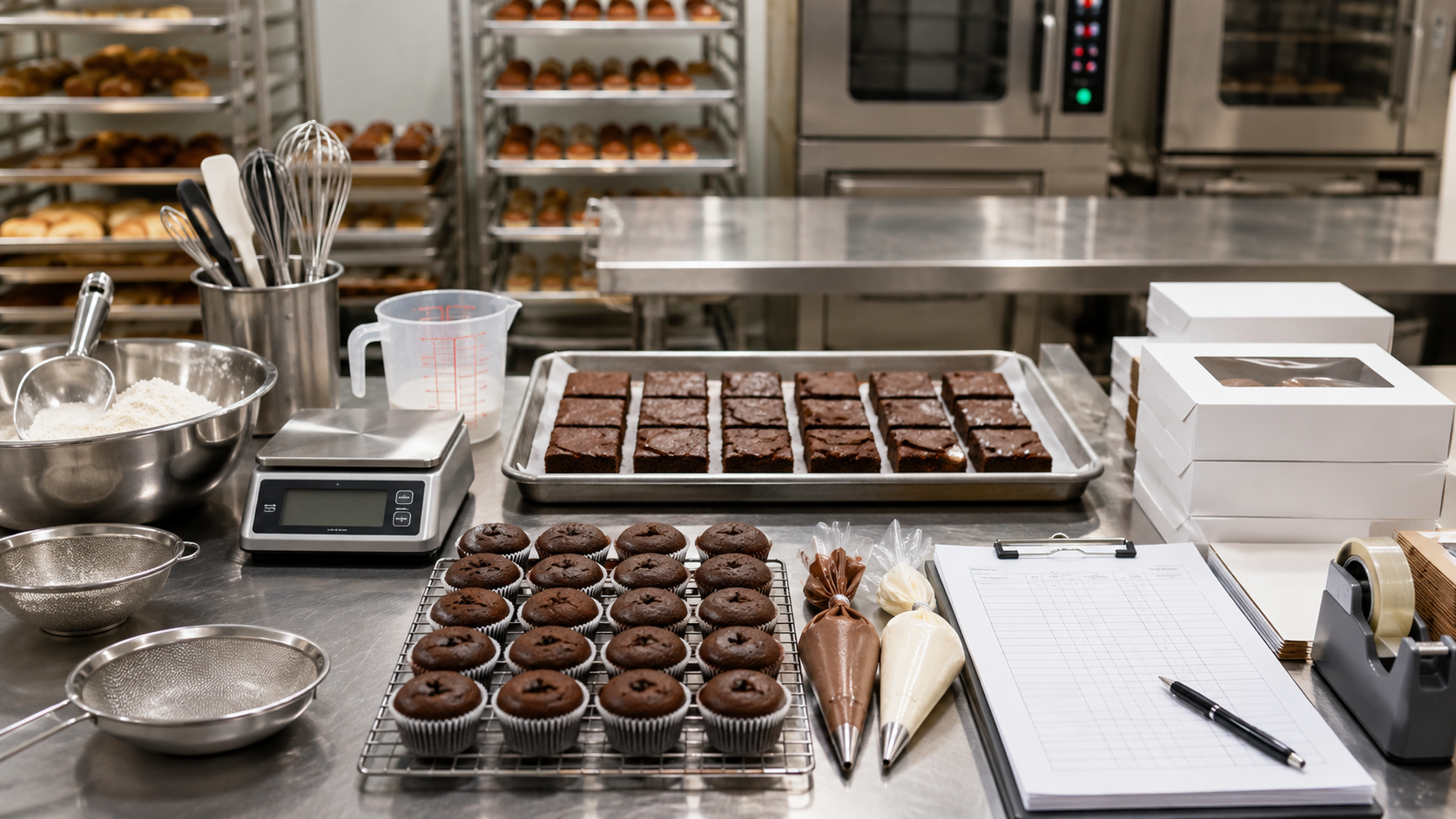
If the chocolate cake you make on Monday tastes different from the same cake you make on Friday, you do not yet have a standardized product.
If one employee fills 420 g of batter into a tin and another fills 500 g, you do not have a standardized process.
If everybody knows the brownie recipe but nobody can tell you which batch of chocolate went into yesterday's brownies, you do not have useful traceability.
And if a customer complains that a box of cookies was unusually soft but your only production record is an order number in WhatsApp, you have very little information to investigate.
This is where a bakery production SOP system becomes useful.
It does not have to mean a 200-page manual.
A home baker can build a surprisingly strong system with five well-designed sheets. A bakery with ten employees may need a larger controlled system with master recipes, production records, cleaning schedules, ingredient receiving records, QC specifications, traceability, training records and corrective-action logs.
The principle is the same at both levels:
Decide how the product should be made. Document that method. Record what actually happened. Compare the result with your standard. Correct anything that went wrong.
This guide shows you how to build that system from scratch.
Quick Answer: What Documents Does a Bakery Actually Need?
If you want the simplest useful version, start with these five:
| Document | What It Does |
|---|---|
| 1. Master Recipe / Product Specification | Defines exactly how the product should be made. |
| 2. Batch Production Sheet | Records what actually happened during one production batch. |
| 3. Finished Product QC Sheet | Checks whether the batch meets your defined standards. |
| 4. Cleaning & Pre-Production Checklist | Confirms that the work area and equipment are ready before production. |
| 5. Deviation / Complaint Log | Records problems, investigation and corrective action. |
That is enough to move a small bakery away from memory-based production.
As the operation grows, you can add:
ingredient receiving checks, approved supplier records, allergen controls, calibration logs, maintenance records, packaging specifications, staff training records, lot traceability, stock rotation records, dispatch records, recall procedures and formal document-control registers.
First Understand the Difference Between an SOP, a Recipe and a Batch Record
These terms are often mixed together, but they perform different jobs.
Standard Operating Procedure — SOP
An SOP explains how a repeatable activity should be performed.
For example:
How to receive ingredients.
How to prepare the production room.
How to make chocolate ganache.
How to clean a planetary mixer.
How to label finished products.
How to deal with a damaged ingredient bag.
How to release a finished batch for dispatch.
The SOP is the instruction.
Master Recipe or Standard Recipe
The master recipe defines exactly how one product is supposed to be produced.
It should contain considerably more information than a recipe copied from Instagram or stored in someone's notebook.
A production-grade recipe can define:
ingredient weights, ingredient specifications, batch size, order of addition, mixing method, mixer speed, mixing time, batter weight, pan or mould, filling weight, oven setting, expected yield, cooling method, finishing instructions, packaging format, storage conditions and QC expectations.
Batch Production Record
The batch sheet records what actually happened.
If the master recipe says:
Target batter per mould: 450 g
the batch record may say:
Actual: 448 g, 452 g, 451 g, 449 g.
If the master recipe identifies a specific chocolate specification, the batch sheet records the lot or batch of chocolate actually used.
This distinction is extremely important.
The recipe tells you what should happen. The batch record tells you what did happen.
QC Specification
The quality-control specification defines what an acceptable finished product looks like.
For a brownie that may include:
target piece weight
dimension
surface appearance
centre texture
cut quality
absence of burnt edges
correct filling or topping
correct packaging
correct label
correct quantity per box
The specification makes quality less subjective.
Instead of:
“Does this look okay?”
your team asks:
“Does this meet BR-QC-01?”
What Professional Food Businesses Do Internationally
The exact paperwork differs between businesses and certification systems, but mature food-production systems usually follow a similar architecture.
| Layer | Purpose | Bakery Example |
|---|---|---|
| Policy / System | Defines overall expectations | Food safety policy |
| SOP | Defines how a process is performed | Ingredient Receiving SOP |
| Master Specification | Defines what a product/process should be | Chocolate Brownie Master Recipe |
| Record | Shows what actually happened | Brownie Batch Record #BR-20260813-02 |
| Verification | Checks that the system is working | Supervisor reviews batch record |
| Deviation / Corrective Action | Controls failures | Wrong filling weight investigated |
| Revision / Improvement | Changes the standard in a controlled way | Recipe version changed from V3 to V4 |
This is much more useful than simply having a folder labelled “SOP”.
A good system creates a loop:
Standard → Production → Record → Check → Correct → Improve.
A Home Baker Does Not Need a Factory-Sized Documentation System
One of the quickest ways to destroy an SOP project is to create too much paperwork.
If one person runs a home bakery and produces twelve products, that person probably does not need sixty SOPs.
The documentation should match the scale and complexity of the operation.
For a small home bakery, we would start with:
| Document | Suggested Scope |
|---|---|
| Master Recipe | One for every regular selling product |
| Batch Sheet | One simple sheet for each production batch |
| Opening / Cleaning Checklist | One daily checklist |
| QC & Packing Check | One section on the batch sheet or separate sheet |
| Problem Log | One running spreadsheet |
Once another baker joins the business, documentation becomes considerably more valuable because the process must now transfer from one person's head into another person's hands.
Step 1: Map Your Bakery's Actual Production Flow
Do this before writing any SOP.
Choose one product and write down every stage from purchasing ingredients to dispatch.
For a cake, the flow might be:
Ingredient receiving → storage → weighing → mixing → pan filling → baking → cooling → trimming → filling → crumb coat → final frosting → decoration → final QC → packing → refrigerated/ambient holding as applicable → dispatch.
For cookies:
Receiving → storage → weighing → mixing → dough resting/chilling if applicable → portioning → baking → cooling → QC → primary packaging → secondary packaging → storage → dispatch.
For bread:
Receiving → weighing → mixing → bulk fermentation → dividing → shaping → proofing → baking → cooling → slicing if applicable → packaging → storage → dispatch.
Do not copy somebody else's flow chart blindly.
Write what actually happens in your kitchen.
Once the sequence is visible, identifying the documents you need becomes much easier.
Step 2: Give Every Controlled Document an Identity
If your business has only three sheets this may feel unnecessary.
Once you have twenty, it becomes extremely useful.
A simple code system could be:
| Prefix | Meaning | Example |
|---|---|---|
| SOP | Standard Operating Procedure | SOP-PROD-001 |
| MR | Master Recipe | MR-BR-001 |
| QC | Quality Specification | QC-BR-001 |
| CLN | Cleaning Procedure | CLN-MIX-001 |
| FRM | Blank Form | FRM-BATCH-001 |
| REC | Completed Record | REC-BR-20260813-01 |
You do not need to copy these exact codes.
The goal is simply to make every document identifiable.
Every SOP Should Have Version Control
Imagine your brownie originally used 280 g flour.
After testing, you change the formula to 250 g.
You update the Google Sheet.
But somebody printed the old recipe three months ago and it is still sitting beside the mixer.
Now you have two “official” recipes.
This is exactly what document control is designed to prevent.
At minimum, every controlled SOP or master recipe should show:
| Field | Example |
|---|---|
| Document Title | Chocolate Brownie Master Recipe |
| Document ID | MR-BR-001 |
| Version | V4 |
| Effective Date | 13 August 2026 |
| Prepared By | Production |
| Approved By | Owner / Head Baker |
| Supersedes | V3 |
When a new version becomes effective, remove or clearly mark old production copies.
Step 3: Build a Proper Master Recipe
This is the most important document in the production system.
A recipe saying:
“Bake until done.”
is not a production specification.
Neither is:
“Whip cream until stiff.”
Those instructions depend too heavily on judgement.
Wherever practical, convert judgement into measurable parameters.
Master Recipe Format
| PRODUCT IDENTIFICATION | |
|---|---|
| Product Name | Chocolate Brownie |
| Product Code | BR-CHO |
| Recipe Version | V1 |
| Standard Batch Yield | 24 pieces |
| Target Finished Piece Weight | Defined by your validated product specification |
| Pan / Mould | Specified size and material |
Then add the formulation:
| Ingredient | Specification | Quantity | Unit |
|---|---|---|---|
| Chocolate | Approved chocolate specification | Your formula | g |
| Fat | Approved butter/oil specification | Your formula | g |
| Sugar | Defined sugar type | Your formula | g |
| Egg / egg replacement | Defined specification | Your formula | g |
| Flour | Defined flour specification | Your formula | g |
Notice the use of grams.
For commercial consistency, weighing ingredients is normally much more controllable than asking different employees to interpret “one cup”, “one heaped spoon” or “half a bowl”.
Specify the Order of Addition
Two bakers can use exactly the same ingredient quantities and still produce different results because they mixed them differently.
Your master recipe should therefore include the sequence.
For example:
| Step | Operation | Target |
|---|---|---|
| 1 | Prepare equipment and ingredients | All ingredients verified and weighed |
| 2 | Combine first ingredient phase | Defined time / visual endpoint |
| 3 | Add second phase | Defined mixer speed and time |
| 4 | Add dry ingredients | Defined mixing endpoint |
| 5 | Deposit into mould | Defined batter weight per mould |
| 6 | Bake | Validated oven program / product endpoint |
| 7 | Cool | Defined handling and cooling procedure |
Do not use the example targets above as universal food-safety limits. Actual processing parameters must be developed and validated for your own product, equipment and applicable requirements.
Standardize the Mould, Not Just the Recipe
A 1 kg bowl of cake batter does not produce a standardized cake if people divide it differently every time.
Specify:
mould dimensions
mould material
batter weight per mould
number of moulds per batch
positioning if oven loading matters
expected finished yield
This becomes particularly important when moving between metal tins and bake-and-serve moulds.
For example, our Bake and Serve Round Paper Mould currently includes several nominal capacity formats, including 100 g, 150 g, 250 g, 500 g and 1000 g options in the product range.

But the product listing itself notes that capacity is approximate and can vary with batter density.
That is exactly why a production SOP should not simply say:
“Use the 500 g mould.”
After testing your recipe, write:
Mould SKU: X
Target batter deposit: Y g
Finished acceptable weight range: internally defined specification
Now the result can be reproduced.
You can explore other standardized production formats through our Bakeware collection.
Step 4: Create the Batch Production Sheet
The master recipe should remain unchanged during routine production.
The batch sheet is the document your team actually fills in.
Start with identification:
| Field | Example |
|---|---|
| Product | Chocolate Brownie |
| Product Code | BR-CHO |
| Recipe Version | V4 |
| Batch Number | BR-20260813-02 |
| Production Date | 13 August 2026 |
| Planned Quantity | 96 pieces |
| Number of Standard Batches | 4 |
| Operator | Initials / name |
The batch number is extremely useful.
A simple format could be:
PRODUCT-DATE-SEQUENCE
Example:
BR-20260813-02
This could mean:
Brownie
13 August 2026
second brownie batch of the day
This is only an example. Use any coding system your team can reliably follow.
Record Ingredient Lots on the Batch Sheet
Your ingredient table should contain both the target quantity and actual information from production.
| Ingredient | Target Qty | Actual Qty | Supplier / Brand | Lot / Batch | Checked By |
|---|---|---|---|---|---|
| Chocolate | Formula | Actual | Approved supplier | Supplier lot | Initial |
| Flour | Formula | Actual | Approved supplier | Supplier lot | Initial |
| Fat | Formula | Actual | Approved supplier | Supplier lot | Initial |
Now imagine a complaint arrives.
Customer:
“The brownies from my Thursday order tasted strange.”
Without batch records, your investigation starts with memory.
With records, you can find:
which batch the customer received
which ingredients were used
which supplier lots were used
who produced the batch
actual production values
QC results
other customers who received the same batch
This is what traceability looks like in practical bakery terms.
Record Process Actuals, Not Just Ingredient Weights
| Process | Standard | Actual | Operator |
|---|---|---|---|
| Mixing | Master recipe specification | Recorded actual | Initial |
| Batter temperature if relevant | Validated product target | Actual | Initial |
| Batter deposit | Defined g per mould | Actual sample results | Initial |
| Oven | Validated program | Actual setting / timing | Initial |
| Cooling | Defined procedure | Actual | Initial |
You do not need to record twenty values simply because you can.
Record the parameters that genuinely influence safety, consistency, quality or yield.
Step 5: Define Quality Before You Try to Control It
“Good brownie” is not a useful QC specification.
“Cake should look premium” is even worse.
Your QC criteria need to be observable or measurable.
A practical finished-product specification might cover:
| QC Parameter | Standard | How to Check | Frequency |
|---|---|---|---|
| Unit Weight | Defined internal range | Calibrated weighing scale | Defined sampling plan |
| Dimensions | Defined range | Measure sample | Per batch / as defined |
| Colour | Approved reference | Visual comparison | Every batch |
| Texture | Defined description | Product evaluation | Defined frequency |
| Foreign Material | None acceptable | Visual/process controls | Continuous / defined check |
| Decoration | Matches approved standard | Visual | Every order where relevant |
| Packaging | Correct SKU | Verification | Every batch |
| Label | Correct approved version | Verification | Every batch |
Create a “Golden Sample” for Visual Products
Not everything in a bakery can be measured with a number.
Decoration is a good example.
If you sell the same signature chocolate cake every day, create an approved reference image showing:
icing height
border style
drip pattern
topping placement
logo placement
cake-board colour
final box presentation
Put the image beside the written specification.
Now new decorators have something concrete to compare against.
Step 6: Treat Packaging as Part of the Product Specification
Production does not finish when the cake is decorated.
If yesterday's cake went into an 8 × 8 × 5 box and today's goes into an 8 × 8 × 4 box, you have changed the finished product system.
Your master product specification should identify:
cake base SKU and size
box SKU and dimensions
cupcake insert if used
pouch specification
dessert tub and lid combination
number of units per box
label version
sticker position
tamper evidence where used
carry bag or outer carton where applicable
For cakes, standardizing this becomes easier once the correct physical box has already been chosen. Our Cake Box Size Guide covers that decision separately.
You can then assign the selected box a permanent internal packaging code and source it through the Bakeyy Cake Box collection.
Packaging QC Should Be on the Batch Sheet
| Check | Pass Criteria |
|---|---|
| Correct box | Matches approved packaging SKU |
| Correct quantity | Specified number of units |
| Box condition | No crushing, dirt, tearing or unacceptable damage |
| Label | Correct product / approved label version |
| Date / batch identification | Correct and legible where applicable |
| Presentation | Meets approved product standard |
Your packaging stock itself also needs to be available when production reaches this stage. We cover reorder points, days of cover and packaging SKU planning separately in our Bakery Packaging Inventory Planning Guide.
Step 7: Build a Pre-Production Checklist
A production SOP should start before ingredients enter the mixer.
A simple opening check can prevent many avoidable problems.
| Pre-Production Check | Status | Action if Failed |
|---|---|---|
| Work surface clean | Pass / Fail | Clean before production |
| Mixer clean and assembled correctly | Pass / Fail | Clean / correct |
| Required utensils clean | Pass / Fail | Clean |
| Weighing equipment ready | Pass / Fail | Verify equipment |
| Correct recipe version available | Pass / Fail | Obtain current version |
| Required ingredients available | Pass / Fail | Resolve shortage |
| Ingredients within acceptable condition/date requirements | Pass / Fail | Hold / reject as appropriate |
| Correct packaging available | Pass / Fail | Resolve before production |
| Refrigeration / storage operating normally where applicable | Pass / Fail | Investigate |
Do not tick these boxes automatically.
A checklist only works when a failed check actually stops or changes the process.
Step 8: Write Cleaning SOPs Around Equipment, Not Vague Instructions
“Clean the kitchen daily” is not a cleaning SOP.
A useful procedure defines:
WHAT is cleaned.
WHEN it is cleaned.
WHO is responsible.
HOW it is cleaned.
WITH WHAT product or method.
HOW EFFECTIVENESS IS CHECKED.
Example structure:
| Equipment | Frequency | Method | Responsible | Verification |
|---|---|---|---|---|
| Planetary mixer bowl | After use / defined schedule | Approved cleaning procedure | Operator | Visual / defined verification |
| Mixer attachments | After use | Approved cleaning procedure | Operator | Visual |
| Work table | Before and after production / as required | Approved procedure | Assigned staff | Pre-op check |
| Oven exterior/interior | Defined frequency | Manufacturer-compatible procedure | Assigned staff | Inspection |
| Refrigerator | Defined schedule | Approved procedure | Assigned staff | Inspection |
Always follow chemical-manufacturer instructions and your applicable food-safety requirements rather than copying chemical concentrations from somebody else's SOP.
Step 9: Create an Ingredient Receiving SOP
Consistency starts with what enters the bakery.
Your receiving check can record:
| Field | Why It Matters |
|---|---|
| Date | Traceability |
| Supplier | Source identification |
| Ingredient | Material identification |
| Quantity | Inventory control |
| Supplier Lot / Batch | Traceability |
| Manufacturing / expiry information where applicable | Acceptance and stock rotation |
| Packaging condition | Detect damage or contamination risk |
| Temperature where relevant | Cold-chain/process control |
| Accepted / Rejected | Disposition |
| Checked By | Responsibility |
For frequently used ingredients, maintain an approved specification.
Do not allow the purchasing team to silently change an ingredient just because another brand is ₹20 cheaper.
If flour, chocolate, cream, fat, colour, filling or another functional ingredient changes, production performance can change too.
Step 10: Build Traceability Into the Batch Number
You do not need a sophisticated ERP to create useful bakery traceability.
At minimum, you want to be able to move in both directions:
Finished batch → ingredients used
and
Ingredient lot → finished batches that used it.
A simple structure could work like this:
| Record | Example |
|---|---|
| Chocolate Supplier Lot | Supplier Lot CH2408A |
| Internal Brownie Batch | BR-20260813-02 |
| Customer Orders | #XXXX, #XXXX, #XXXX |
Now if the chocolate supplier contacts you about a problem with CH2408A, you can determine which production batches used it.
That is far more useful than searching invoices and asking staff what they remember.
Step 11: Create a Finished Product Release Check
In a one-person home bakery, the producer and releaser may be the same person.
In a larger bakery, separating production from final QC can be valuable.
A batch should not be considered complete simply because baking is finished.
Release can require:
batch record complete
yield recorded
QC checks acceptable
correct packaging
correct label
allergen information checked where applicable
storage requirement confirmed
deviations reviewed
release signed
Step 12: Track Yield
Yield is one of the most valuable production numbers in a bakery.
Suppose your standard says a batch should produce 48 cookies.
Today it produces 42.
Something changed.
Possibilities include:
portion weight increased
dough was lost in equipment
ingredient weight was incorrect
damaged pieces increased
staff sampled or discarded pieces without recording them
the formula changed
Record:
Expected Yield
Actual Yield
Rejected / Damaged Units
Yield Variance
Over time, this becomes useful for production planning and costing.
Build a Waste Reason Code
Do not record:
“Waste: 9 pieces.”
Record why.
| Code | Reason |
|---|---|
| W01 | Burnt / overbaked |
| W02 | Underweight |
| W03 | Broken during handling |
| W04 | Decoration defect |
| W05 | Packaging damage |
| W06 | Process trial / setup |
| W07 | Other — explanation required |
After three months you may discover that most of your brownie loss is not baking loss at all — it is breakage during cutting.
Now you know where improvement effort should go.
Step 13: Create a Deviation System
A deviation simply means:
Something happened outside the approved standard.
Examples:
wrong ingredient quantity
wrong chocolate used
oven stopped during baking
product weight outside specification
wrong box used
label missing
cream left outside its defined handling procedure
damaged ingredient packaging
unexpected foreign material
yield far below standard
Do not train employees to hide deviations.
A production system improves when problems are visible.
Simple Bakery Deviation Form
| Field | Example |
|---|---|
| Deviation Number | DEV-20260813-03 |
| Batch | BR-20260813-02 |
| What Happened? | Describe facts |
| When? | Date / time |
| Who Detected It? | Name / initials |
| Product Affected | Quantity / batch |
| Immediate Action | Hold / segregate / correct / other approved action |
| Investigation | Cause analysis |
| Final Disposition | Approved decision |
| Corrective Action | What will prevent recurrence? |
| Closed By | Responsible person |
Correction and Corrective Action Are Not the Same Thing
Suppose an employee puts the wrong label on ten boxes.
Correction: Replace the ten labels.
Problem solved for those ten boxes.
But why did it happen?
If the reason was that old and new labels were stored in the same unmarked tray, the process is still capable of producing the same mistake tomorrow.
Corrective action: change label storage, remove obsolete versions, train the packing team and add label verification before packing starts.
That addresses the system.
Use Root-Cause Thinking Instead of Blaming the Baker
“Employee mistake” is rarely a useful root cause.
Ask why.
The wrong ingredient was added.
Why?
Two similar containers were beside each other.
Why?
The containers had handwritten labels that were difficult to read.
Why?
No standard ingredient identification system existed.
Now the improvement becomes obvious.
Step 14: Control Recipe Changes
One of the biggest hidden problems in growing bakeries is informal recipe modification.
The chef changes sugar by 5%.
A baker changes the mixing time.
Someone changes chocolate brands.
Another employee starts using a different mould.
None of the changes are documented.
Six months later nobody knows what the original product was supposed to be.
Create a simple change log.
| Version | Date | Change | Reason | Approved By |
|---|---|---|---|---|
| V1 | 01/06/2026 | Initial recipe | New product | Owner |
| V2 | 15/06/2026 | Reduced filling quantity | Improved structural stability after trials | Owner |
| V3 | 10/08/2026 | Changed approved chocolate | Supplier change after successful validation | Owner |
Do not delete the history.
Step 15: Train Staff Against the Current SOP
An SOP nobody has read is not implemented.
For important production procedures, record:
employee name
SOP trained
document version
training date
trainer
competency check if appropriate
signature/acknowledgement
If the SOP changes materially, determine whether retraining is required.
Do Not Confuse Training With Sending a PDF on WhatsApp
For a production task, proper training should often include:
Explain → Demonstrate → Employee performs → Trainer checks → Employee is released to work independently.
For example, a cupcake-filling SOP should not simply tell someone “fill evenly”.
Show:
how the filling device is used
target weight
how often weight is checked
acceptable variation
what to do if weight drifts
how rejected units are recorded
Step 16: Build a Daily Production Sheet
The SOP tells people how to work.
The production plan tells them what work needs to happen today.
A useful daily sheet might contain:
| Product | Required Qty | Batch Size | Batches | Start | Required Ready Time | Status |
|---|---|---|---|---|---|---|
| Chocolate brownies | 96 | 24 | 4 | 08:00 | 12:00 | Planned |
| Vanilla cupcakes | 48 | 24 | 2 | 09:30 | 14:00 | Planned |
| Celebration cakes | 6 | Order-specific | — | Defined | Dispatch schedule | Planned |
The numbers above are illustrative.
The important thing is connecting customer demand to actual production batches.
A Complete Bakery Production Record Should Tell a Story
If somebody unfamiliar with production picks up yesterday's batch sheet, they should be able to understand:
what was made
which recipe version was used
who made it
when it was made
which ingredient lots were used
how much was planned
what happened during processing
how much was produced
how much was rejected
whether QC passed
which packaging was used
whether any deviations occurred
who approved release
where that product went
If the document does that, it is useful.
Example: One-Page Brownie Batch Sheet
| BROWNIE BATCH PRODUCTION RECORD | |||||
|---|---|---|---|---|---|
| Product | Chocolate Brownie | Code | BR-CHO | Recipe | V4 |
| Batch No. | BR-________ | Date | ________ | ||
| Operator | ________ | Planned Yield | ________ | ||
| Ingredient | Target | Actual | Supplier Lot | Check | Notes |
| Ingredient 1 | |||||
| Ingredient 2 | |||||
| Ingredient 3 | |||||
| Process | Standard | Actual | Initial | Notes | |
| Mixing | MR-BR-001 | ||||
| Deposit | MR-BR-001 | ||||
| Baking | MR-BR-001 | ||||
| Cooling | MR-BR-001 | ||||
| QC | Standard | Actual | Status | Initial | |
| Piece Weight | QC-BR-001 | Pass/Fail | |||
| Appearance | QC-BR-001 | Pass/Fail | |||
| Texture | QC-BR-001 | Pass/Fail | |||
| Packaging | Approved SKU | Pass/Fail | |||
| Label | Approved Version | Pass/Fail | |||
| Expected Yield | Actual Yield | Waste | |||
| Deviation? | Yes / No | Deviation No. | Released By | ||
A home baker can run a very capable production system using a sheet similar to this.
How Detailed Should Your SOP Be?
Use this test:
Could a properly trained person perform the operation consistently without needing the author standing beside them?
If not, the SOP may be too vague.
But there is an opposite problem.
An SOP that takes fifteen minutes to read before a two-minute task is probably too complicated.
Write for the person doing the work.
Use Photographs Where Words Are Weak
Some bakery processes are much easier to teach visually.
Useful SOP photographs include:
correct dough development
correct piping-bag fill level
approved cake finish
correct brownie cut
correct packaging assembly
correct label position
correct storage arrangement
acceptable versus unacceptable product
An annotated photograph can sometimes replace two paragraphs of confusing text.
What Should a Larger Bakery Add?
Once multiple people, shifts, wholesale customers or substantial daily volumes are involved, expand the system.
A more complete bakery documentation library might look like this:
| System | Typical Documents |
|---|---|
| Document Control | Master document register, revision history |
| Supplier Control | Approved supplier list, specifications, receiving records |
| Production | Master recipes, batch sheets, production plans |
| Quality | Incoming, in-process and finished product QC |
| Cleaning | Cleaning SOPs, schedules, completed records |
| Equipment | Maintenance and calibration records |
| People | Training, hygiene and competency records |
| Traceability | Ingredient lots, batch codes, dispatch records |
| Non-Conformance | Hold, rejection, deviation and corrective-action records |
| Complaints | Complaint log, investigation and trend review |
| Recall | Recall procedure and test/verification records |
QC Should Happen at Three Stages, Not Just at the End
A strong bakery quality system checks:
1. Incoming materials
2. Production while it is happening
3. Finished product before release
Incoming QC
Examples:
correct ingredient
approved supplier
packaging integrity
lot identification
date information
storage condition
temperature where relevant
In-Process QC
Examples:
ingredient weight
dough/batter characteristics
portion or deposit weight
process time
equipment settings
proof development where applicable
product colour
baked dimensions
Finished Product QC
Examples:
finished weight
appearance
texture against internal specification
count
packaging
label
storage/disposition
Don't Create Arbitrary Food-Safety Limits Just to Make the SOP Look Professional
This point matters.
A spreadsheet filled with temperatures and percentages is not automatically scientifically valid.
If a limit affects food safety, determine it using your actual process, product, applicable food-safety requirements and appropriate technical validation.
Do not copy a cheesecake cooling limit from somebody's YouTube video and turn it into a “CCP”.
Likewise, do not assume every bakery baking step is automatically a Critical Control Point simply because heat is involved.
HACCP requires hazard analysis and control decisions based on the specific product and operation.
A bakery SOP system and a HACCP plan are related concepts, but they are not the same thing.
What About HACCP for a Home Bakery?
You can use HACCP thinking without pretending your three-person bakery is a multinational factory.
Ask:
What could go wrong here?
How are we preventing it?
How do we know the control worked?
What do we do if it did not?
What record proves it?
That mindset alone improves SOP quality dramatically.
For Indian food businesses, your own system must ultimately be aligned with the current requirements that apply to your operation. This article is an operational guide, not a replacement for applicable FSSAI regulations, licensing requirements or a food-safety professional where one is required.
Record Shelf-Life Decisions Separately
Do not type “Shelf life: 7 days” into a master recipe merely because another bakery uses seven days.
Shelf life depends on the product, formulation, processing, packaging, storage and other factors.
Once you have established an appropriate product shelf life, however, put it into your controlled product specification so employees do not invent different answers for customers.
For a deeper explanation of the subject, see our Bakery Shelf Life Guide for India.
How Should You Store Bakery SOPs?
Paper works.
Google Drive works.
Google Sheets works.
Dedicated quality-management software works.
The system matters more than the technology.
A simple digital folder structure could be:
01 — Current SOPs
02 — Master Recipes
03 — QC Specifications
04 — Blank Forms
05 — Completed Batch Records
06 — Cleaning Records
07 — Receiving Records
08 — Deviations & Corrective Actions
09 — Training Records
10 — Obsolete Documents
Restrict editing access to controlled master recipes.
Production employees should not be able to accidentally change the official formulation while entering a batch result.
Paper Records Need Rules Too
If you use printed records:
write legibly
complete entries when the activity occurs
do not leave important blanks unexplained
identify the person making the entry
make corrections traceable rather than silently erasing the original entry
protect completed records from damage
store them systematically
The value of the record disappears if nobody trusts the data.
How Often Should SOPs Be Reviewed?
Do not update a recipe simply because a calendar date arrived.
Review procedures periodically, but also trigger a review when something meaningful changes.
Examples:
new ingredient
new supplier
new oven
new mixer
new mould
new packaging
new recipe
new production volume
customer complaint trend
significant deviation
regulatory change
new food-safety information
production moving to another facility
Use Complaint Data to Improve the SOP
Your complaint log is one of the best sources of production improvement.
Suppose your last twenty complaints include:
8 × cake damage during delivery
5 × brownie pieces inconsistent in size
4 × cookies too soft
2 × wrong topper
1 × wrong flavour
Do not treat those as twenty unrelated incidents.
Look for systems.
The cake problem may lead to a revised assembly or packaging SOP.
The brownie problem may lead to a cutting jig or portioning specification.
The cookie problem may require investigation of baking, cooling, storage or packaging.
The wrong-flavour incidents may require a better order-to-production identification system.
Seven Common Bakery SOP Mistakes
1. Writing the SOP Before Watching the Process
If you write what you think employees do instead of what they actually do, the SOP becomes fiction.
2. Copying Another Bakery's SOP
Their oven, ingredients, batch size, equipment, staff and products may be different.
3. Making Everything a Critical Control Point
HACCP terminology should come from proper hazard analysis, not from making the document sound technical.
4. Recording Data Nobody Reviews
If employees record fifty temperatures a day and nobody ever examines them, you have created paperwork rather than control.
5. Keeping Old Recipe Versions in Production
This is one of the easiest ways to destroy consistency.
6. Writing Subjective Standards
“Bake nicely”, “medium brown”, “add enough cream”, “use suitable box” and “decorate properly” leave too much interpretation.
7. Punishing People for Reporting Problems
If staff learn that recording a deviation gets them shouted at, deviations will disappear from the paperwork — not from production.
The Best SOP Is Usually Created With the Person Doing the Job
If your cake decorator has frosted 3,000 cakes, involve that person when documenting the frosting procedure.
If your packer knows exactly why a particular cake rubs against one side of the box, listen.
Management defines the standard, but the production team often knows where the real process fails.
A Practical 7-Day SOP Setup for a Home Bakery
| Day | Task |
|---|---|
| Day 1 | List every regular product and every production stage. |
| Day 2 | Standardize your top five recipes into grams and defined yields. |
| Day 3 | Create one batch-record template. |
| Day 4 | Define finished-product QC for the five products. |
| Day 5 | Create opening, cleaning and packing checklists. |
| Day 6 | Create batch codes and an ingredient-lot recording method. |
| Day 7 | Run one complete production day using the system and fix anything that feels unnecessarily complicated. |
A 30-Day SOP Setup for a Growing Bakery
Week 1: Map products, processes, responsibilities and documents.
Week 2: Standardize top-selling master recipes and QC specifications.
Week 3: Implement receiving, cleaning, traceability, batch records and deviations.
Week 4: Train staff, review completed records, remove unnecessary fields and correct process gaps.
Do not try to standardize 150 products on the first Monday.
Start with the products generating most of your daily production.
Bakery SOP Maturity Chart
| Stage | What Production Looks Like | Next Improvement |
|---|---|---|
| Stage 0 — Memory | Recipes and methods are mostly in someone's head | Write master recipes |
| Stage 1 — Recipes | Recipes exist but actual production is not recorded | Add batch sheets |
| Stage 2 — Records | Ingredients and batches are recorded | Add QC and traceability |
| Stage 3 — Controlled Production | Recipes, batches, QC and deviations are controlled | Add trend analysis and corrective action |
| Stage 4 — Managed System | Documents, staff, suppliers, traceability, verification and improvements are linked | Continuous improvement / formal certification if commercially relevant |
This is our practical maturity model, not an external certification scale.
What Should a Standard Recipe Include?
At minimum: product name, code, version, ingredient quantities, preparation sequence, equipment, pan or mould specification, portion/deposit weight, processing instructions, expected yield, finishing method, storage requirement if established, packaging specification and QC criteria.
What Is a Bakery Batch Sheet?
A bakery batch sheet records the details of one actual production run. It connects the standard recipe to real ingredient lots, actual quantities, process values, yield, QC results, packaging and deviations.
Does a Home Baker Need SOPs?
A one-person home bakery does not need factory-level paperwork, but standard recipes, batch identification, cleaning checks and QC records become very useful as order volume grows. They become even more important once another person starts helping with production.
How Do I Create a Batch Number for Bakery Products?
Use a short system your team can follow consistently. One example is product code + production date + sequence number, such as BR-20260813-02. There is nothing special about that exact format; consistency and traceability are what matter.
Should Every Bakery Recipe Be in Grams?
For production standardization, weight-based formulas are generally much easier to control than inconsistent household measures. Ingredients where unit count matters can still include both unit count and verified weight where useful.
What Is the Difference Between an SOP and a Checklist?
An SOP explains how to perform the task. A checklist confirms that required steps or conditions have been checked. A pre-production checklist might ask whether the mixer is clean; the mixer-cleaning SOP explains how it should be cleaned.
What Is the Difference Between an SOP and a Batch Record?
The SOP is a controlled instruction describing what should happen. The batch record is evidence of what actually happened during a particular batch.
What Should Be Checked in Bakery QC?
QC should be based on the product. Useful checks can include incoming ingredient condition, portion weight, process parameters, finished weight, appearance, dimensions, texture, count, packaging, labelling and storage requirements.
How Can I Improve Consistency Between Two Bakers?
Remove unnecessary interpretation. Standardize ingredient weights, equipment, recipe order, mixing method, portion weight, mould, process parameters, finished-product standards and packaging. Then train both bakers against the same controlled recipe and compare actual batch records.
How Do I Know If My SOP Is Working?
Look at outcomes.
Are batch-to-batch weights becoming more consistent?
Are complaints reducing?
Is waste reducing?
Are two employees producing similar results?
Can you trace a complaint to its production batch?
Can new employees learn faster?
Can you explain why a failed batch failed?
If yes, the SOP is doing useful work.
Final Bakery Production SOP Checklist
Before calling your system complete, check that you have:
mapped your production process
created controlled master recipes
assigned product codes
assigned document versions
removed obsolete production recipes
defined ingredient quantities by weight where practical
defined batch size and expected yield
standardized moulds and portion weights
created a batch numbering system
recorded ingredient lots
defined important process parameters
created finished-product QC criteria
standardized packaging SKUs
created a pre-production check
created cleaning procedures
created receiving records
created deviation records
created corrective-action procedures
created recipe change control
created training records
linked batches to dispatch/customer orders where practical
reviewed completed records
removed paperwork that adds no control
Build the System Around the Product, Not the Paperwork
The purpose of a bakery SOP is not to make a small bakery look like a large factory.
It is to make tomorrow's product behave more like today's.
A good production system lets you answer five questions quickly:
What should we do?
The SOP and master recipe answer that.
What actually happened?
The batch record answers that.
Was the result acceptable?
The QC specification answers that.
What happened when it was not acceptable?
The deviation and corrective-action record answers that.
Can we trace where the ingredients came from and where the finished product went?
The batch and traceability records answer that.
For a home baker, start with five documents and make them work.
For a growing bakery, build outward from there.
Do not create thirty procedures simply because somebody told you a professional bakery needs SOPs. Create the documents that control real risks, real variation, real quality and real production problems.
If you are also building the wider operation around this system, continue with our Home Bakery Setup Guide, Bakery Packaging Inventory Planning Guide and Bakery Shelf Life Guide.
The next logical step after implementing this SOP system is to build proper production planning around it: how many batches to make, when each batch should start, which products should share oven time, how to avoid mixer and cooling bottlenecks, and how to schedule packing around dispatch deadlines.