

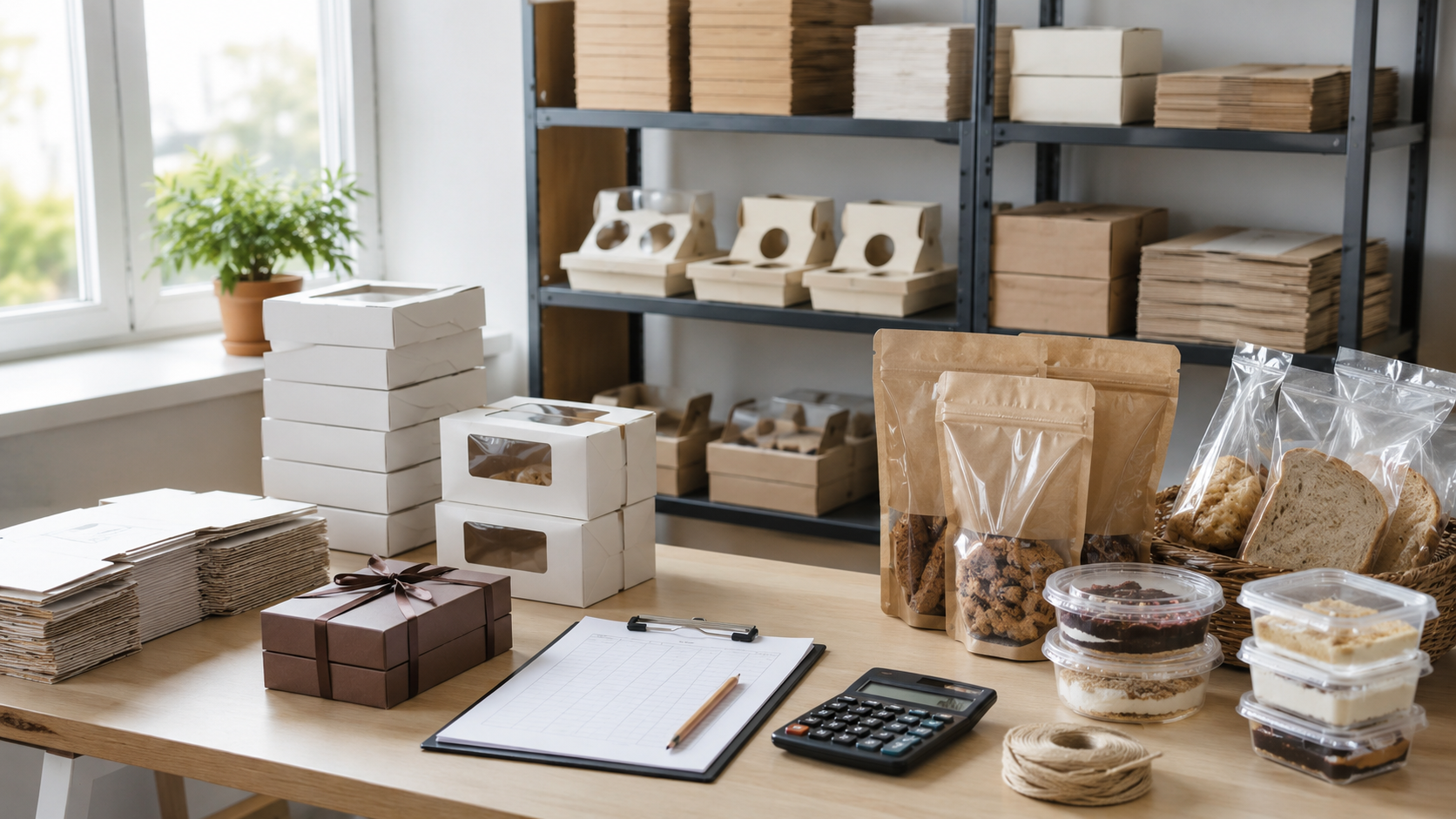
Running out of chocolate at 6 PM is obviously a problem. Running out of the correct 8-inch cake box at 6 PM can create almost the same problem.
The cake may be finished. The customer may be on the way. You may even have twenty other cake boxes on the shelf. But if none of them safely fits that cake, those twenty boxes are not useful inventory for this order.
Packaging stock is easy to underestimate because it does not feel like production inventory. Boxes, pouches, cupcake inserts, dessert tubs, chocolate cavities and bread bags sit on shelves until the final stage of an order. Yet every finished product depends on the correct packaging being available at exactly the right time.
The opposite problem is just as expensive. Many bakeries accumulate stacks of packaging they barely use: one size for a menu item discontinued six months ago, festive boxes left after the season, three colours of a cupcake box when customers overwhelmingly choose one, or 500 pouches purchased because the unit price looked attractive.
So the useful question is not:
“How much packaging should a bakery stock?”
The useful question is:
“How much of each packaging SKU does my bakery consume before I can reliably replenish it?”
That is what we are going to calculate in this guide.
We will build a simple packaging inventory system for home bakers, commercial bakeries, cafés, cloud kitchens, dessert brands and gifting businesses in India. We will apply it to real packaging formats from Bakeyy, including cake boxes, brownie boxes, cupcake boxes, zip-lock pouches, cookie pouches, dessert containers, bread pouches and chocolate boxes.
This is not a rule telling every bakery to hold the same number of boxes. A home baker doing 15 orders a week and a café dispatching 150 dessert portions a day should not have remotely similar inventory.
Instead, by the end of this guide you should be able to look at any packaging SKU and calculate a sensible stocking and reorder plan for your own business.
Quick Answer: How Much Bakery Packaging Should You Keep in Stock?
Start with four numbers for every packaging SKU:
1. Average usage: how many pieces you actually consume per day or week.
2. Replenishment lead time: how many days it normally takes from placing an order until usable stock reaches you.
3. Safety stock: the extra quantity you choose to keep for demand spikes or delivery delays.
4. Supplier pack size: whether you have to reorder in packs of 10, 25, 50, 100 or another quantity.
A simple working formula is:
Reorder Point = Average Daily Packaging Usage × Lead Time in Days + Safety Stock
If you express your safety stock as a number of extra cover days, it becomes:
Reorder Point = Average Daily Usage × (Lead Time Days + Safety Days)
That tells you when to reorder.
It does not automatically tell you how much to purchase. Your purchase quantity should then respect the supplier's pack size and the maximum amount you actually want to store.
Why Packaging Inventory Is Different From Ingredient Inventory
A kilogram of chocolate can potentially be divided across many orders. A box cannot.
An 8 × 8 inch cake box is one discrete unit. If tomorrow's order needs a 10 × 10 inch box, having fifty 8 × 8 inch boxes does not solve the problem.
This makes packaging inventory highly dependent on variants.
Consider something as simple as cake boxes. Our current Cake Box collection contains dozens of products across different dimensions, heights, materials, windows, colours and constructions. You do not need to stock every option simply because it exists.
You need to identify the small number of formats that support most of your menu.
The same applies to brownies. A one-brownie box, six-brownie box and twelve-brownie box are three separate packaging SKUs even if they share the same colour and design.
Pouches introduce another layer. A 100 g pouch and 500 g pouch may look identical in a photograph but serve different products and quantities.
Containers create both unit and storage problems because rigid PET tubs and dome containers generally occupy more physical volume than flat-packed paper boxes or pouches.
For that reason, packaging inventory has to be managed in pieces, variants, storage space and money — not just total packs purchased.
First Build a Packaging-to-Menu Map
Before calculating inventory, list everything you currently sell and the packaging each item consumes.
| Menu Item | Primary Packaging | Secondary Packaging | Units Used Per Order |
|---|---|---|---|
| 500 g cake | Cake base | 8-inch cake box | 1 base + 1 box |
| 1 kg cake | Cake base | 10-inch cake box | 1 base + 1 box |
| Box of 6 brownies | Liners if used | 6-brownie box | 1 box |
| 4 cupcakes | Cupcake insert | 4-cupcake box | 1 complete box set |
| Single cookie | Cookie pouch | Optional outer box/bag | 1 pouch |
| 4 dessert tubs | 4 individual tubs | Optional carry box/bag | 4 tubs |
| Box of 12 chocolates | 12-cavity tray | Chocolate gift box | 1 complete box |
This sounds basic, but it reveals something important.
Your packaging consumption is not necessarily equal to your number of orders.
If you receive ten dessert orders and each order contains four individual dessert tubs, you have consumed forty tubs.
If you receive ten cake orders, you may consume ten boxes — but perhaps four are 8-inch, three are 10-inch, two are tall boxes and one is a bento box.
So do not write “cake boxes: 10”. Track the actual SKU or size.
The Packaging Inventory Formula We Recommend
For a small or medium bakery, you do not need an enterprise inventory optimisation system to improve packaging purchasing.
Start with this:
Average Daily Usage = Packaging Units Consumed ÷ Number of Operating Days
Then:
Lead-Time Requirement = Average Daily Usage × Supplier Lead Time
Add the buffer you are comfortable carrying:
Safety Stock = Average Daily Usage × Safety Days
Finally:
Reorder Point = Lead-Time Requirement + Safety Stock
Or, combined:
Reorder Point = Average Daily Usage × (Lead Time + Safety Days)
This is deliberately simple. The purpose is not to produce a mathematically perfect forecast. It is to stop you from purchasing packaging based on instinct alone.
Worked Example: How Many Cake Boxes Should You Stock?
Assume a bakery uses an average of 12 units of one specific cake-box size every week.
For this worked example only, assume:
Average weekly usage = 12 boxes
Average daily usage = 12 ÷ 7 = approximately 1.71 boxes
Supplier lead time = 4 days
Chosen safety buffer = 7 days
Your reorder point becomes:
1.71 × (4 + 7) = approximately 18.8
Round that operationally to 19 boxes.
That means when usable stock falls to around 19 pieces, it is time to place the replenishment order under these assumptions.
Now suppose the box is sold only in packs of 50.
You cannot order 31 boxes. Your purchase quantity has to respect the pack multiple. One new pack gives you another 50 boxes.
At usage of 12 per week, 50 boxes represent a little over four weeks of normal demand.
This is why the supplier's pack size matters almost as much as the formula.
Do Not Confuse Reorder Point With Maximum Stock
A reorder point tells you when purchasing should begin.
It does not mean you should fill the storeroom every time you reorder.
Imagine you consume only five premium magnetic gift boxes per month, but you find a price break for 500 pieces. The unit cost may look attractive while the total decision is terrible for your working capital and storage space.
For each SKU, set a second number:
Target Stock Level
A simple version is:
Target Stock = Average Daily Usage × Target Days of Cover
If your target is 30 days and you consume two units per day:
2 × 30 = 60 pieces.
Then your purchase calculation becomes:
Suggested Order Quantity = Target Stock – Inventory Position
where inventory position considers what is usable on hand, what is already confirmed inbound and what is already committed to confirmed orders.
Finally, round the required quantity to the supplier's selling pack.
Your Fast-Moving Packaging Deserves More Protection
Not every box deserves the same inventory policy.
A useful way to separate packaging is:
| Class | Packaging Type | Typical Characteristics | Inventory Approach |
|---|---|---|---|
| A — Core | Your everyday box, pouch or tub | High usage; stockout directly blocks common menu items | Monitor frequently, reorder early, hold intentional safety stock |
| B — Secondary | Regular but less frequent format | Moderate usage or has an acceptable substitute | Moderate cover, periodic review |
| C — Special | Occasional colour, premium box or niche size | Low usage; often tied to special orders | Keep lean or buy against orders |
| S — Seasonal | Diwali, Christmas, Valentine's or event packaging | Demand concentrated into a short period | Forecast separately from normal weekly demand |
This is our packaging adaptation of inventory prioritisation rather than a rigid accounting classification.
The key lesson is simple: do not give a slow-moving decorative box the same safety-stock policy as the plain cake box you use every day.
What Should Be an A-Class Packaging SKU?
Ask one question:
If this packaging runs out tomorrow, how much of my normal menu becomes impossible to dispatch properly?
If the answer is “a lot”, it belongs near the top of your inventory attention list.
For a cake-focused bakery, that might be:
8 × 8 cake boxes
10 × 10 cake boxes
corresponding cake bases
standard carry bags
regular labels
For a cookie business, it could be:
individual cookie pouches
your main stand-up pouch size
standard shipping carton
For a dessert brand, it could simply be two PET container formats and spoons.
Your A list should usually be surprisingly short.
Real Example: Cake Boxes and the Cost of Stocking Too Many Sizes
Look at our Plain White Cake or Pastry Box.
The current listing is sold in packs of 50 and includes multiple size options. When checked on 12 August 2026, available variants included 7 × 7 × 4, 8 × 8 × 4, 8 × 8 × 5, 10 × 10 × 4 and 10 × 10 × 5 inches.

This is exactly where inventory discipline matters.
If your menu regularly uses 8 × 8 × 5 and 10 × 10 × 5 boxes but almost never needs 7 × 7 × 4, there is no reason to maintain identical quantities of all three simply because they belong to the same product family.
Track demand by size.
A practical SKU sheet could look like this:
| Box Size | Weekly Use | Priority | Decision |
|---|---|---|---|
| 8 × 8 × 5 | 18 | A | Continuous stock + buffer |
| 10 × 10 × 5 | 9 | A/B | Regular stock |
| 7 × 7 × 4 | 2 | C | Keep lean |
| Special tall box | Occasional | C | Buy closer to confirmed requirement |
The usage numbers above are examples, not Bakeyy sales data.
If you are still deciding which physical dimensions your menu needs, solve that first with our Cake Box Size Guide. Inventory planning only works after the correct packaging specification is fixed.
Brownie Boxes: Pack Size Can Help You Test Before You Commit
Brownie packaging demonstrates another useful principle: smaller purchasing packs can be valuable when demand is not yet proven.
Our Yellow Brownie Box is currently sold in packs of 10 with multiple capacities. At the time of checking, active options included a single-brownie L-window box and 2-, 4- and 6-brownie top-window formats.

If you are launching a new 4-brownie gift pack and have no sales history, ordering a smaller quantity first lets actual customer demand determine the next purchase.
Once the product becomes a core seller, a larger repeat-purchase format may make more operational sense.
For example, our White Brownie Boxes are sold in packs of 25 and include larger brownie capacities.
This does not mean “pack of 25 is always better”.
It means your purchasing unit should follow demand maturity.
New menu item → test lean.
Proven repeat seller → hold deeper.
For box selection itself, see our Complete Brownie Packaging Guide.
Cupcake Boxes: Do Not Stock Every Capacity Equally
A bakery may technically sell single cupcakes, pairs, boxes of four and boxes of six.
That does not mean demand is split 25% each.
If 70% of your cupcake orders are boxes of six, the six-cupcake packaging is your operational core.
Our Yellow Cupcake Box is sold in packs of 10 and includes configurations for one, two, four and six cupcakes, including handled and non-handled variants where applicable.

Track capacity demand, not merely “cupcake box demand”.
That distinction becomes especially important before large birthday, wedding, corporate or event orders.
Pouches Need a Different Inventory Mindset
Pouches usually store more efficiently than rigid containers, but their variants can multiply extremely quickly.
Our Zip Lock Pouches collection currently contains 29 products, before even counting every size and colour variant inside those products.
For example, our Coloured Stand-Up Zip Lock Pouch with Window is available across capacities described from 100 g through 2 kg and across multiple colours.

The pack contains approximately 98–100 pieces because the quantity is packed by weight rather than guaranteed as an exact individually counted 100 pieces. That detail matters when your production plan requires an exact number of filled units.
This is a perfect example of why “I have 500 pouches” is not useful inventory information.
You need to know:
how many 100 g pouches
how many 250 g pouches
how many 500 g pouches
which colour or finish is actually part of your standard range
how many are already allocated to confirmed orders
If your top-selling cookie pack uses one 250 g pouch, that 250 g pouch should have its own usage rate and reorder point.
Your rarely ordered 1 kg format should not automatically receive the same stock depth.
For more on the pouch format itself, you can also read our existing Standing Zip Lock Pouch Guide.
Cookie Pouches: Count Individual Units, Not Just Packs
Small packaging can disappear faster than you expect because it is often consumed one piece per retail unit.
Our Transparent Self-Sealing Cellophane Bags come in a pack of 100 with multiple size options including 4 × 6, 5 × 7, 6 × 8 and 7 × 9 inches.

If you sell thirty individually wrapped cookies at a weekend market, one event consumes 30% of a 100-piece pack.
Four similar events would require more than one pack even before allowing for damaged pouches, samples, customer orders or other usage.
This is why event businesses should deduct booked future consumption before looking at the stock number.
If there are 70 pouches on your shelf but 60 are already needed for Saturday's order, your genuinely available inventory is closer to ten than seventy.
For more format-specific guidance, see our Cookie Pouch collection and Cookie Making & Packaging collection.
Rigid Dessert Containers Need a Storage-Space Limit
A flat cake box and a rigid PET dessert container can have the same purchase value but completely different warehouse impact.
Our Golden Square PET Dessert Container is sold in packs of 50. The range includes small through extra-large formats, with clear lids and coloured bases.

When we checked the listing, large and extra-large variants were available. The large was listed at ₹1,015 per pack of 50 and extra-large at ₹1,230 per pack of 50.
The point is not the exact price — that can change.
The point is that buying ten packs means storing 500 rigid containers.
Before increasing purchase quantity simply for convenience, measure how many cartons or shelf locations that actually consumes.
A useful rule for bulky packaging is to set both:
a financial maximum
and
a physical maximum
If you have room for only four cartons without interfering with daily operations, your purchasing system should know that.
Our Dessert Tubs 101 guide covers the menu side of using tubs; this article is about controlling the stock after you decide which tubs belong on your menu.
Chocolate Packaging Should Follow the Assortment You Actually Sell
Chocolate businesses face the same variant trap.
Two-cavity, three-cavity, four-cavity, six-cavity, twelve-cavity and eighteen-cavity boxes may all be useful — but only if customers buy those formats.
Our Gold Chocolate Gift Box with PVC Cover and Cavity Tray is currently sold in packs of 20 with multiple cavity capacities.

At the time of checking, 2-, 3- and 4-cavity options were available while the queried 6-cavity option was unavailable.
If your standard chocolate menu is 4, 9 and 16 pieces, those are the capacities you should plan around. Do not let the packaging catalogue create your inventory structure backwards.
Your menu defines the required packaging.
For the wider range, see our Chocolate Box collection and Chocolate Making & Packaging collection.
Bread Pouches: Sample Before Stocking Multiple Sizes
Bread packaging is a good example of a product where dimensions matter more than nominal product names.
A sourdough loaf, sandwich loaf, brioche and small bun assortment can all need different pouch dimensions.
Our Bread Pouch Sample Pieces product exists specifically so different bread-pouch structures and sizes can be tested before committing to the main pack format.

This is exactly how we recommend approaching an uncertain packaging SKU: fit test first, stock later.
Once you know which dimensions fit your actual loaf, then start collecting usage history.
Packaging Inventory Priority Chart
This chart is an operational guide, not a scientific scoring system.
| Packaging Situation | Stockout Impact | Demand Predictability | Storage Burden | Suggested Stock Depth |
|---|---|---|---|---|
| Everyday cake box | Very High | High | Medium | Higher |
| Main cookie pouch | Very High | High | Low | Higher |
| Core dessert tub | Very High | High | High | Moderate to Higher |
| Secondary cupcake capacity | Medium | Medium | Medium | Moderate |
| Premium gift box | Low to Medium | Low | High | Lean |
| Seasonal printed packaging | High during season | Season-dependent | Varies | Forecast separately |
| Experimental new menu packaging | Low initially | Unknown | Varies | Minimum practical test quantity |
How Much Packaging Should a New Home Bakery Start With?
There is no responsible answer such as “buy 100 of every box”.
If you do not yet have sales history, build your initial inventory around the menu you are prepared to sell during the first few weeks.
Suppose your launch menu contains:
500 g cakes
1 kg cakes
boxes of 6 brownies
boxes of 6 cupcakes
individual cookies
dessert tubs
You do not need twelve cake-box sizes, six brownie capacities and five cupcake colours.
Choose one standard packaging format for each core selling format.
Then estimate expected weekly orders conservatively.
| Product | Expected Orders/Week | Packaging per Order | Expected Weekly Packaging Use |
|---|---|---|---|
| 500 g cake | 6 | 1 | 6 boxes |
| 1 kg cake | 4 | 1 | 4 boxes |
| 6 brownies | 8 | 1 | 8 boxes |
| 6 cupcakes | 5 | 1 | 5 boxes |
| Individual cookies | 30 | 1 | 30 pouches |
| Dessert tubs | 8 orders × 4 tubs | 4 | 32 tubs |
These are hypothetical numbers.
After two to four weeks, throw away the forecast and start using actual consumption wherever you have enough data.
If you are still at the business-setup stage, our Home Bakery Setup Guide for India covers the wider operational picture.
Use Rolling Usage, Not Lifetime Average
If your bakery has been operating for two years, lifetime usage can hide what is happening now.
Suppose you used 1,200 brownie boxes over twelve months.
The simple average is 100 per month.
But what if the last three months were:
Month 1: 130
Month 2: 160
Month 3: 190
Your business is clearly not behaving like the annual average anymore.
Use a recent rolling period that reflects your current business and then separately account for known events.
For a stable SKU, four to eight recent weeks can often be more operationally useful than an old annual average.
For highly seasonal packaging, recent normal weeks may be almost useless.
Seasonal Packaging Needs Its Own Forecast
Diwali boxes should not be planned using April's ordinary weekly box usage.
Christmas bread pouches should not be forecast purely from September bread orders.
Valentine's chocolate packaging should not be averaged across the entire year.
Seasonal stock should use:
last year's event sales if available
current pre-orders
corporate enquiries
confirmed bulk orders
planned marketing volume
new customer growth since the previous season
supplier lead time
and how reusable the packaging is after the event.
Generic red or gold packaging can often be reused for another occasion.
A box printed specifically with “Happy Diwali 2026” has far less post-season flexibility.
That difference should influence how aggressively you stock it.
How Should You Treat Custom Printed Packaging?
Custom packaging deserves a stricter inventory policy because it is usually much harder to repurpose.
If a plain white box becomes slow-moving, you may still use it for another menu item, add a different sticker or use it for a different event.
A box printed with a specific logo, product name, campaign or seasonal message has fewer escape routes.
Before committing to a custom quantity, calculate:
expected monthly usage
months required to consume the batch
cash committed
storage requirement
likelihood of dimensions or branding changing
risk of the product being discontinued
If your branding is still evolving, carrying a year's worth of printed packaging simply because the unit cost is cheaper can become very expensive dead stock.
The Hidden Cost: Variant Explosion
Packaging businesses offer variety because different customers need different formats.
Your bakery does not need to own that entire variety.
Consider this combination:
5 cake-box sizes × 3 colours × 2 window designs = 30 cake-box variants.
If you hold only 25 pieces of each, you already have:
750 cake boxes.
Yet you may discover that three of those variants handle 80% of your actual cake orders.
This is why standardisation can be more valuable than constantly adding new packaging.
Where practical, design your menu around a smaller number of packaging footprints.
If your 500 g cake, mini cheesecake and selected celebration cake can safely share the same outer-box footprint, purchasing becomes simpler.
Do not force products into unsuitable boxes just to standardise — but when two options genuinely work, reducing SKU count has operational value.
Packaging Inventory Should Be Measured in Days of Cover
A statement like “we have 200 pouches” tells you almost nothing.
If you consume 100 per day, that is two days of inventory.
If you consume five per day, that is forty days.
A more useful metric is:
Days of Cover = Usable Stock ÷ Average Daily Usage
Examples:
| SKU | Stock | Daily Use | Days of Cover |
|---|---|---|---|
| 8-inch cake box | 60 | 3 | 20 days |
| Cookie pouch | 200 | 20 | 10 days |
| Dessert tub | 150 | 10 | 15 days |
| Premium hamper box | 40 | 1 | 40 days |
Now you can compare completely different packaging types on the same basis.
Do Not Ignore Open Packs and Damaged Packaging
Your physical count and usable count are not always the same.
A paper box can be crushed.
A clear lid can crack.
A cavity insert can be missing.
A pouch can become dirty or creased.
A printed box can have a production defect.
So your stock sheet should distinguish:
Physical stock
Damaged / unusable stock
Reserved stock
Available stock
A simple formula is:
Available Stock = Physical Stock – Damaged Stock – Reserved Stock
Replenishment decisions should be made from available stock, not the number somebody counted on the shelf.
Reserve Packaging for Confirmed Large Orders
This matters especially for corporate gifting, weddings and event orders.
Suppose you have:
120 six-cupcake boxes physically available.
You also have a confirmed corporate order requiring 100 next week.
Your shelf count is 120.
Your genuinely uncommitted stock is 20.
If your normal business uses 10 boxes a day, you effectively have only two days of free stock.
Allocate packaging to large confirmed orders as soon as the order becomes firm.
Supplier Lead Time Should Change How Much You Hold
Two bakeries with identical sales can rationally carry different packaging inventory.
Bakery A can replenish its standard boxes very quickly.
Bakery B buys the same type of packaging from a supplier with a much longer and less predictable replenishment cycle.
Bakery B needs more protection because it has to survive a longer period between ordering and receiving stock.
This is why location matters indirectly.
A Bengaluru bakery with reliable local replenishment may be able to hold leaner stocks of some standard packaging than a business ordering the same supplies into a location where transport adds several additional days.
The same logic applies in Mumbai, Hyderabad, Chennai, Delhi NCR, Pune, Kolkata or any other city: use your real replenishment history, not a generic national assumption.
If you buy packaging from multiple suppliers, store the lead time against the SKU/supplier combination rather than just the product.
Our Bakery Packaging Supplier Checklist covers other questions worth checking before depending heavily on one packaging source.
How Much Safety Stock Should You Keep?
There is no universal number of safety days that every bakery should use.
Use more buffer when:
demand is volatile
the packaging is essential
there is no acceptable substitute
supplier lead time varies
you have upcoming campaigns or events
the item stores compactly
running out would cause a significant service failure
Use less buffer when:
demand is very low
the packaging is highly seasonal
the SKU occupies substantial storage space
it is expensive
you have a good substitute
the design may soon change
the item can be replenished very quickly
A Simple Safety-Stock Matrix
| Demand Variability | Lead-Time Reliability | Stockout Impact | Buffer Direction |
|---|---|---|---|
| Low | High | Low | Lean |
| Low | High | High | Moderate |
| High | High | High | Moderate to Higher |
| High | Low | High | Highest attention |
| Seasonal | Any | High during event | Forecast separately |
What About Emergency Substitute Packaging?
It is useful to know which packaging can substitute for another before you actually have a stockout.
Create a substitute column in your inventory sheet.
| Main SKU | Emergency Substitute | Acceptable? |
|---|---|---|
| Plain 8 × 8 cake box | Premium 8 × 8 window box | Possibly, if dimensions and height fit |
| 250 g branded pouch | Plain 250 g pouch + sticker | Often possible if the packaging properties suit the product |
| 6-brownie box | Larger brownie box | Only if product can be restrained safely |
| Specific dessert tub | Alternative tub | Only after testing lid fit, volume and delivery suitability |
A substitute is not merely “something the product physically fits inside”.
It still has to protect the food and present the order properly.
For packaging-performance considerations such as keeping textures protected, see our Texture Is King packaging guide.
How Often Should You Count Bakery Packaging?
Core packaging deserves a more frequent count than slow-moving stock.
A simple cycle could be:
| Packaging Class | Suggested Review Behaviour |
|---|---|
| A — Core | Review at least weekly and before major sales periods |
| B — Secondary | Review regularly, such as every 1–2 weeks |
| C — Special | Review monthly or before offering the product |
| S — Seasonal | Review against the event plan, bookings and countdown to dispatch |
The exact frequency should reflect your business. A high-volume café may need daily checks for some containers.
Create a Minimum Packaging Dashboard
You do not need complicated software to begin.
A spreadsheet with these columns is enough to transform the way packaging is purchased:
| Field | What to Record |
|---|---|
| SKU / Internal Name | Example: CB-8x8x5-WHITE |
| Category | Cake box / pouch / tub / etc. |
| Supplier | Your current source |
| Supplier Pack Size | 10 / 25 / 50 / 100 etc. |
| On Hand | Physical count |
| Reserved | Committed to confirmed orders |
| Damaged | Unusable pieces |
| Available | On hand – reserved – damaged |
| Average Weekly Use | Based on recent consumption |
| Average Daily Use | Weekly use ÷ operating days |
| Lead Time | Real historical replenishment time |
| Safety Days | Your selected buffer |
| Reorder Point | Daily use × (lead time + safety days) |
| Days of Cover | Available stock ÷ daily use |
| Priority | A / B / C / Seasonal |
| Substitute SKU | Approved backup if one exists |
Do a Packaging Inventory Clean-Up Every Quarter
Packaging dead stock usually accumulates slowly enough that nobody notices it.
Once every quarter, identify:
SKUs with zero usage
SKUs with extremely high days of cover
duplicated sizes
old branding
seasonal leftovers
damaged packaging
boxes belonging to discontinued menu items
products with a newer approved substitute
Then decide deliberately what to do with them.
Can the packaging be repurposed?
Can another menu item use it?
Can you create a temporary product around it without compromising product quality?
Can a plain box be relabelled?
If not, stop letting obsolete packaging occupy active pick locations.
Storage Layout Is Part of Inventory Planning
A perfect spreadsheet does not help if the team cannot find the box.
Label shelf locations clearly.
Separate sizes visually.
Do not place nearly identical 8-inch and 10-inch flat boxes in an unlabelled stack.
Keep the fast-moving packaging closest to the packing area.
Move seasonal or reserve stock away from prime picking space.
For flat-packed paper boxes, clearly mark the pack size and box dimensions on the outer bundle.
For containers with separate bases and lids, count both components. Fifty bases and forty lids do not equal fifty usable containers.
The usable inventory is determined by the limiting component.
One of the Best Metrics: Packaging Cost per Finished Order
Packaging inventory planning is not only about avoiding stockouts.
It can reveal what each menu format is really costing you.
Calculate:
Packaging Cost per Order = Sum of All Packaging Components Used
For a cake this could include:
cake base
cake box
support insert if required
sticker
carry bag
outer shipping protection if applicable
For four dessert tubs:
4 tubs
4 lids
4 spoons/forks if supplied separately
carry bag or secondary box
labels
Tracking this also makes it easier to see why an apparently cheap menu item may consume expensive packaging.
Should You Buy More Packaging to Get a Lower Unit Price?
Sometimes yes.
Not automatically.
Compare the saving with what you are giving up.
If increasing an order from 100 to 500 pieces saves ₹1 per box, the theoretical saving is ₹400.
But if the extra 400 boxes take ten months to consume, occupy valuable storage, and the packaging design changes after four months, the ₹400 saving was not a saving.
Before buying the larger quantity, ask:
How many weeks of demand does this purchase represent?
How much cash does it commit?
Where will I physically store it?
How stable is the menu item?
How stable is the branding?
Can the box be used elsewhere?
What is the risk of demand falling?
Bulk pricing should improve a good inventory decision, not justify a bad one.
Packaging Purchasing for Bangalore vs Pan-India Businesses
Your geography changes replenishment planning, not the fundamental formula.
If your bakery is in Bangalore and you can access packaging quickly, some standard SKUs may justify fewer days of cover.
If you are in another city and routinely experience a longer transit cycle, your reorder point needs to account for that real lead time.
Do not add random buffer simply because you are outside Bengaluru. Measure it.
If three recent packaging orders took four, five and six days, you have useful evidence about replenishment behaviour.
For Bengaluru businesses, you can also read our Bakeyy24 Bangalore guide for the separate local programme.
What Should You Do When a Packaging SKU Is About to Stock Out?
Do not wait until zero to discover the problem.
Once a core item crosses its reorder point:
1. Verify the physical count.
2. Deduct confirmed-order reservations.
3. Check inbound purchase orders.
4. Confirm current supplier availability.
5. Place replenishment if required.
6. Identify the approved backup SKU.
7. If no substitute exists, control new order acceptance for that format before you create a customer problem.
The purpose of a reorder point is to make the stockout visible while you still have time to act.
Bakery Packaging Inventory Checklist
Before your next packaging purchase, check:
Do I know exactly which SKU is being reordered?
Do I know its actual recent usage rate?
How many usable pieces are physically available?
How many are reserved for confirmed orders?
How long does replenishment normally take?
Have I chosen an intentional safety buffer?
What is the reorder point?
What is the supplier pack size?
How many days of inventory will the new purchase create?
Do I physically have room for it?
Is the product core, secondary, special or seasonal?
Is there an approved substitute?
Is this packaging tied to branding or an event that could make it obsolete?
Am I buying more because demand justifies it, or only because the unit price is lower?
Frequently Asked Questions About Bakery Packaging Inventory
How Many Cake Boxes Should a Home Baker Keep?
There is no universal quantity. Calculate usage separately for every core cake-box size. If you use a particular box 10 times a week and another only once, they should not have equal stock levels. Use average daily usage, lead time, safety stock and supplier pack size to set the reorder point.
How Do I Calculate a Reorder Point for Cake Boxes?
A simple method is:
Reorder Point = Average Daily Box Usage × Supplier Lead Time + Safety Stock.
If you hold safety stock as additional cover days, use average daily usage × (lead-time days + safety days).
How Much Safety Stock Should a Bakery Keep?
There is no single correct percentage. Core packaging with unpredictable demand, long replenishment times and no substitute deserves a larger buffer than a slow-moving decorative box that can be reordered quickly.
Should I Stock Every Cake Box Size?
No. Stock the sizes your menu and order history actually require. Keep low-frequency specialist sizes lean unless their stockout would affect an important part of your business.
Should I Buy Bakery Packaging in Packs of 10, 25, 50 or 100?
Choose based on consumption and risk, not only price. Smaller packs can make sense for a new or experimental format. Larger packs can make sense for a proven fast-moving SKU when you have the cash and storage space to support them.
How Many Pouches Should I Keep for Cookies?
Start from your actual number of individually packed units. If you sell 200 individually wrapped cookies a week, that consumes 200 pouches even if those cookies were part of only 40 customer orders. Calculate pouch inventory from units packed, not order count.
How Do I Manage Dessert Tub Inventory?
Track the complete usable set. If the tub requires a separate lid and fork, make sure all required components are available. Also set a storage-space maximum because rigid containers can consume shelf volume much faster than flat boxes or pouches.
How Often Should Bakery Packaging Be Counted?
Fast-moving core packaging should be reviewed most frequently. For many small bakeries, a weekly review is a useful starting rhythm, while very high-volume operations may need more frequent checks. Slow or seasonal stock can be reviewed on a different cycle.
How Do I Plan Packaging for Diwali, Christmas or Valentine's Day?
Do not use only ordinary weekly averages. Combine previous seasonal sales, current pre-orders, confirmed bulk business, marketing plans, supplier lead times and leftover-stock risk. Highly event-specific printed packaging should usually be managed more cautiously than generic packaging that can be reused after the festival.
What Is Dead Packaging Stock?
Dead packaging stock is packaging that is unlikely to be consumed through normal future sales. Examples include obsolete branding, discontinued sizes, old seasonal designs and boxes tied to products no longer on the menu.
Final Takeaway: Stock Packaging Based on Consumption, Not Anxiety
The goal of packaging inventory planning is not to have the fullest storeroom.
It is to have the correct box, pouch or container available when a real order needs it — without locking unnecessary money and space into packaging that may sit untouched for months.
Start small.
List every packaging SKU your current menu actually uses.
Measure how quickly each one moves.
Separate core packaging from secondary, specialist and seasonal stock.
Calculate your lead-time requirement.
Add a deliberate safety buffer.
Set a reorder point.
Respect the supplier's pack multiple.
Then keep watching actual consumption.
If you do this consistently, packaging stops being a collection of boxes on a shelf and becomes a controlled part of your bakery operation.
To build or standardise your own packaging range, explore our Cake Boxes, Brownie Boxes, Cupcake Boxes, Zip Lock Pouches, Cookie Pouches, Dessert Tubs, Bread Pouches and Chocolate Boxes.
If you are still deciding which packaging formats belong in your standard range before calculating stock, start with our Bakery Packaging Supplies Guide and Bakery Packaging Supplier Checklist. Once the specifications are fixed, come back to this inventory system and let the numbers decide how much you actually need.