
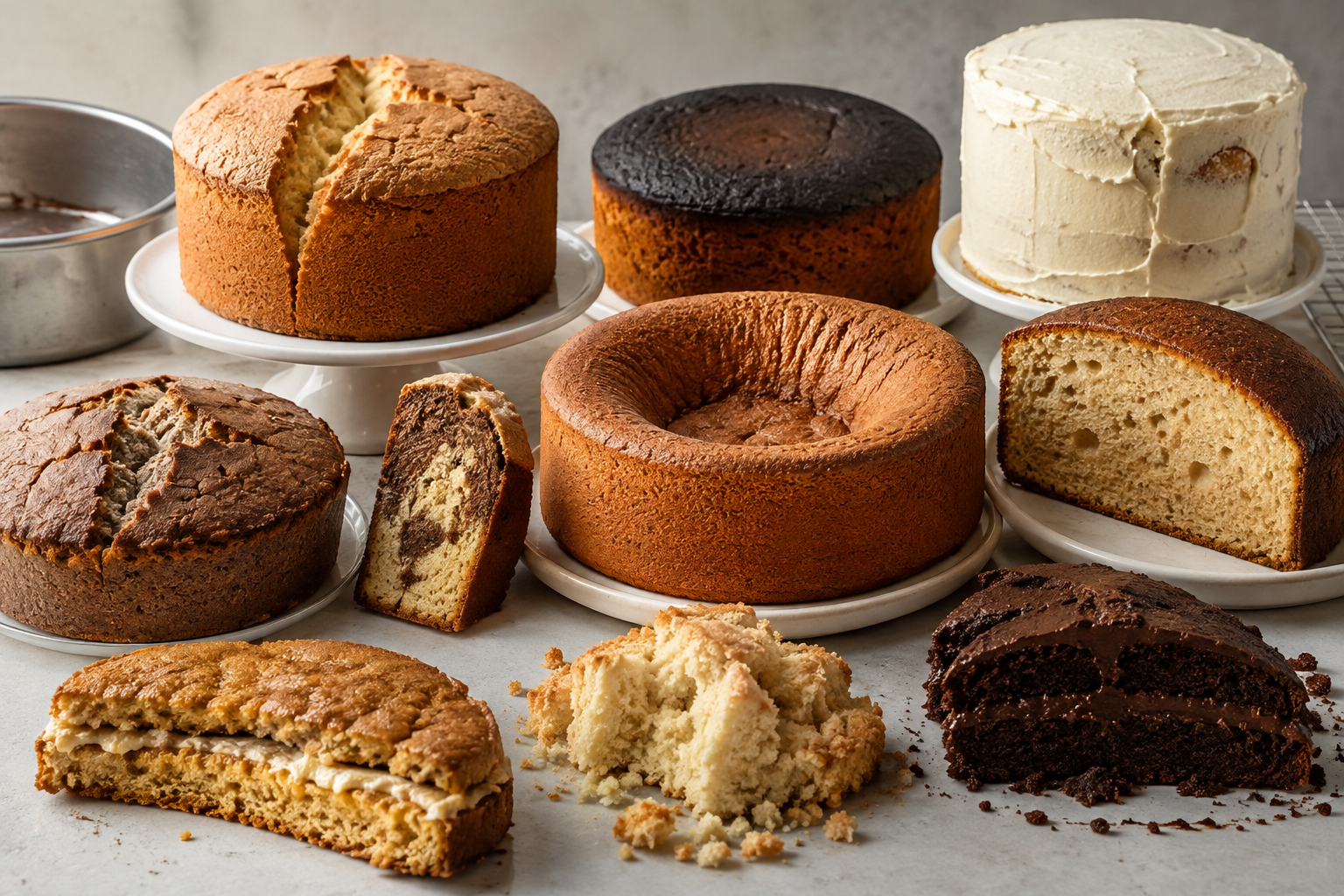
You followed the recipe, measured the ingredients, preheated the oven and waited patiently — only to find a cake that sank in the middle, turned out dry, stayed raw inside, cracked on top or came out strangely dense.
If you have ever searched “why did my cake fail?”, the good news is that most cake failures are not random. A cake usually gives you visible clues about exactly what went wrong.
A sunken centre often points toward structure, leavening or doneness. A dry cake may indicate excess flour, too much baking time or the wrong pan. A cake that rises dramatically and then collapses may have too much leavener, too much incorporated air or an underbaked centre that never developed enough structure to stay standing.
This complete cake troubleshooting guide explains 25 of the most common cake baking problems, what causes them, how to fix them, and how to prevent them in your next batch.
It is written especially for home bakers and small bakery businesses in India using OTGs, convection ovens and regular home baking equipment.
If you are still building your baking setup, you can also read Bakeyy's Complete Cake Decorating Tools Guide for Beginners and Complete Baking Ingredients Guide.
Quick Answer: Why Do Cakes Fail?
Most cake failures can be traced back to one or more of these areas:
- Incorrect ingredient measurement
- Wrong ingredient temperature
- Too much or too little mixing
- Incorrect baking powder or baking soda quantity
- Old or ineffective leavening agents
- Wrong cake tin size
- Oven temperature problems
- Opening the oven too early
- Underbaking or overbaking
- Incorrect cooling or demoulding
Baking is a balance between structure, moisture, fat, sugar, air, heat and time. Changing one variable can affect several others.
Cake Failure Diagnosis Chart
| What You See | Most Likely Area to Check First | Common Cause |
|---|---|---|
| Cake sinks in centre | Doneness / leavening | Underbaked centre or too much leavener |
| Cake barely rises | Leavening / mixing | Weak leavener or poor aeration |
| Dense heavy cake | Measurement / mixing | Too much flour or incorrect mixing |
| Dry cake | Flour / oven / time | Too much flour or overbaking |
| Raw middle | Temperature / tin size | Outside cooking faster than centre |
| Cracked top | Oven temperature | Surface setting before centre finishes rising |
| Large dome | Heat / pan | Edges setting too quickly |
| Rubbery cake | Mixing | Excess gluten development |
| Greasy cake | Fat / emulsion / temperature | Butter too warm or batter poorly emulsified |
| Cake sticks to tin | Pan preparation | Insufficient greasing or lining |
| Cake overflows | Tin size | Too much batter in pan |
| Uneven cake | Oven heat | Hot spots or uneven pan positioning |
Fast Cake Troubleshooting Flow Chart
Start here: Did the cake rise properly?
↓
NO → Check baking powder/baking soda → check ingredient measurement → check butter-and-sugar aeration → check whether batter was mixed according to the recipe.
YES, BUT IT FELL → Check whether the centre was fully baked → check if too much leavener was added → check whether the batter was over-aerated → avoid disturbing the cake before its structure sets.
YES, BUT IT IS DRY → Check flour quantity → baking time → pan size → oven temperature.
YES, BUT THE MIDDLE IS RAW → Check oven temperature → pan depth → batter quantity → pan material → rack position.
YES, BUT TEXTURE IS DENSE OR RUBBERY → Check mixing method → flour measurement → ingredient temperature → batter emulsion.
Before Troubleshooting: Measure Your Ingredients Properly
One of the easiest ways to ruin a cake is also one of the easiest to avoid: inaccurate measurement.
Flour is particularly important. A measuring cup filled with loosely aerated flour can contain considerably less flour than a cup that has been scooped directly from a tightly packed bag.
That difference changes the ratio between flour, liquid, fat and sugar.
Too much flour can produce:
- Dry cake
- Dense crumb
- Crumbly texture
- Poor rise
- Thicker-than-expected batter
Whenever possible, weigh baking ingredients in grams. For recipes written using cups, use the measuring method specified by the recipe rather than packing ingredients into the cup.
Useful Tool: Measuring Cups & Spoons Set

For recipes written in teaspoons, tablespoons and cups, a consistent measuring set helps reduce accidental variation between batches. View the Measuring Cups & Spoons Set at Bakeyy.
1. Why Did My Cake Sink in the Middle?
A sunken cake is one of the most common baking problems.
The cake may look perfectly risen inside the oven, but after you remove it, the centre slowly collapses.
Possible causes
- The centre was still underbaked
- Too much baking powder or baking soda was used
- The batter was excessively aerated
- The recipe proportions were altered
- The cake structure was disturbed before it had set
- The oven temperature was inaccurate
A cake needs enough internal structure to support the gases that make it rise. If the cake rises faster than its structure develops, it can collapse.
Too much chemical leavener can create an impressive initial rise, but more rise is not necessarily better. The structure may stretch beyond what it can support and then fall.
How to fix it next time
Measure leavening agents carefully, follow the specified tin size, and do not remove the cake merely because the top looks baked.
Look for multiple doneness signs: the centre should appear set, the cake should respond appropriately to a gentle touch for that recipe, and a tester should not contain wet raw batter.
2. Why Is My Cake Flat and Not Rising?
If your cake enters the oven as batter and comes out looking only slightly taller, start by checking your leavening and mixing method.
Common reasons
- Baking powder or baking soda has lost effectiveness
- You forgot the leavener
- The wrong amount was used
- Butter and sugar were not aerated sufficiently in a creamed cake
- Ingredients were too cold for the recipe
- The batter was not mixed enough to build the structure required by that specific recipe
- The recipe was scaled incorrectly
Not every cake relies on the same rising mechanism. Butter cakes may depend on both creaming and chemical leavening. Sponge cakes often depend heavily on aerated eggs. One-bowl oil cakes behave differently again.
That is why generic advice such as “never mix cake batter too much” is incomplete. The correct mixing method depends on the recipe.
3. Why Is My Cake Dense and Heavy?
A dense cake has a tight, heavy texture rather than a soft and even crumb.
Likely causes
- Too much flour
- Cold butter that did not cream properly
- Butter that was too warm to hold aeration
- Incorrect mixing
- Weak leavening
- Too little liquid
- Incorrect recipe scaling
- A broken batter emulsion
For cakes using the creaming method, butter temperature matters. Butter should generally be soft enough to mix and aerate but not melted or greasy.
If it is extremely cold, it does not aerate effectively. If it is excessively warm, the bubbles created during mixing can collapse.
What to do
Follow the recipe's ingredient-temperature instructions instead of automatically using everything straight from the refrigerator.
If the recipe says to cream butter and sugar until lighter and fluffy, actually complete that step rather than simply combining them.
Useful Tool: 7-Speed Electric Hand Mixer

A mixer with multiple speed settings helps you control creaming, egg incorporation and final mixing rather than running every stage at one speed. Explore the 7-Speed Electric Hand Mixer.
4. Why Does My Cake Have Dense or Gummy Streaks?
You cut into a cake that looks normal from the outside, but inside there are dense, wet-looking or gummy bands — frequently near the bottom.
This can come from either insufficient or excessive mixing.
Possible causes
- Flour was not incorporated sufficiently
- Batter was overmixed after adding flour
- Butter and sugar were excessively aerated
- Leavener was too weak
- Too much leavener caused excessive rise followed by collapse
- The cake structure did not develop correctly
This is why the safest instruction is not simply “mix less.” Instead, follow the mixing time and speed stated in a tested recipe.
If your batter still has obvious flour pockets, unmixed butter or thick residue at the bottom of the bowl, it is not properly mixed.
5. Why Is My Cake Dry?
A dry cake is usually the result of imbalance between flour, moisture and baking time.
Most common causes
- Too much flour
- Too little liquid or fat
- Overbaking
- Oven running hotter than expected
- Using a larger pan than the recipe specifies
- Incorrect ingredient substitutions
- Leaving thin cake layers in the oven too long
Pan size matters more than many beginners realise.
If the same amount of batter is spread over a larger surface area, the cake becomes thinner and usually finishes baking faster. Using the original baking time can therefore dry it out.
Can simple syrup fix a dry cake?
Simple syrup can add moisture to an already baked layer cake, but it does not correct the underlying baking problem.
If every batch needs heavy soaking to remain soft, investigate your recipe ratios, flour measurement, pan and baking time.
6. Why Is My Cake Raw or Wet in the Middle?
A dark, well-baked exterior with a liquid or sticky middle means the outside finished cooking before enough heat reached and set the centre.
Possible reasons
- The cake was removed too early
- The tin is too deep for the recipe
- Too much batter was placed in the tin
- The oven was too hot
- The pan material caused fast exterior browning
- The cake was placed too close to an intense heating element
This problem is particularly familiar to bakers using compact OTGs, where heating elements may sit relatively close to the baking tin.
What should you do?
Use the correct tin size, position the cake according to your oven's behaviour, and avoid assuming a dark top means the centre is finished.
If a recipe provides a target internal temperature for a specific cake such as cheesecake or another dense bake, a food thermometer can give you an additional objective measurement.
Useful Tool: Digital Food Thermometer

Use a food thermometer when a tested recipe specifies a target internal temperature rather than inventing one universal temperature for every cake. View the TP-101 Digital Food Thermometer.
7. Why Are My Cake Edges Burnt but the Centre Is Raw?
This pattern usually indicates that heat is reaching the cake exterior too aggressively.
Check these factors
- Oven temperature
- Pan colour
- Pan material
- Pan depth
- Rack position
- Amount of batter
Dark cake pans can absorb and transfer heat aggressively, causing the edges to set and brown sooner. Meanwhile, the centre may still need more time.
Do not automatically increase oven temperature because the centre is taking too long. That may worsen the contrast between the overcooked exterior and raw middle.
8. Why Did My Cake Crack on Top?
A cracked cake is often still delicious, but if you want level layers for decorating, large cracks can be frustrating.
Common causes
- The oven is too hot
- The tin is too small
- Too much batter is in the pan
- The top set before the centre finished expanding
- The cake is too close to the top heating element
When the surface forms a crust early but the centre continues to rise, internal pressure can split the top.
How to prevent cracks
Confirm oven temperature, use the recommended pan size, and avoid overfilling.
A small natural crack on a loaf or pound cake may be expected, so always judge the result based on the type of cake you are making.
9. Why Is My Cake Domed in the Centre?
A dome forms when the edges of the cake set earlier while the centre continues rising.
Possible causes
- Oven temperature is too high
- Dark pan
- Pan is too small
- Batter layer is too deep
- Heat distribution is uneven
For layer cakes that will be stacked and frosted, a flatter surface means less trimming and less waste.
Choosing a suitable cake pan matters

The pan should suit the batter quantity and recipe rather than being chosen simply because it is available. View Bakeyy's Non-Stick Round Cake Pan or explore the complete Bakeware Collection.
10. Why Is My Cake Higher on One Side?
A lopsided cake often says more about your oven than your batter.
Possible reasons
- The oven rack is not level
- The pan is warped
- The oven has a strong hot spot
- Batter was distributed unevenly
- Multiple pans are blocking airflow
Home ovens and OTGs rarely heat every area identically.
If the same side of every cake consistently browns or rises faster, your oven likely has a repeatable hot zone.
Learn your specific oven rather than assuming the temperature dial tells the whole story.
11. Why Does My Cake Have Large Holes and Tunnels?
A good cake crumb generally contains many relatively even air cells. Very large tunnels may indicate mixing or aeration problems.
Potential causes
- Overmixing after flour is added
- Excessive aeration
- Unevenly distributed leavener
- Batter containing unmixed pockets
- Recipe ratios are incorrect
Mix dry ingredients thoroughly before adding them when the recipe instructs you to do so. Scrape the bowl during mixing so ingredients at the bottom are not left behind.
12. Why Does My Cake Have a Coarse Crumb?
A coarse cake has larger irregular holes rather than a fine, even crumb.
Possible causes
- Batter emulsion broke
- Cold eggs were added to softened butter
- Eggs were added too quickly
- Butter temperature was wrong
- Mixing method was incorrect
In butter-based cakes, fat, water and air need to remain properly dispersed.
If cold eggs suddenly chill softened butter, the batter may become curdled rather than smooth.
If your recipe specifically calls for room-temperature eggs, treat that instruction as part of the formula — not optional decoration.
13. Why Does My Cake Crumble and Fall Apart?
A cake can be soft without being structurally weak. If it breaks into crumbs when you try to lift a slice, check both the formula and cooling process.
Common causes
- Too much flour
- Insufficient binder or liquid
- Recipe substitutions changed the structure
- Cake was cut while still very warm
- Cake was removed from the pan before it had enough strength
- Undermixing in recipes that require adequate structure development
Cooling matters because the crumb continues to firm as the cake cools.
A delicate hot cake may break even though the exact same cake would slice cleanly after proper cooling.
14. Why Is My Cake Greasy or Oily?
A greasy cake may leave visible fat on the surface, feel heavy in the mouth, or have an oily line at the bottom.
Potential causes
- Butter was excessively soft or partially melted when a recipe required creaming
- Too much fat was added
- The batter emulsion broke
- Ingredients were at incompatible temperatures
- Recipe measurements were incorrect
If a recipe requires creaming, melted butter is not automatically interchangeable with softened butter.
The physical state of the fat affects how much air the batter can hold.
15. Why Did My Cake Pull Away or Shrink Excessively?
A small amount of pulling away from the sides can occur as a cake finishes baking and cools.
Large shrinkage is different.
Possible causes
- Overbaking
- Excessive aeration followed by collapse
- Incorrect recipe proportions
- Sudden structural collapse during cooling
If the cake is significantly smaller after cooling than it appeared in the oven, investigate whether it was over-aerated or lacked enough structure to support its rise.
16. Why Is My Cake Stuck to the Pan?
Few things are more frustrating than baking the cake correctly and losing half of it during demoulding.
Most common reasons
- The tin was not prepared correctly
- The recipe needed parchment or baking paper
- Intricate areas were not greased properly
- The cake was removed at the wrong cooling stage
- The pan surface is damaged
There is no single pan-preparation method suitable for every cake. Some recipes instruct you to grease and flour. Others use baking paper. Certain foam cakes intentionally depend on gripping an ungreased pan wall for structure.
Follow the recipe rather than automatically greasing every pan in exactly the same way.
17. Why Does My Cake Break When I Remove It from the Tin?
A cake can release from the pan without sticking and still split during removal.
Possible reasons
- The cake is too hot and fragile
- The cake has cooled too long in a pan where it has become firmly attached
- The cake itself lacks structure
- The pan design makes removal difficult
For cheesecakes and other delicate cakes, a springform pan may be more practical than trying to invert the finished cake.
Springform Option

Detachable springform sides can simplify removal for recipes suited to this style of pan. View the 3-Piece Springform Cake Pan Set.
18. Why Did My Cake Overflow in the Oven?
If cake batter climbs over the sides of the tin and lands on the oven floor, you have a capacity problem, a leavening problem or both.
Likely causes
- Pan is too small
- Pan was filled too high
- Too much baking powder or baking soda was used
- Recipe was scaled without scaling pan capacity
Never assume that a deeper-looking cake tin can automatically hold any recipe.
If you scale a recipe up, you must also think about the volume and depth of the batter.
19. Why Is My Cake Too Brown?
An over-browned cake is not always overbaked inside, which makes diagnosis important.
Possible causes
- Oven is too hot
- Dark cake tin
- Cake sits too close to the heating element
- Recipe contains ingredients that brown readily
- Baking time is too long
Colour should never be the only doneness test.
A dark pan can brown the exterior sooner than a lighter pan under otherwise similar conditions.
20. Why Is My Cake Pale?
A pale cake can result from insufficient heat, insufficient baking time or characteristics of the recipe itself.
Check
- Whether the oven actually reached the required temperature
- Whether you removed the cake too early
- The pan material
- The recipe's sugar and dairy content
Do not keep a finished cake in the oven purely to force a darker colour if the crumb is already properly baked.
21. Why Is the Bottom of My Cake Burnt?
A burnt bottom is especially common in compact ovens with a strong lower heating element.
Possible causes
- Rack positioned too low
- Strong bottom heat
- Dark pan
- Thin pan transferring heat aggressively
- Oven hot spots
- Excessive bake time
If the problem repeats with several recipes, treat it as an oven-behaviour issue rather than continually changing every recipe.
22. Why Is My Cake Tough or Rubbery?
Cake should have enough structure to stay together, but most styles should not feel elastic like bread.
Likely causes
- Too much mixing after flour was added
- Too much flour
- Incorrect recipe proportions
- Ingredient substitutions that increased protein or reduced tenderness
Flour provides structure through starch and, in wheat flour, gluten-forming proteins. Excessive gluten development can produce a tougher texture.
Once flour is introduced, use the mixing method specified by the recipe and stop when the required texture has been reached.
Useful Tool: Silicone Spatula

A flexible spatula is useful for scraping the bottom of the bowl and folding ingredients without leaving hidden flour pockets behind. View the Silicone Baking Spatula.
23. Why Does My Cake Batter Look Curdled?
Curdled batter looks lumpy, separated or grainy rather than smooth and emulsified.
Why it happens
This is common in butter cakes when the water-containing ingredients and fat no longer remain properly emulsified.
Common triggers include:
- Cold eggs added to soft butter
- Adding eggs too quickly
- Large ingredient temperature differences
- Too much liquid introduced at once
How to prevent it
If the recipe asks for room-temperature eggs, use them. Add eggs gradually where instructed and wait for each addition to incorporate before adding more.
Scrape the bowl throughout mixing.
Some butter-cake recipes can recover from early signs of curdling by incorporating a small portion of the recipe's measured flour during egg addition, but only use this approach where it suits the recipe method.
24. Why Do Chocolate Chips, Nuts or Fruit Sink to the Bottom?
When inclusions sink, the batter may not be viscous or structured enough to hold them before the cake sets.
Possible causes
- Batter is naturally very thin
- Pieces are too large or heavy
- Too many inclusions were added
- Recipe was not designed for the quantity added
Do not assume coating every inclusion in flour will solve every sinking problem. The underlying batter consistency and inclusion weight matter more.
For a recipe that was developed without fruit, nuts or chocolate, adding a large amount changes the formula and may require testing.
25. Why Did My Cake Collapse After Coming Out of the Oven?
This looks similar to a sunken centre, but sometimes the entire cake noticeably loses height after removal.
Main causes
- The cake was underbaked
- Too much leavening caused excessive expansion
- Too much air was incorporated during mixing
- The cake did not have enough structure to support its height
- The recipe proportions were incorrect
When a cake rises beautifully but immediately contracts dramatically, do not automatically add more baking powder next time. Extra leavener can actually make the collapse worse.
Instead, examine the entire process: measurement, aeration, leavening, pan size and doneness.
The Most Important Cake-Baking Rule: Follow the Recipe's Method, Not Generic Baking Advice
One reason cake troubleshooting is confusing online is that baking advice is often presented as universal.
For example:
“Never overmix cake batter.”
Correct — excessive gluten development can be a problem in many cakes.
But batter can also be undermixed. If a recipe requires additional mixing to build structure or properly emulsify ingredients, stopping too early can create its own problems.
“Always use room-temperature ingredients.”
Useful for many creamed cakes — but not automatically necessary for every one-bowl or oil-based recipe.
“A toothpick must come out completely clean.”
Not necessarily for every cake. Doneness should be judged according to the recipe and several indicators, not one slogan.
“More baking powder gives more rise.”
Too much can produce excessive expansion followed by collapse.
The safest approach is to use a well-tested recipe and follow its specific method accurately.
How Ingredient Temperature Changes Cake Texture
| Ingredient Situation | Possible Result in a Creamed Cake |
|---|---|
| Butter too cold | Poor aeration and potentially dense texture |
| Butter too warm or melting | Poor air retention, greasy batter |
| Cold eggs added to soft butter | Broken or curdled emulsion |
| Ingredients at recipe-specified temperature | More predictable emulsification and texture |
Why Cake Tin Size Matters More Than You Think
The same batter behaves differently when baked at different depths.
If you move a recipe from a smaller pan to a much larger pan, the layer becomes thinner and generally bakes faster.
Move the same batter to a smaller, deeper pan and the exterior may finish much earlier than the centre.
This can contribute to:
- Raw centres
- Dry edges
- Domed cakes
- Cracking
- Overflowing
- Longer-than-expected baking
Explore suitable pans and baking moulds through Bakeyy's Bakeware Collection and Moulds Collection.
OTG Cake Baking Problems in India
Many Indian home bakers use countertop OTGs rather than large built-in ovens. These ovens can produce excellent cakes, but you need to understand your individual appliance.
Common OTG issues include
- Strong top heat
- Strong bottom heat
- Small distance between pan and heating elements
- Hot spots
- Temperature cycling
- Limited space around multiple cake pans
If one recipe fails repeatedly in exactly the same pattern — for example, the bottom burns every time — do not keep adjusting the ingredients blindly.
Run controlled tests with rack position, pan type and oven temperature so you can understand how your own oven behaves.
How to Make Your Cake Results More Consistent
Professional bakers do not depend only on memory. They build repeatable processes.
1. Record ingredient weights
Use grams whenever possible. This makes scaling and repeating recipes much easier.
2. Record the exact tin
Write down diameter, shape and depth.
3. Record batter quantity
If you operate a home bakery, note how much batter goes into each pan.
4. Record oven settings
Write down:
- Temperature
- Rack position
- Convection on or off
- Preheating method
- Actual baking time
5. Change one variable at a time
If a cake fails and you simultaneously change flour, baking powder, oven temperature and pan size, you will not know which change solved the problem.
Make controlled adjustments.
Cake Failure Root-Cause Priority Chart
| Symptom | Check First | Then Check | Then Check |
|---|---|---|---|
| Flat cake | Leavener | Mixing method | Ingredient temperature |
| Sunken cake | Doneness | Leavener quantity | Aeration |
| Dry cake | Flour measurement | Baking time | Pan size |
| Raw centre | Baking time | Pan depth | Oven heat |
| Dense cake | Flour quantity | Mixing | Ingredient temperature |
| Greasy cake | Fat measurement | Butter temperature | Emulsion |
| Uneven cake | Rack and pan position | Oven hot spots | Batter distribution |
| Burnt edges | Oven temperature | Pan type | Pan size |
Essential Tools for More Consistent Cake Baking
You do not need dozens of gadgets to solve baking problems. A small number of reliable tools can eliminate major sources of inconsistency.
| Tool | Why It Helps |
|---|---|
| Accurate measuring tools | Reduces recipe ratio errors |
| Correct cake pans | Controls batter depth and baking behaviour |
| Silicone spatula | Helps scrape and incorporate batter evenly |
| Variable-speed mixer | Provides better control over aeration and mixing |
| Food thermometer | Useful where recipes specify internal temperatures |
Explore more equipment in Bakeyy's Baking Tools & Accessories Collection.
Can You Save a Failed Cake?
Sometimes, yes.
Dry cake
Use a measured amount of simple syrup when appropriate and convert the cake into a layered dessert.
Broken cake layers
Use them for:
- Trifle
- Cake jars
- Dessert cups
- Cake pops
- Layered pudding desserts
Domed cake
Level it before decorating if the crumb itself is properly baked.
Cracked cake
For a frosted layer cake, the surface can often be levelled if the inside is fully baked and structurally sound.
Raw cake
If the centre contains raw batter, do not treat frosting as a solution. A genuinely underbaked cake needs to be handled as an undercooked product rather than merely a cosmetic failure.
Should Home Bakers Keep a Cake Troubleshooting Log?
Absolutely — especially if you sell cakes.
Create a simple record for every important recipe:
| Test Detail | Example |
|---|---|
| Recipe version | Vanilla Sponge V3 |
| Pan | 6-inch round |
| Batter weight | Record actual batch value |
| Oven | Your OTG or convection model |
| Rack | Middle |
| Temperature | Record actual setting |
| Baking time | Record actual result |
| Result | Flat / domed / ideal / dry / underbaked |
| Next change | One controlled variable |
After several batches, you will have your own tested production standard rather than relying on guesswork.
If you are turning your baking into a business, also read How to Start a Home Baking Business in India.
Frequently Asked Questions About Failed Cakes
Why does my cake rise and then sink?
A cake that rises and then sinks may be underbaked, contain too much leavener, or have been aerated beyond what its structure can support. Check doneness and measurement before adding more baking powder.
Why is my cake dense even though I used baking powder?
Baking powder is only one part of cake structure. Too much flour, poor creaming, unsuitable ingredient temperatures, incorrect mixing or a broken batter can still produce a dense cake.
Why does my cake sink after I remove it from the oven?
The structure may not have been fully set. Underbaking is a common possibility, but excess leavener or excessive aeration can also produce a rise-and-collapse pattern.
Can too much baking powder make a cake sink?
Yes. Too much leavener can cause a cake to expand rapidly and then collapse because the structure cannot support the excessive rise.
Why is my cake hard the next day?
The cake may have been overbaked, made with too much flour, poorly stored, or formulated with relatively low moisture. Separate baking problems from storage problems when diagnosing the cause.
For storage guidance, read Bakeyy's Bakery Shelf Life Guide for India.
Why is the middle of my cake sticky?
A sticky or wet middle may indicate underbaking. However, gummy streaks can also result from mixing and structure problems. Cut the cake and examine whether you are seeing genuinely raw batter or a compressed gummy crumb.
Why does my cake crack while baking?
A common cause is the surface setting before the centre has finished expanding, often because of high heat, a deep batter layer or an unsuitable pan size.
Why is my cake dry around the edges?
The edges are exposed to heat earlier than the centre. Overbaking, a hot oven, an aggressive pan or an unsuitable pan size can dry the outer portion before the centre finishes.
Why does cake batter curdle after adding eggs?
The batter's fat-and-water emulsion can break, especially when eggs are colder than the creamed butter mixture or are added too quickly.
Can I use melted butter instead of softened butter?
Only if the recipe allows it. In a recipe that depends on creaming softened butter with sugar, melted butter behaves differently and cannot trap air in the same way.
Should I use cups or grams for baking?
Both can work in recipes designed for them, but weighing ingredients in grams generally improves repeatability and avoids variation caused by how ingredients are packed into measuring cups.
How do I know whether my cake is fully baked?
Use the indicators recommended by the recipe. Depending on cake style, useful signs can include a set centre, appropriate spring-back, slight pulling from the sides, a tester without raw batter and, where specifically provided by the recipe, a target internal temperature.
Why does my cake fail even when I follow the same recipe every time?
Your recipe may be the same while another variable changes. Flour measurement, ingredient temperature, batter mixing, pan choice, room conditions, oven heat and bake time can all introduce variation.
Final Cake Troubleshooting Checklist
Before your next cake goes into the oven, check:
- Did I read the entire recipe first?
- Did I measure the ingredients accurately?
- Are my ingredients at the temperature specified by the recipe?
- Did I use the correct baking powder or baking soda quantity?
- Did I use the recommended pan size?
- Did I prepare the pan correctly?
- Did I mix according to the method and timing given?
- Did I scrape the bottom and sides of the bowl?
- Did I preheat the oven if the recipe requires it?
- Is the pan positioned appropriately in my oven?
- Am I checking the cake for real doneness rather than only surface colour?
- Am I allowing the cake to cool correctly before demoulding or decorating?
Final Thoughts: A Failed Cake Is Usually a Useful Clue
When a cake fails, resist the urge to change everything at once.
Look at the symptom.
A dry cake points you toward flour, moisture, time and temperature. A sunken centre points toward structure, leavening and doneness. A greasy cake points toward fat, temperature and emulsion. A lopsided cake may point toward your oven rather than your recipe.
Once you start reading these clues, cake troubleshooting becomes much more systematic.
For home bakers and bakery businesses, consistency comes from controlling variables: accurate measurements, suitable bakeware, good ingredients, repeatable mixing and an oven you understand.
Bakeyy offers bakeware, measuring tools, mixers, spatulas, moulds, ingredients and cake decorating equipment for home bakers and professional baking businesses across India.
Explore:
You can also continue learning with: