
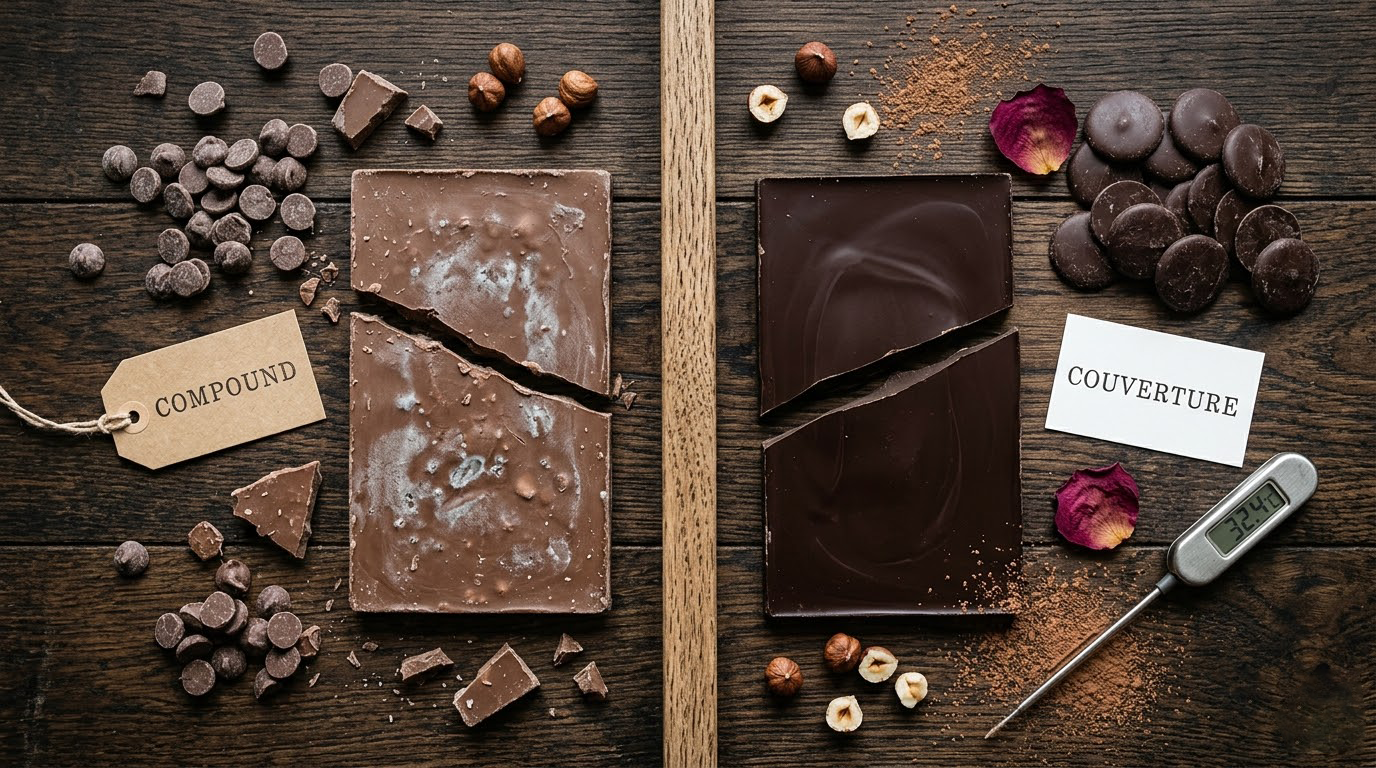
If you have ever stood in front of a chocolate shelf, or scrolled through Bakeyy's Compounds and Couverture collection, wondering what the difference between compound chocolate and couverture actually is, you are not alone. This is one of the most common questions Indian home bakers ask when they start getting serious about chocolate work.
The short answer: compound chocolate uses vegetable fat instead of cocoa butter, making it easier to work with and more affordable. Couverture chocolate contains a minimum of 31% cocoa butter, requires tempering, and delivers a noticeably superior flavour and finish. But the longer answer is what this guide is about.
We will cover exactly what each type of chocolate is made of, how they behave in the kitchen, which applications each one suits best, and which brands are available in India right now at Bakeyy.com.
Quick Answer: Compound vs Couverture at a Glance
| Feature | Compound Chocolate | Couverture Chocolate |
|---|---|---|
| Fat used | Vegetable oil (CBE/CBR) | Pure cocoa butter only |
| Tempering needed? | No — melt and use | Yes — required for gloss and snap |
| Cocoa butter % | 0% (replaced by vegetable oil) | Minimum 31% (legal standard) |
| Taste | Milder, sweeter, stable | Complex, rich, deep |
| Melt point | Higher — survives Indian heat better | Lower — more sensitive to temperature |
| Price range | Rs. 170 to Rs. 500 per 500g | Rs. 470 to Rs. 5,000+ per 500g or 2.5kg |
| Best for | Moulding, coating, ganache for home bakers | Truffles, tasting bars, professional work |
| Shelf life | Longer (more stable fats) | Shorter (cocoa butter blooms faster) |
| India availability | Widely available and affordable | Available at Bakeyy.com in premium brands |
What Is Chocolate Compound?
Chocolate compound, also called compound coating or baking chocolate, is a chocolate-flavoured product made from cocoa powder, sugar, and vegetable fat such as palm oil or coconut oil instead of cocoa butter. The replacement of cocoa butter with cheaper vegetable oils is what defines it as a compound rather than true chocolate.
Because compound chocolate does not contain cocoa butter, it does not need to be tempered. You simply melt it in short microwave bursts or over a double boiler, and it sets firm with a reasonable gloss once it cools. For most home bakers in India, this predictability is exactly what they need.
Compound chocolate comes in three varieties: dark, milk, and white. Each variety has a different cocoa content and sweetness level. Dark compound uses the highest proportion of cocoa powder and gives the most pronounced chocolate flavour of the three, though it is still milder than couverture dark chocolate.
Why Indian Bakers Rely on Compound Chocolate
India's climate is the biggest reason compound chocolate dominates the home baking market. In cities like Bangalore, Chennai, Mumbai, and Hyderabad, summer temperatures can push past 35 degrees Celsius, and humidity during monsoon season is notoriously brutal for chocolate work. Compound chocolate, because it uses vegetable fats with a higher melting point than cocoa butter, handles these conditions significantly better than couverture does.
There is also the matter of skill level and time. Tempering couverture correctly requires a thermometer, precise temperature control across three stages, and practice. Compound chocolate removes that step entirely. You melt it, use it, and move on. For home bakers producing brownies, chocolate-dipped cookies, cake ganaches, and moulded chocolates as gifts or small-scale sales, compound is fast, reliable, and produces consistent results.
Compound Chocolate Brands Available at Bakeyy
Bakeyy stocks compound chocolate from three trusted Indian brands and one professional international brand:
Morde is one of the most widely recognised compound chocolate brands in India. Available in Morde Dark Compound 500g, Morde Milk Compound 500g, and Morde White Compound 500g. Morde is the go-to brand for home bakers and small bakeries across India for its consistent melt, good coating properties, and competitive price point.
2M is a professional-grade compound widely used by bakery businesses. Bakeyy carries the 2M Dark Compound CP11 500g, 2M Dark Compound CP16 500g, 2M Milk Compound 500g, and 2M White Compound 500g. The CP11 and CP16 are different dark chocolate formulations with slightly different viscosity profiles. CP16 is thinner and often preferred for coating and dipping applications.
Micks is stocked at Bakeyy in Micks Milk Compound 500g and Micks White Compound. A good option for bakers looking to try an alternative to Morde or 2M at a competitive price.
Van Houten produces both compound and couverture lines. Their compound range at Bakeyy includes the Van Houten Signature Dark Compound 1kg, which bridges the quality gap between standard compounds and entry-level couvertures. It is a strong step up for bakers who want better flavour without committing to full tempering.
You can browse the full range in one place on Bakeyy's Compounds and Couverture collection page.
What Is Couverture Chocolate?
Couverture is the term for professional-grade chocolate that contains a minimum of 31% cocoa butter, as required by international food standards. The word couverture comes from the French verb couvrir, meaning to cover, and the name reflects its original purpose: to coat and enrobe confections with a thin, even, glossy shell.
Couverture chocolate is made from cocoa mass, cocoa butter, sugar, and in the case of milk couverture, milk solids. No vegetable oils are used. The high cocoa butter content gives couverture a lower viscosity when melted, which means it flows more freely and creates thinner, more even coatings than compound chocolate.
The trade-off is that couverture absolutely requires tempering to behave correctly. Tempering is the controlled melting and cooling process that aligns the fat crystals in cocoa butter into a stable Form V crystal structure. Properly tempered couverture sets with a hard snap, a mirror-bright gloss, and a clean mouthfeel. Improperly handled couverture sets soft, streaky, or with a grey bloom on the surface.
The Science Behind Tempering (Simplified)
Cocoa butter is polymorphic, meaning it can solidify into six different crystal forms numbered I through VI. Only Form V produces the ideal characteristics a chocolatier wants: hardness, gloss, snap, and a stable shelf life. The tempering process deliberately moves chocolate through specific temperature ranges to destroy unstable crystals and encourage Form V to dominate.
For dark couverture, the standard tempering curve is: melt to 50 to 55 degrees Celsius, cool to 27 to 28 degrees while agitating (the seeding stage), then raise back to 31 to 32 degrees for working temperature. Milk and white couvertures work at slightly lower temperatures. Without a chocolate thermometer, consistent tempering is nearly impossible.
Couverture Brands Available at Bakeyy
Bakeyy stocks professional couverture from some of the world's most respected chocolate manufacturers:
Callebaut is a Belgian couverture manufacturer and the benchmark for professional chocolate work worldwide. Bakeyy stocks several Callebaut varieties: Callebaut 811 Dark Couverture 54.5% Cocoa 2.5kg, Callebaut 823 Milk Couverture 2.5kg, Callebaut W2 White Couverture 2.5kg, Callebaut Ruby RB2 Couverture 2.5kg, and Callebaut Gold Caramel Couverture 2.5kg. The 811 is the most commonly used dark couverture in professional patisserie worldwide. Ruby and Gold are specialty couvertures for high-end applications.
Morde Couverture is an excellent Indian alternative for bakers who want the quality of couverture without the import price. The Morde D45 Dark Couverture 45% 500g, Morde M28 Milk Couverture 500g, and Morde W35 White Couverture 500g are available in 500g bars, ideal for home bakers who want to explore couverture work without committing to 2.5kg quantities.
Van Houten Couverture is available in 1kg blocks at Bakeyy. The Van Houten Professional Dark 46.5% 1kg and Van Houten Professional Dark 55% 1kg are a practical middle ground between the 500g Morde bars and the 2.5kg Callebaut slabs. The 1kg format suits small bakeries or serious home bakers doing regular couverture work.
2M High-Cocoa Chocolates are true couvertures with declared cocoa percentages, suitable for tempering and professional chocolate making. The 2M 72% Dark Chocolate 500g and 2M 46.5% Dark Chocolate 500g are both stocked at Bakeyy.
Compound vs Couverture: Which One Should You Choose?
The right choice depends entirely on what you are making, your skill level, and how the final product will be used. Here is a practical breakdown:
Choose Compound Chocolate When:
- You are making chocolate-dipped items such as biscuits, strawberries, pretzels, or cookie pops, where you need reliable, fast-setting coverage without tempering.
- You are producing moulded chocolates for gifting in large quantities, especially during summer or the festive season when temperature control is challenging.
- You are baking brownies, chocolate cake layers, or ganache where the chocolate is mixed into a batter or combined with cream. Tempering is irrelevant in these applications.
- You are a home baker or small bakery building a product range and want cost-effective, consistent chocolate work.
- Your products will be shipped or displayed at room temperature. Compound's higher melting point makes it far more stable for packaging and transport in Indian conditions.
Choose Couverture Chocolate When:
- You are making hand-crafted truffles, bonbons, or pralines where flavour complexity and a clean, snappy finish are central to the product's value.
- You are producing tasting bars or chocolate slabs where the chocolate is the product itself, not a component. Couverture's depth of flavour justifies its price.
- You are working with ganache for layered entremets or tarts at a professional or semi-professional level where texture and mouthfeel are closely evaluated.
- You are doing chocolate showpieces, decorations, or sculptures. Properly tempered couverture gives the hard snap and gloss needed for structural work.
- You want to upgrade your home chocolate business to a higher price point. Couverture is the legitimate reason to charge more per piece.
Common Mistakes Indian Home Bakers Make With Chocolate
Understanding the compound vs couverture difference is just the start. Here are the practical mistakes that cause chocolate problems in Indian kitchens and how to avoid them:
Overheating compound chocolate. Compound melts easily. Microwave it in 20 to 30 second bursts and stir between each interval. Above 50 degrees Celsius, compound loses its smooth texture and becomes grainy.
Skipping the thermometer for couverture. Attempting to temper by feel rather than temperature is the biggest source of bloom and soft-set problems. A digital probe thermometer is a non-negotiable tool for couverture work.
Adding water to chocolate. Even a single drop of water from a wet bowl, a spoon, or steam can seize either compound or couverture immediately, turning smooth melted chocolate into a thick, grainy paste that cannot be recovered for coating.
Using couverture in warm weather without cooling. If you do not have an air-conditioned workspace below 20 degrees Celsius, working with couverture in Indian summers is extremely difficult. Compound chocolate is the practical choice for uncontrolled-temperature environments.
Storing chocolate near strong odours. Chocolate, especially couverture, absorbs surrounding smells readily. Store it sealed in an airtight container, away from spices, onions, and strong-smelling foods.
Once Your Chocolates Are Made: Packaging Matters
Whether you have moulded compound chocolates for a gifting order or crafted couverture truffles for a premium box, the right packaging protects your work and elevates the presentation. Bakeyy has dedicated packaging solutions for every style of chocolate product:
- Chocolate Box collection for rigid boxes designed for individual and assorted chocolates, suitable for gifting and retail.
- Chocolate Bar Box collection for slim packaging designed for moulded bars.
- Chocolate Wrapping Essentials including matte and foil wrappers for individually wrapped chocolates and bonbons.
- Tin Boxes for reusable metal tins popular for premium gifting, especially during Diwali and wedding season.
- Goodie Boxes for when you are mixing chocolates with other baked goods in a hamper.
For high-volume chocolate gifting or bakery orders, joining Bakeyy Super gives you automatic wholesale discounts on packaging and ingredients, including on all chocolate compounds and couvertures in the collection.
Frequently Asked Questions
Is compound chocolate real chocolate?
Technically, no. Under most food labelling standards, a product must contain cocoa butter to be called chocolate. Compound uses vegetable fat instead of cocoa butter, which is why it is labelled as a chocolate-flavoured coating or compound rather than chocolate. For baking and home confectionery this distinction rarely matters in practice, but it is important to know if you are marketing your products.
Can I substitute compound chocolate for couverture in a recipe?
Yes, in most applications. For ganaches, batters, and moulded items, compound and couverture are interchangeable with minor adjustments. The main difference you will notice is in flavour depth and melt behaviour. Compound tends to set firmer and faster; couverture melts more slowly and smoothly in the mouth. In a decorated cake ganache or chocolate drip the difference is minimal. In a tasting truffle the difference is significant.
Which brand is best for beginners, Morde or 2M?
Both are excellent. Morde is slightly more forgiving for beginners and is widely trusted for its consistent melt and reasonable flavour. 2M is favoured by bakery-scale users for its flowing consistency during dipping and coating. Try both and see which suits your work. Both are available in 500g packs at Bakeyy so the entry cost is low. Browse them in the Compounds and Couverture collection.
Is Callebaut couverture worth the price for home bakers?
Callebaut 811 at 2.5kg is expensive upfront but works out to a reasonable per-kilogram price compared to smaller packs. The quality is undeniable. For home bakers making premium chocolate boxes or entering the serious confectionery business, Callebaut is worth the investment. For bakers whose chocolate is mainly used in baked goods, Morde couverture is a far more practical choice.
What is Ruby chocolate and why is it pink?
Ruby couverture is a fourth type of chocolate developed by Barry Callebaut and released commercially in 2017. It is made from Ruby cacao beans processed using a specific method that preserves naturally occurring pink pigments and creates a fruity, berry-like flavour with no added colouring or flavouring. It is a true couverture requiring tempering. Bakeyy stocks the Callebaut Ruby RB2 Couverture 2.5kg for bakers who want to work with this specialty variety.
The Bottom Line
Compound chocolate and couverture are not competitors. They serve different needs. Compound is your workhorse: affordable, forgiving, heat-stable, and perfect for the majority of Indian home baking and small-bakery applications. Couverture is your upgrade path: richer flavour, professional finish, and the ingredient of choice when you are producing chocolates you want customers to notice.
The best approach for most home bakers is to start with a quality compound like Morde or 2M, learn your chocolate work, and then gradually introduce couverture starting with Morde's couverture range or Van Houten as your skills and ambitions grow.
Bakeyy stocks the full range: from accessible 500g compound bars from Morde, 2M, and Micks, to professional-grade Callebaut couverture in 2.5kg slabs. Whether you are making your first chocolate-dipped brownie pop or your hundredth bonbon box, everything you need is in the Compounds and Couverture collection at Bakeyy.com.