
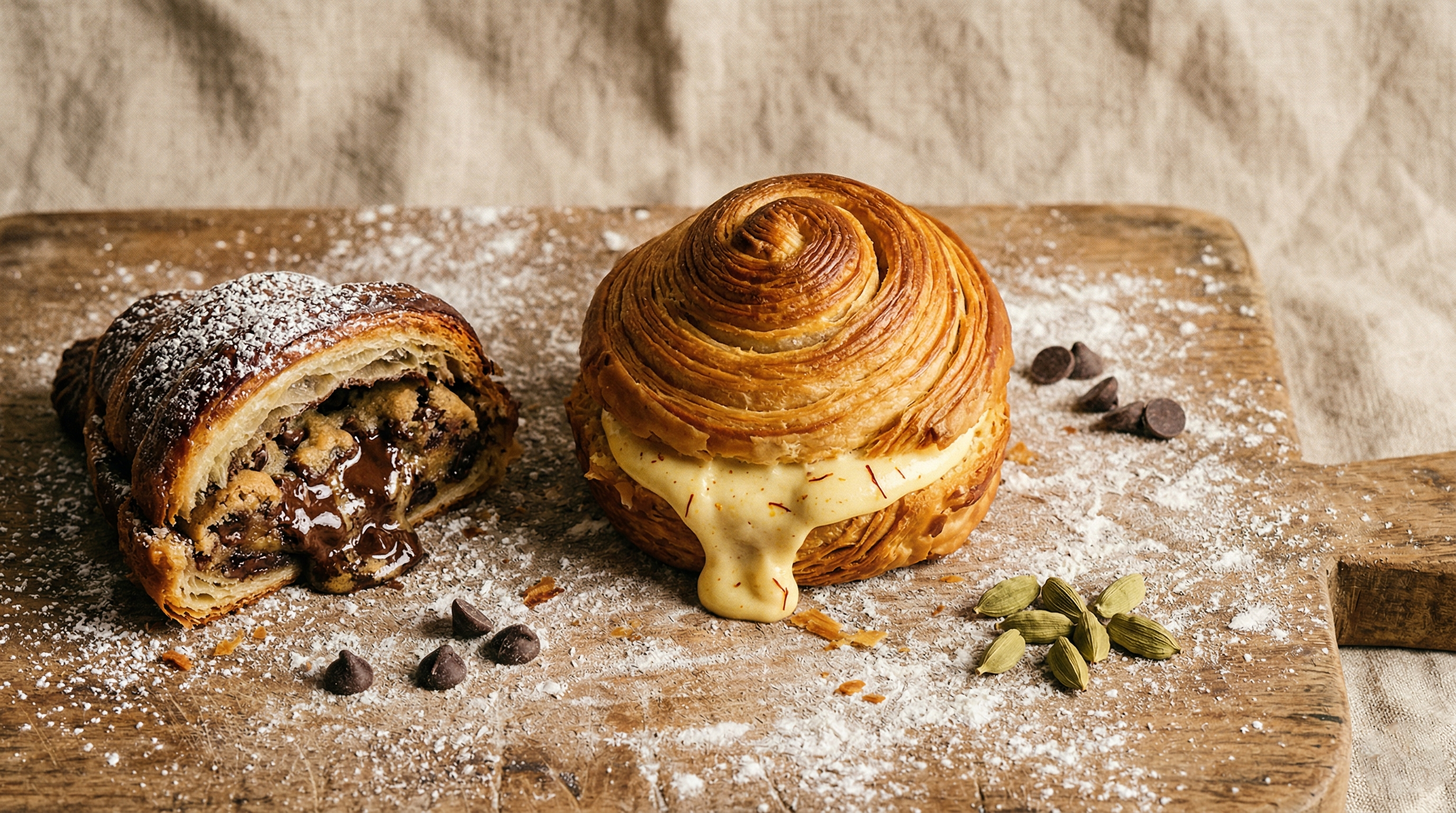
Hybrid pastries are not a passing phase. They are the most talked-about category in global bakery right now and Indian home bakers who master them early will have a serious edge.
Something has quietly shifted in the world of baking. Walk into any aspirational café in Mumbai, Bengaluru, or Delhi, and you will increasingly spot pastries that defy easy categorisation — spiralled, layered creations stuffed with pistachio cream, or croissants baked a second time with gooey cookie dough spilling out of their sides. These are not accidents or gimmicks. They are the result of a global hybrid baking movement that has been building momentum since 2013 and is now, in 2026, completely mainstream.
This post breaks down the three hybrid bakes you need to know — the cruffin, the crookie, and the broader texture-mashup wave — explains exactly why they are selling, and gives you an honest, practical guide to making them at home using equipment you can source right here on Bakeyy.com.
Why Hybrid Bakes Are Dominating 2026
Before diving into recipes and techniques, it is worth understanding why hybrid pastries have become such a commercial and cultural force. The answer lies in three overlapping trends.
1. Texture is the new flavour. Research by Puratos tracking 23,000 consumers across 56 countries found that online conversations about crunchy and crusty bakery textures are expected to grow by 19% in 2026, following a 15% rise in 2025. Consumers are no longer satisfied with one-dimensional baked goods. They want contrast: a shattering exterior followed by a soft, gooey interior. Hybrid pastries are the most efficient vehicle for delivering that contrast in a single bite.
2. Social media demands the dramatic moment. A perfectly baked cruffin being pulled apart on camera, revealing spiral layers slicked with salted caramel cream, is a piece of content. A crookie being bitten into, with cookie dough still molten inside, is a piece of content. According to Food & Hotel Asia's 2026 trend report, one in three consumers made a food or drink purchase directly through a social platform in 2024. The visual drama of hybrid bakes is not incidental — it is the product.
3. The "familiar but surprising" formula sells. Hybrid pastries win because they are legible — customers know what a croissant is, they know what a muffin is — but they deliver novelty. Market researcher Datassential found that 40% of consumers are most likely to try a new item if it is a "twist on the familiar." Hybrid bakes are exactly that: comfort with a plot twist.
The Cruffin: The One That Started It All
The Origin Story
The cruffin — croissant dough, baked in a muffin tin — was first created in July 2013 by pastry chef Kate Reid at Lune Croissanterie in Melbourne, Australia. It was initially offered with fillings like lemon curd and kaya custard. The cruffin's popularity surged internationally after its introduction to the United States in November 2014 by Ry Stephen at Mr. Holmes Bakehouse in San Francisco, where it was trademarked and became a signature item, drawing long lines and media attention.
The story gets stranger from there. Demand was so great that the daily production sold out by noon, with purchases limited to two per customer — and in March 2015, thieves broke into Mr. Holmes Bakehouse and stole the recipe binders containing the cruffin formula and 230 other recipes, leaving cash registers and iPads untouched. The brazen pastry heist only amplified the cruffin's legend.
Today, a significant surge in popularity occurred between 2024 and 2025, marked by a 224% year-over-year increase in menu appearances across global bakeries, largely propelled by viral content on TikTok and Instagram. Bakeries from Riga to London's Covent Garden have opened dedicated cruffin outposts. The cruffin is no longer a novelty — it is an established product category.
What Makes a Cruffin Different from a Croissant
Technically, a cruffin uses the same laminated dough as a croissant. The difference is entirely in the shaping and baking. Croissant dough is rolled into a tight spiral or log, placed upright in a deep muffin tin, and baked — creating a tall, round pastry that has the layered flakiness of a croissant but the shape and portability of a muffin. Most cruffins are then filled after baking, through the bottom or side, using a piping bag.
The laminated dough creates hundreds of paper-thin layers that puff up dramatically in the oven, giving you that signature flaky texture that shatters beautifully with each bite. The tall, open-topped shape also creates a natural "crown" that catches fillings and toppings — making it one of the most photogenic pastries in modern baking.
How to Make Cruffins at Home: What You Actually Need
Let us be honest: cruffins require patience. The dough goes through 3 rounds of lamination (folding butter into dough) and multiple chilling periods. Most experienced home bakers spread the process over two or three days. That said, the technique is learnable — and the results are extraordinary.
The equipment essentials:
- A good muffin tray — Taller wells give you a more dramatic cruffin with a proper "rise above the rim" look. A standard 12-cup muffin tray works perfectly for home bakers. You can shop baking moulds and tins on Bakeyy.com — look for deep-well tins for best results.
- A rolling pin or scraper — You will be rolling the dough out multiple times. A good, even rolling pin is non-negotiable. Bakeyy stocks a range of baking tools including rolling pins and bench scrapers.
- Parchment paper — Essential for lining your tins and preventing sticking. Available on Bakeyy.com.
- A piping bag and nozzle — For filling your cruffins post-bake. A large round nozzle or star nozzle works best. Browse piping bags and nozzles on Bakeyy.com.
The dough basics:
You need high-protein flour (bread flour or maida with high gluten content), instant yeast, whole milk, sugar, salt, and — most critically — high-fat butter with at least 82% fat content for the lamination block. European-style varieties with high fat content are recommended because this allows the fat to create distinct, steam-separated sheets during baking. Lower-fat butter will merge into the dough and you will lose your layers.
The lamination process in brief:
- Make a yeasted dough, refrigerate overnight.
- Roll the chilled dough into a rectangle. Place a flattened butter block on one half. Fold the dough over the butter ("letter fold") and refrigerate for 30 minutes.
- Repeat the rolling and folding process 3 times total, chilling between each fold. This is what creates the layers.
- After the final fold, roll the dough thin, cut into strips, roll each strip tightly into a spiral, and place upright in greased muffin tins.
- Proof for 1–2 hours until puffy. Bake at 190–200°C until deep golden brown.
- Let cool slightly, then fill using a piping bag pushed into the base or side.
Indian-friendly filling ideas for cruffins:
- Kesar (saffron) custard cream
- Gulkand (rose petal jam) with whipped cream
- Salted caramel — especially good with a sprinkle of fleur de sel on top
- Chocolate ganache with cardamom
- Mango cream (seasonal — perfect for April to June)
For your fillings, you can use compound or couverture chocolate from Bakeyy.com to make a silky ganache filling. For the caramel versions, Bakeyy's range of baking ingredients includes everything you need.
Pro tip for Indian kitchens: Laminated dough is temperature-sensitive. If your kitchen runs warm (above 25°C), work in short bursts and refrigerate aggressively between folds. In Indian summer conditions (April–June), do your folding in the evening when temperatures drop, or run the AC in your kitchen. We wrote a full guide on summer baking survival for Indian kitchens that is worth reading before you start.
The Crookie: Paris's Most Viral Export Since the Baguette
The Origin Story
The crookie — a croissant stuffed with cookie dough and baked a second time — was invented in October 2022 by Stéphane Louvard, the baker behind Maison Louvard on Rue de Châteaudun in Paris's 9th arrondissement. It was not the result of extensive research or market surveys — it came about one Saturday morning when Louvard was baking croissants and saw his team making cookies beside him and simply decided to combine them.
For months, it sold around 100–150 pieces a day. Then, in February 2024, TikTok influencers got hold of it — one video by Johan Papz racked up 2.9 million views — and suddenly Maison Louvard was selling over 2,000 crookies a day and had to reorganise its entire production. The Maison Louvard team starts work at four in the morning — the dough rests at controlled temperatures, is filled with butter, and folded a dozen times to achieve the proper puff — before the croissants are stuffed with cookie dough and baked a second time.
The crookie has since spread to London, Edinburgh, New York, and beyond. It is now firmly part of the hybrid baking vocabulary alongside the cronut and the cruffin.
Why the Crookie Works (Technically and Commercially)
The crookie's genius lies in its textural contrast. The croissant exterior, already flaky and buttery, becomes even crispier when returned to the oven. The cookie dough inside stays partially raw — gooey, molten, brownie-adjacent — creating a textural duality that is genuinely arresting. Research shows that texture mashups are now the second-fastest-growing trend in global bakery, with online conversations about crunchy and crusty baked textures spiking by 19% in 2026.
Commercially, the crookie has another advantage: it is relatively straightforward to make compared to the cruffin. You do not need to master lamination from scratch. You need a good croissant (store-bought is fine for home bakers) and a solid cookie dough.
How to Make Crookies at Home
What you need:
- Large, good-quality croissants (ideally from a bakery, or baked fresh — not supermarket packaged ones, which tend to be too soft)
- A simple chocolate chip cookie dough (recipe below)
- A baking tray lined with parchment paper
- A serrated bread knife
- Icing sugar for dusting (optional but traditional)
Basic chocolate chip cookie dough for crookies:
- 115g unsalted butter, softened
- 80g brown sugar
- 40g caster sugar
- 1 egg
- 1 tsp vanilla extract
- 190g all-purpose flour (maida)
- ½ tsp baking soda
- ½ tsp salt
- 150g chocolate chips or chopped dark chocolate
Cream butter and sugars together until pale. Add the egg and vanilla. Mix in flour, baking soda, and salt until just combined. Fold in the chocolate. Do not overbake this dough — you want it soft and slightly underdone. You can use Bakeyy's chocolate chips or couverture chocolate, chopped into chunks, for better flavour than most commercial chips.
Assembly:
- Preheat your oven to 180°C (160°C fan).
- Using a serrated knife, slice each croissant in half horizontally — like a sandwich bun.
- Generously stuff the bottom half with cookie dough. Replace the top half. Then pile more cookie dough on top of the croissant.
- Place on a parchment-lined tray and bake for 10–12 minutes. The cookie dough on top should be just set with a slight golden colour. The interior should still be molten.
- Serve immediately while warm. A dusting of icing sugar adds the Parisian finish.
Indian flavour variations to try:
- Gulabo crookie — rose-flavoured cookie dough with white chocolate chips
- Chai spice crookie — cookie dough spiced with cinnamon, cardamom, and ginger
- Dark chocolate and orange crookie — dark chocolate cookie dough with orange zest
- Biscoff crookie — substitute some of the butter with Biscoff spread in the cookie dough for a caramelised, spiced finish
Beyond Cruffins and Crookies: The Broader Hybrid Baking Wave
Cruffins and crookies are the most established hybrids, but they are part of a much bigger trend. Pastry and baking trends in 2026 show the category evolving through global inspiration, social influence, and emotional connection — with hybrid bakes at the forefront of that evolution.
Here are the other hybrids gaining traction that Indian home bakers should have on their radar:
The Brookie (Brownie + Cookie)
Easier than both the cruffin and the crookie, the brookie layers brownie batter and cookie dough in the same tin and bakes them together. The result is a bar that is fudgy and dense at the bottom and chewy and crisp on top. This is arguably the most home-baker-friendly hybrid on this list — it requires no special skills, just two batters and a baking tin. Use a square baking tin from Bakeyy.com for clean, even slices.
The Cronut (Croissant + Doughnut)
Invented by Chef Dominique Ansel in New York in 2013, the cronut uses laminated dough that is cut into rounds and deep-fried rather than baked. The result has the layers of a croissant with the golden exterior of a doughnut. It is more technically demanding than a cruffin (requiring controlled-temperature frying), but the payoff is extraordinary. If you are comfortable with lamination, this is a natural next step.
The Cinnamon Roll Croissant (Cro-Roll)
This is exactly what it sounds like: laminated croissant dough rolled with cinnamon-sugar filling and baked in the shape of a classic cinnamon roll. Food trend forecasters at AF&Co. + Carbonate predict cinnamon rolls to be the next big thing after croissants in 2026 — so combining the two is a smart commercial move. For the cinnamon sugar filling, use good-quality ground cinnamon and brown sugar, both available on Bakeyy.com.
The Cruffin-Mochi Hybrid
This is an emerging East-meets-West creation: laminated dough with a mochi (glutinous rice) filling inside instead of cream. The contrast between the shattering, flaky exterior and the bouncy, chewy mochi interior is genuinely unlike anything else in baking. Gen Z, in particular, prizes layered and evolving textures, finding delight in foods that are stretchy, bouncy, or that shift as they chew — and this hybrid delivers exactly that.
The Business Case: Why Home Bakers Should Add Hybrids to Their Menu
If you run a home bakery, hybrid bakes are not just a fun creative project — they are a genuine revenue opportunity. Here is why:
Premium pricing is justified and accepted. A crookie at Maison Louvard costs €7 to eat in — roughly three times the price of a standard croissant — with Louvard citing the quality of butter, flour, and labour as justification. Indian customers who follow food trends on Instagram understand that craft and technique command a premium. A well-made cruffin filled with saffron cream or a crookie stuffed with Belgian chocolate chip cookie dough is a ₹150–₹250 item, not a ₹50 one.
They are inherently shareable. Every hybrid bake is a content opportunity for your customers. When someone orders a cruffin from your home bakery and films themselves pulling it apart, that is free marketing. Design your packaging to support this — clean, branded boxes that frame the pastry well. Browse Bakeyy's gift packaging and bakery boxes for options that will make your products look the part.
The market window is now. The Latvian bakery Cruffins opened its first UK location in London's Covent Garden in September 2025, signalling that what started as a niche café trend is becoming mainstream. In India, the curve is typically 12–24 months behind Western markets for baked goods trends. That means right now is the ideal time for Indian home bakers to get ahead of mass adoption.
Ingredients are accessible. Unlike some trend-driven bakes that require obscure imports, cruffins and crookies use ingredients that are largely available in India — good quality flour, butter, eggs, chocolate. The key upgrade is in technique and sourcing quality inputs. Stock your pantry from Bakeyy.com's baking ingredients collection, where you will find everything from quality compound and couverture chocolate to vanilla extracts, baking stabilisers, and more.
Common Mistakes to Avoid
Using low-fat butter for lamination. This is the single biggest mistake home bakers make with cruffins. Standard table butter in India often has lower fat content than European-style baking butter. If your butter has less than 80% fat, you will get greasy, heavy pastry instead of distinct flaky layers. Use the best quality butter you can access.
Warm kitchen, warm dough. Laminated dough must stay cold throughout the folding process. If the butter melts into the dough, you lose your layers. If your kitchen is warm, work in short 10-minute sessions and return the dough to the refrigerator between folds. This is especially important in Indian summer months.
Overfilling crookies. The cookie dough expands during baking. If you pile too much on top, it will slump off the sides of the croissant and make a mess on your tray. A generous but controlled amount — roughly 2–3 tablespoons on top — is correct.
Underbaking cruffins. The inside of a cruffin needs to be fully cooked through despite its thick shape. If you pull it too early, the interior layers will be doughy and raw. Tap the bottom — it should sound hollow. Internal temperature should reach around 90°C.
Wrong tin depth for cruffins. A standard shallow muffin tin will give you a squat cruffin that does not have the dramatic height associated with the format. If possible, use a deep muffin tin or even a popover pan for more impressive results. Check Bakeyy's mould collection for deep-well options.
The Bigger Picture: Hybrid Baking Is Here to Stay
It is fair to ask: are hybrid bakes just a trend, or do they have lasting power? The evidence strongly suggests the latter. The croissant itself is a hybrid — it was adapted by French bakers from Austrian kipferl in the 19th century. The Danish pastry is a hybrid. The doughnut has been hybridised dozens of times over the past century. BAKERpedia notes that "the hybrid craze is here to stay, with bold creations turning heads" and emphasises that "texture is where hybrid pastries shine."
What changes is the specific form the hybrid takes. The cronut had its moment. The cruffin is in its sustained second wave. The crookie is at peak virality. Whatever comes next will be built on the same principle: take two beloved baked goods, find the point of maximum textural and flavour contrast, and combine them with enough technique to justify a premium price.
As an Indian home baker, your advantage is in the flavour layer. A cruffin filled with cardamom custard or a crookie made with dark chocolate and chai spice cookie dough is not just a trend item — it is a distinctly Indian take on a global format. That combination of global technique and local flavour is exactly what the most interesting food in the world looks like right now.
Master the lamination. Experiment with the fillings. Get the packaging right. And make sure your tools are up to the task — from your muffin tins and baking moulds to your piping bags and nozzles to your chocolate and baking ingredients — all available at Bakeyy.com, India's wholesale baking supply store.
Quick Reference: Hybrid Bakes at a Glance
| Hybrid | What It Is | Difficulty | Best For |
|---|---|---|---|
| Cruffin | Croissant dough baked in a muffin tin, filled with cream | Advanced | Premium home bakery menus, special orders |
| Crookie | Croissant stuffed with cookie dough, baked twice | Intermediate | Everyday menu item, high Instagram value |
| Brookie | Brownie and cookie dough baked together in layers | Beginner-friendly | Gifting, bulk orders, regular production |
| Cro-Roll | Croissant dough with cinnamon sugar, baked as a roll | Intermediate | Brunch, café-style home bakery |
All baking tools, moulds, piping equipment, chocolate, and packaging mentioned in this post are available at Bakeyy.com — India's wholesale baking supplies store. Whether you are just starting out or scaling up a home bakery, we stock everything you need to bake professionally.