

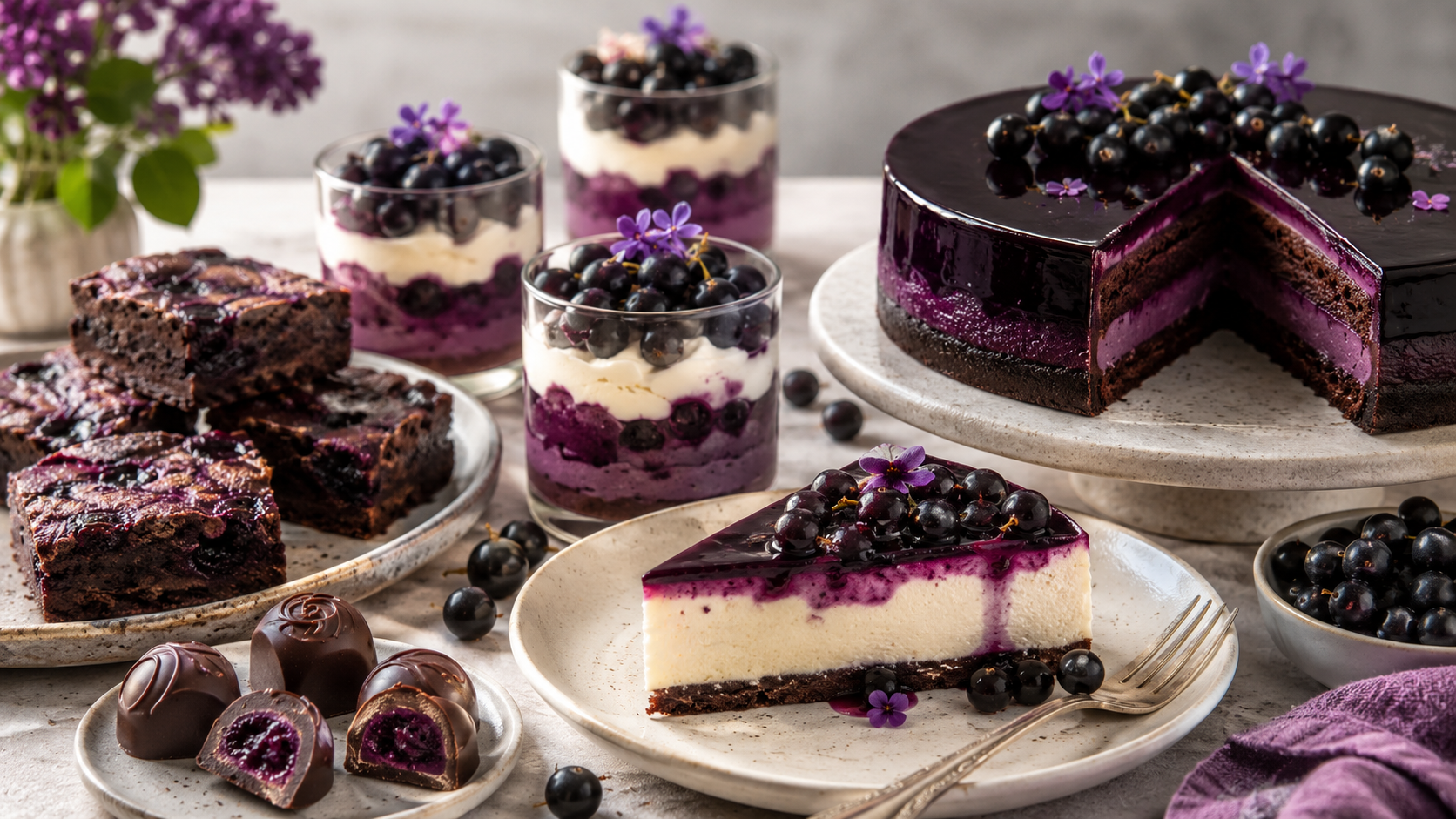
Black currant is emerging as one of 2026’s most interesting dessert flavours because it offers something many bakery menus currently lack: intense fruit character without depending entirely on sweetness.
Its flavour can be tart, dark, aromatic, earthy, slightly floral and mildly herbal. That makes black currant suitable for products where ordinary strawberry can feel too familiar, blueberry too mild or chocolate too rich on its own.
McCormick selected black currant as its 2026 Flavor of the Year, giving the ingredient a strong international trend signal. However, the real business opportunity is not the announcement itself. The opportunity comes from how well black currant works across several commercially useful bakery formats.
It can cut through a rich cheesecake, create contrast inside a dark chocolate brownie, brighten white chocolate mousse, become the centre of a moulded chocolate and give an ordinary vanilla cake a deeper premium identity.
Indian customers are also not completely unfamiliar with the flavour. Black currant has appeared for years in ice creams, beverages, syrups and confectionery. The next step is using it more thoughtfully in bakery and dessert products rather than treating it only as a purple syrup.
This guide explains how to develop black currant cakes, cheesecakes, brownies, mousse cups and chocolates for Indian customers. It covers flavour balance, ingredient formats, anthocyanin colour behaviour, dairy compatibility, chocolate pairing, production, packaging, pricing, shelf-life testing, monsoon conditions and menu design.
It also links directly to relevant Bakeyy ingredients, chocolate, bakeware and packaging products. Every product image has been selected for the specific section where it is useful rather than inserted only for decoration.
Important: the recipes, ratios, shelf-life periods and prices in this guide are product-development starting points. Final results depend on the specific fruit product, sugar concentration, dairy, chocolate, equipment, storage temperature and packaging used by the bakery.
Quick Answer: Is Black Currant a Good Bakery Business Flavour?
Yes. Black currant has strong bakery potential because one flavour can be extended across cakes, cheesecakes, brownies, mousse, chocolates, dessert cups, tea cakes and beverages.
It works particularly well for bakeries that want to offer desserts that feel:
More balanced than extremely sweet products; more premium than standard mixed-fruit flavours; visually darker and more distinctive; suitable for chocolate and dairy; adaptable to individual portions; and easy to introduce through a limited seasonal menu.
| Product | Best black currant application | Production difficulty | Delivery suitability | Commercial role |
|---|---|---|---|---|
| Layer cake | Compote, soak, mousse layer or ganache | Intermediate | Medium | Celebration and premium cake orders |
| Cheesecake | Swirl, gel layer, compote or glaze | Intermediate | Medium with refrigeration | High-value signature dessert |
| Brownie | Concentrated ripple, gel centre or ganache topping | Beginner to intermediate | High | Easy entry product and gifting box item |
| Mousse cup | Fruit mousse, white chocolate mousse or layered gel | Intermediate | Medium with cold delivery | Sampler, party and café product |
| Chocolate | Ganache, jelly, caramel or fruit centre | Intermediate to advanced | High when correctly made | Premium gifting and festive boxes |
Black Currant or Blackcurrant: Which Spelling Should You Use?
Both spellings are widely used.
Black currant uses two words and is common in North American product descriptions and search queries.
Blackcurrant is commonly written as one word in British English and in many international food products.
For Indian SEO, use both naturally throughout the article and product listing. A product title could be written as “Dark Chocolate Black Currant Brownie,” while the description can also mention “blackcurrant fruit filling.”
Do not force both spellings repeatedly in every sentence. Use the clearer spelling in the product name and include the alternate form in the description, SEO text and frequently asked questions.
What Does Black Currant Taste Like?
Black currant is not simply a darker blueberry.
Its flavour is generally more concentrated, tart and aromatic. Depending on the ingredient format and ripeness, customers may notice dark berry, grape-like, earthy, floral or herbal notes.
The intensity is useful in rich desserts because the fruit does not disappear immediately behind butter, cream cheese or chocolate.
Black currant can make a white chocolate mousse feel less sugary. It can give a brownie a sharper finish. It can turn a basic cheesecake into a flavour-led product rather than a plain cheesecake with coloured topping.
The ingredient can also taste medicinal or artificial when it is used carelessly. This usually happens when a strong flavour or syrup is added without enough real fruit character, acidity or supporting ingredients.
The goal is not maximum black currant intensity. The goal is a recognisable fruit flavour that remains balanced with the dessert base.
Black Currant vs Jamun, Blueberry and Blackberry
| Fruit | Typical flavour impression | Typical colour direction | Strong bakery uses |
|---|---|---|---|
| Black currant | Tart, concentrated, aromatic, earthy and dark-fruited | Red-purple to deep purple depending on pH and formulation | Cheesecake, mousse, ganache, chocolate centres and glazes |
| Jamun | Earthy, mildly sweet, tart and sometimes astringent | Purple to magenta | Sorbet, mousse, panna cotta and Indian fusion desserts |
| Blueberry | Milder, sweeter and gently acidic | Blue-purple to violet | Muffins, cheesecake, fillings and breakfast products |
| Blackberry | Juicy, tart, wine-like and sometimes seedy | Purple-black to red-purple | Pies, compotes, jams, tarts and cake fillings |
These fruits are not direct one-to-one substitutes. Their acidity, aroma, natural sugar, seed content, colour and water level differ.
If a recipe is developed for a thick blueberry filling, replacing it with a thinner black currant crush may make the cake wet. Replacing a tart black currant gel with sweet blueberry filling may make the dessert taste flatter.
Choose the Correct Black Currant Ingredient Format
The word “blackcurrant” on a label does not tell you how the ingredient will behave inside a dessert.
A fruit crush, purée, jam, filling, concentrate, powder and flavour emulsion have different water, sugar, acidity and fruit-solid levels.
| Ingredient format | Best applications | Advantages | Main limitation |
|---|---|---|---|
| Fresh or frozen fruit | Compote, sauce, jam and garnish | Real fruit texture and natural variation | Availability, cost, seeds, water and batch variation |
| Fruit purée | Mousse, gel, glaze, ganache and cheesecake | Predictable fruit distribution | Needs freezing or refrigeration and may be expensive |
| Fruit crush or syrup | Soaks, beverages, sauces, quick mousse flavouring and drizzles | Convenient and easy to portion | Added sugar and water must be included in the recipe balance |
| Ready-to-use fruit filling | Cake layers, cheesecakes, doughnuts and brownie ripples | Stable consistency and quick production | May be sweeter and less tart than the desired flavour profile |
| Jam or preserve | Cookies, brownies, sandwich cakes and tea cakes | Thick, accessible and easy to layer | High sweetness can dominate the dessert |
| Concentrate | Ganache, glaze, gel and intense flavour bases | Strong flavour with lower water addition | Can become harsh or medicinal when overdosed |
| Freeze-dried powder | Chocolate, buttercream, cookies and dry decoration | Adds fruit solids with relatively little water | Premium cost and possible colour fading |
| Flavour or emulsion | Sponge, buttercream and large-batch products | Consistent aroma and low dosage | Does not provide real fruit body, acidity or texture |
A useful commercial formulation may use two formats together. For example, a mousse can use fruit crush for aroma and a concentrated compote or purée for tartness and fruit body.
This produces a more convincing flavour than relying only on a syrup.
Bakeyy Black Currant Ingredient Option

The Mala’s Fruit Crush Syrup listing includes 250 ml and 750 ml flavour variants.
When checked on August 6, 2026, the 750 ml Black Currant variant was listed at ₹185 and showed limited inventory. The 250 ml Black Currant variant was listed at ₹85 but was out of stock at that moment.
Prices and stock can change. Check the live product page before finalising a recipe cost or marketing launch.
Because it is a fruit-crush format, do not automatically replace purée gram-for-gram. Begin with a small controlled test and adjust the recipe’s added sugar and liquid.
The Black Currant Flavour Architecture
A convincing black currant dessert usually needs three connected flavour layers.
Layer 1: Aroma. This is the first black currant impression the customer notices. Fruit crush, flavour, zest, aromatic spices or a visible glaze can supply it.
Layer 2: Acidity. Tartness prevents dairy, sugar and chocolate from flattening the flavour. Purée, compote or a carefully formulated fruit gel can provide this layer.
Layer 3: Body. Fruit solids, chocolate, cream cheese, nut paste or cooked fruit make the flavour feel complete rather than watery.
A dessert containing only aromatic syrup may smell like black currant but taste sugary and thin.
A dessert containing only very tart fruit may feel sharp and unfinished.
A good product connects the aroma, acidity and body into one experience.
Why Black Currant Colour Changes
Black currant contains anthocyanin pigments. These pigments can create red, purple and blue colour directions, but they are sensitive to the dessert environment.
Four factors are especially important:
Acidity: acidic mixtures generally push anthocyanins towards redder or magenta-purple appearances.
Neutral or less acidic dairy: colour may become more muted, bluish, greyish or unstable depending on the complete formulation.
Heat: prolonged or intense heating can degrade anthocyanins and reduce colour intensity.
Light and storage: colour can fade or shift during display and storage.
This is why black currant sauce can look bright ruby-purple while the same ingredient appears pale violet inside whipped cream and nearly black inside a cocoa brownie.
Black Currant Colour Map for Bakers
| Dessert environment | Likely colour direction | Development risk | Useful approach |
|---|---|---|---|
| Acidic fruit gel | Red-purple or magenta-purple | Excess acidity can taste harsh | Balance acid, sugar and fruit concentration together |
| Whipped cream | Pale violet, mauve or muted purple | Grey tone or curdling from acidic liquid | Use a concentrated cooled base and add gradually |
| Cream cheese | Muted pink-purple or violet | Loose consistency from excess liquid | Use thick compote, gel or reduced fruit base |
| White chocolate | Pastel violet to berry-purple | Too much liquid can split ganache | Control the chocolate-to-liquid ratio |
| Dark chocolate | Very dark purple-brown | Fruit becomes visually invisible | Use a visible gel, centre or top decoration |
| Baked sponge or cookie | Muted purple, grey-purple or brown-purple | Heat degradation and browning | Use black currant in post-bake filling or glaze for stronger colour |
Do not promise customers a naturally bright purple cake unless the finished recipe has been tested.
Natural fruit colour is affected by pH and the food matrix. A small amount of permitted food colour may be used where appropriate, but colour should not replace flavour.
Bakeyy’s Guide to Food Colours in Culinary Creations explains broader colour selection and handling.
How to Prevent Black Currant From Curdling Cream
Black currant products can be acidic. Pouring a large amount of acidic fruit liquid directly into dairy can destabilise the mixture.
For whipped cream, begin with a concentrated black currant base rather than a large quantity of watery syrup.
Whip the cream to a softer stage first. Add the cooled fruit base gradually while mixing at low speed. Stop when the cream reaches the required texture.
For cream cheese, loosen the cream cheese separately before adding fruit. A thick reduction or gel is easier to control than a thin crush.
For white chocolate mousse or ganache, add the black currant liquid as part of the calculated liquid phase. Do not prepare a finished ganache and then pour in additional fruit liquid without adjusting the chocolate ratio.
Always test the product again after refrigeration. A mousse that appears stable immediately after mixing may release water or become grainy after several hours.
How to Make Black Currant Cake
A black currant cake is most successful when the fruit is distributed through intentional layers rather than mixed randomly into every component.
A strong commercial structure is:
Vanilla or chocolate sponge; light black currant soak; black currant compote or gel; vanilla, cream cheese or chocolate filling; and a restrained black currant glaze or decoration.
This creates clear flavour movement. The customer first notices the glaze or aroma, then the cream, then the sharper fruit centre.
Choose the Right Sponge
Vanilla sponge provides the cleanest background and allows the berry colour to remain visible.
Chocolate sponge creates a richer and more adult profile but can hide the fruit visually.
Almond sponge adds nutty sweetness and pairs well with black currant acidity.
Red velvet-style sponge can work, but cocoa, colour and black currant may compete rather than support one another.
Lemon sponge can brighten the fruit, but the combined acidity must remain balanced.
Use a Controlled Cake Soak
A fruit-crush soak can add aroma throughout the sponge. Dilute and sweeten only after tasting the specific product.
Apply the soak by weight. An uncontrolled pour can make the lower cake layer wet while the upper layers remain dry.
The amount should depend on sponge density, cake size and filling moisture.
Do not use the same heavy soak for a fragile genoise and a dense chocolate sponge.
Make the Filling Thicker Than a Sauce
A cake filling must remain between layers during stacking, chilling and delivery.
A thin black currant sauce can soak into the sponge, leak through the buttercream dam and stain the cake board.
Use a cooked compote, pectin gel, starch-thickened filling or suitable ready-to-use filling. Cool it completely before assembly.
Pipe a stable cream or ganache dam around the edge before adding the fruit centre.
Black Currant Cake Pairing Ideas
Black currant and vanilla: the safest premium introduction.
Black currant and dark chocolate: bold, less sweet and suitable for adult celebrations.
Black currant and white chocolate: visually attractive and creamy, but sweetness must be controlled.
Black currant and pistachio: premium colour and flavour contrast.
Black currant and rose: aromatic and elegant when rose remains restrained.
Black currant and orange: bright, familiar and suitable for tea cakes.
Black currant and cardamom: a useful Indian adaptation.
Black currant and black sesame: deep, nutty and contemporary.
Packaging Black Currant Cakes
Black currant cakes often use glazes, mousse layers or soft fruit centres. The box should protect the finish without touching the sides or top.
Use a rigid cake base and a correctly sized box. Large empty space allows the cake board to slide during delivery.
Clear dome packaging is useful for mini cakes and cheesecakes because the dark purple fruit layer remains visible without opening the package.

The Round Cake Dome Box With Gold Base was listed from ₹1,715 to ₹2,025 for 50 pieces depending on the selected variant when checked on August 6, 2026.
Explore more options in Bakeyy’s Cake Box Collection.
How to Make Black Currant Cheesecake
Cheesecake is one of the strongest formats for black currant because cream cheese provides fat, richness and mild tang while black currant contributes deeper acidity and aroma.
The fruit can be used in four main ways:
A swirl inside the cheesecake; a concentrated layer above the biscuit base; a gel or glaze on the finished cheesecake; or a compote served on top or separately.
Baked Black Currant Cheesecake
For a baked cheesecake, avoid adding an uncontrolled quantity of watery fruit crush directly to the batter.
Extra water can soften the structure and change the baking time. Added sugar can also make the cheesecake sweeter than planned.
A thick black currant reduction or compote is more predictable for swirling.
Add small spoonfuls to the filled pan and create a shallow swirl. Avoid mixing so aggressively that the entire cheesecake becomes grey-purple.
A separate top gel applied after chilling often creates stronger colour and a clearer flavour contrast.
No-Bake Black Currant Cheesecake
No-bake cheesecake allows a brighter fruit colour because the black currant layer is not exposed to long oven heat.
However, the formulation must still control water.
A no-bake black currant cheesecake may use cream cheese, whipped cream, white chocolate or a setting agent. The required setting system depends on the final product, serving temperature and delivery time.
Prepare the fruit base separately and cool it before folding it into the dairy mixture.
If using a fruit layer, allow the cheesecake layer to set enough before adding the fruit. Otherwise, the two layers may mix and lose definition.
Prevent a Watery Black Currant Cheesecake Layer
Common causes include:
Using thin fruit crush without thickening; adding warm fruit to a cold cheesecake; using frozen fruit without accounting for released water; cutting before the cheesecake is fully chilled; and storing the product through major temperature changes.
Test the cheesecake after one full delivery simulation, not only immediately after removal from the refrigerator.
Mini Cheesecake Opportunity
Mini black currant cheesecakes are easier for customers to trial than a full cake.
They can be sold individually, in assorted cheesecake boxes or as part of a dark-fruit tasting menu.
A sampler might include black currant, blueberry, mango and chocolate. This gives the customer a familiar comparison while positioning black currant as the distinctive flavour.
How to Make Black Currant Brownies
Black currant and chocolate work well because tart fruit interrupts the richness of cocoa, butter and sugar.
The biggest formulation mistake is adding a large amount of thin fruit crush directly to brownie batter.
Brownie texture depends on a controlled relationship between fat, sugar, egg, flour, chocolate and water. Extra liquid can make the centre gummy, increase baking time or create a cake-like structure.
Best Black Currant Brownie Formats
Black currant ripple brownie: use a thick fruit filling or reduction swirled lightly over the batter.
Black currant centre brownie: freeze or pre-set a small gel or ganache insert and place it inside each portion.
Black currant ganache brownie: bake a standard brownie and add a fruit-flavoured chocolate topping after cooling.
Black currant cheesecake brownie: combine a cream cheese layer with concentrated fruit ripple.
Black currant brownie sandwich: place fruit ganache or buttercream between two thinner brownie layers.
Black currant brownie bite: portion small squares for sampler and gifting boxes.
Use Fruit as a Contrast, Not a Wet Layer
A good brownie should still taste like a brownie.
The black currant should create a clear tart interruption rather than turning the entire product into damp fruit cake.
For a ripple, use enough fruit to create visible lines but not enough to cover the entire surface.
For a centre, keep the insert away from the brownie edges to reduce leakage.
For ganache, calculate the fruit liquid as part of the ganache formula.
Brownie Baking Pan

The Non-Stick Rectangular Baking Pan was listed from ₹180 to ₹240 depending on size when checked on August 6, 2026.
Packaging Black Currant Brownies
Brownies containing fruit ripple or ganache can mark ordinary paper. Use a food-safe grease-resistant liner before placing them inside a paperboard box.
Allow the brownies to cool completely before cutting and packing.
For ganache-topped brownies, chill until the topping is stable but avoid packing them so cold that condensation forms immediately inside the box.

The Metallic Gold Brownie Box was listed from ₹70 to ₹180 for 10 boxes depending on capacity when checked on August 6, 2026.
Read Bakeyy’s Complete Brownie Packaging Guide for more detailed box, liner and presentation guidance.
How to Make Black Currant Mousse Cups
Mousse cups allow customers to see black currant layers clearly, making them one of the strongest visual products for the trend.
A mousse cup can contain:
Chocolate sponge crumbs; black currant gel; vanilla mousse; white chocolate black currant mousse; cheesecake mousse; chocolate ganache; and a final fruit glaze.
Do not place all seven layers in every cup. A commercial product should remain understandable and efficient to produce.
Three Strong Mousse Cup Structures
White chocolate black currant mousse: chocolate sponge, black currant gel and pale violet white chocolate mousse.
Black currant cheesecake cup: biscuit crumb, cheesecake mousse, fruit layer and light cream.
Dark chocolate black currant cup: brownie crumb, black currant compote, dark chocolate mousse and berry glaze.
Prepare a Concentrated Fruit Base
Mixing large quantities of thin crush directly into whipped cream can reduce stability.
Instead, prepare a concentrated black currant base. Depending on the desired product, this may be a reduction, purée-based gel, white chocolate emulsion or fruit-and-cream mixture.
Cool the base before folding it into whipped cream or mousse.
The exact temperature matters. A warm base can melt the whipped structure, while an extremely cold set gel can form lumps.
Build Clean Layers
Each layer should be stable enough to support the next one.
Allow warm cake crumbs, ganache or fruit gel to cool completely before assembly.
Pipe mousse against the side of the cup carefully to avoid streaks.
Remove air pockets by tapping the cup lightly rather than shaking it aggressively.

Bakeyy’s Disposable Piping Bags were listed from ₹60 to ₹99 for 100 pieces depending on size when checked on August 6, 2026.
Choose the Correct Dessert-Cup Size
Small 60 ml or 90 ml cups work for tasting menus, parties and sampler boxes.
Larger 250 ml cups work for complete individual desserts but require a higher selling price and stronger portion control.

The 60 ml and 90 ml Transparent Dessert Cups With Lids were listed from ₹325 to ₹480 for 100 pieces depending on size.

The 250 ml Round Transparent Dessert Cup was listed at ₹800 for 50 pieces when checked on August 6, 2026.
Explore more formats through Bakeyy’s Acrylic Dessert Cup Collection, Dessert Containers With Lids and Dessert Tubs.
Bakeyy’s Dessert Tubs Guide for Indian Home Bakers explains portioning and menu opportunities in more detail.
How to Make Black Currant Chocolates
Black currant is especially effective in chocolate because acidity and fruit aroma can make a rich chocolate centre taste cleaner.
Possible formats include:
Dark chocolate shell with black currant ganache; white chocolate shell with fruit gel; black currant caramel; layered jelly and ganache bonbon; fruit-flavoured chocolate bar; brownie truffle with black currant centre; and black currant chocolate bark.
Dark Chocolate vs White Chocolate
| Chocolate type | Black currant result | Main advantage | Main risk |
|---|---|---|---|
| Dark chocolate | Deep, tart and sophisticated | Controls sweetness naturally | Strong cocoa can hide mild fruit flavour |
| Milk chocolate | Creamy and approachable | Broad customer acceptance | Can become too sweet with fruit syrup |
| White chocolate | Creamy berry flavour with visible purple tone | Strong colour and visual contrast | High sweetness and sensitive ganache balance |
Control Water in Chocolate Fillings
Chocolate and water require careful formulation.
Adding fruit crush directly to melted chocolate can make the mixture seize, split or form an unstable ganache.
A fruit ganache needs a calculated relationship between chocolate, fruit liquid, cream or other liquids, sugar and fat.
A fruit jelly centre must set firmly enough to pipe or cut without leaking through the chocolate shell.
Do not guess a long shelf life for fruit-filled chocolates. Water activity, acidity, hygiene and storage conditions affect filling stability.
For a detailed explanation of chocolate choices, read Bakeyy’s Chocolate Compound vs Couverture Guide.
Chocolate Options From Bakeyy

The Morde Chocolate Slab was listed from ₹408 to ₹588 for 500 grams depending on the selected dark, milk or white variant.

The Van Houten Professional Compound was listed from ₹169 to ₹223 for 500 grams depending on the variant.
Black Currant Chocolate Bars
A chocolate bar can use black currant as freeze-dried powder, a thin fruit layer, flavoured ganache, crisp inclusion or decorative drizzle.
A wet fruit filling should not be spread casually inside a bar intended for long room-temperature storage.
For a safer initial commercial test, consider:
Dark chocolate with freeze-dried black currant; white chocolate with black currant powder; dark chocolate with black currant-flavoured crisp pieces; or a short-shelf-life filled bar sold refrigerated where appropriate.

The Mini Textured Chocolate Bar Mould was listed at ₹80 when checked on August 6, 2026.
Explore Bakeyy’s Mould Collection and read the Guide to Chocolate Moulds.
Packaging Black Currant Chocolates
Black currant chocolates can be positioned as premium gifting products through dark purple, black, gold, floral or minimal packaging.
The cavity size should match the finished chocolate. An oversized cavity allows movement and surface damage.
Every chocolate should be fully set before packing. Avoid touching glossy shells directly with warm fingers.

The 16-Cavity Hard Chocolate Box was listed at ₹99 per box when checked on August 6, 2026.
Browse more options in Bakeyy’s Chocolate Gift Box Collection.
Black Currant Flavour Pairing Matrix
| Pairing | Flavour result | Best applications | Risk to control |
|---|---|---|---|
| Dark chocolate | Deep, tart and premium | Brownies, bonbons, cakes and ganache | Cocoa overpowering the fruit |
| White chocolate | Creamy and visually bright | Mousse, ganache, cheesecake and bars | Excess sweetness |
| Vanilla | Clean and approachable | Cakes, mousse and cream | Fruit flavour becoming too mild |
| Pistachio | Nutty, luxurious and colourful | Cakes, tarts and chocolates | High ingredient cost |
| Rose | Floral and aromatic | Mousse, macarons and celebration cakes | Perfumed or medicinal aftertaste |
| Orange | Bright and familiar | Tea cakes, brownies and chocolate | Too much combined acidity |
| Cardamom | Warm Indian fusion profile | Cheesecake, tea cake and chocolate | Spice masking berry aroma |
| Black sesame | Dark, nutty and contemporary | Mousse, chocolates and plated desserts | Both flavours becoming visually too dark |
| Coffee | Roasted, dark and adult | Brownies, tiramisu cups and chocolates | Coffee overwhelming the fruit |
Five-Product Black Currant Launch Menu
A new trend menu should not contain twelve products. Start with a limited range that shares ingredients and packaging.
| Menu role | Recommended product | Why it belongs |
|---|---|---|
| Entry product | Dark chocolate black currant brownie | Familiar format with a clear flavour twist |
| Signature product | Black currant baked cheesecake | Rich dairy highlights the fruit’s acidity |
| Visual product | White chocolate black currant mousse cup | Clear purple and cream layers photograph well |
| Gifting product | Black currant dark chocolate bonbon | Premium positioning and box potential |
| Celebration product | Vanilla black currant layer cake | Allows higher-value custom orders |
Product Opportunity Chart
The scores below are strategic planning estimates, not market statistics.
Brownie—beginner launch suitability: 92%
Cheesecake—premium pricing potential: 94%
Mousse cup—visual marketing potential: 96%
Chocolate—gifting potential: 90%
Layer cake—custom-order potential: 88%
How to Price Black Currant Desserts
Do not charge a premium only because the flavour is trending.
Price should come from the complete cost of the product.
Total batch cost = ingredients + packaging + direct labour + electricity + refrigeration + wastage + delivery preparation + allocated overhead.
Cost per saleable unit = total batch cost ÷ saleable units.
Required selling price = unit cost ÷ target cost percentage.
Illustrative Costing: 24 Black Currant Mousse Cups
The figures below demonstrate the calculation method. Replace them with your actual ingredient, labour and packaging costs.
| Cost component | Illustrative batch cost |
|---|---|
| Black currant fruit base | ₹260 |
| Cream, cream cheese and dairy | ₹620 |
| White chocolate and sponge | ₹420 |
| Cups, lids, spoons and labels | ₹300 |
| Direct labour | ₹480 |
| Electricity and refrigeration | ₹160 |
| Wastage and overhead allocation | ₹360 |
| Total batch cost | ₹2,600 |
| Cost per cup | ₹108.33 |
If ₹108.33 should represent 50% of the selling price:
₹108.33 ÷ 0.50 = approximately ₹217.
If it should represent 45% of the selling price:
₹108.33 ÷ 0.45 = approximately ₹241.
The final price might therefore be tested around ₹220, ₹229, ₹239 or ₹249 depending on cup size, city, delivery and positioning.
Visual Cost Distribution
Ingredients: 50%
Labour: 18%
Wastage and overhead: 14%
Packaging: 12%
Energy and refrigeration: 6%
The chart shows why pricing only from fruit crush and cream cost will understate the real expense.
Packaging Guide by Product
| Product | Recommended packaging system | Primary objective | Avoid |
|---|---|---|---|
| Layer cake | Rigid cake board and close-fitting cake box | Prevent sliding and protect glaze | Oversized box and warm delivery |
| Cheesecake | Rigid base, dome or cake box and cold transport | Protect soft filling and fruit layer | Unrefrigerated waiting time |
| Brownie | Grease-resistant liner and brownie box | Control grease and presentation | Packing warm brownies |
| Mousse cup | Clear cup with secure lid and cold transport | Show layers and prevent leakage | Loose lids and empty headspace |
| Bonbons | Cavity tray and rigid outer box | Prevent movement and surface damage | Loose chocolates in a large box |
Bakeyy’s Complete Guide to Bakery Packaging for Home Bakers provides a broader packaging framework.
Indian Summer and Monsoon Considerations
Black currant products often contain cream, cream cheese, chocolate, mousse or fruit gel. Indian heat and humidity can affect all of them.
During summer: keep mousse and cheesecake refrigerated until dispatch. Chill boxes and cold bags where appropriate. Minimise rider waiting time. Keep chocolate away from hot vehicle surfaces. Avoid leaving fruit-glazed cakes in direct sunlight.
During monsoon: watch for condensation when cold products enter warm humid air. Keep empty paperboard packaging dry. Use secure lids on mousse cups. Test whether brownie boxes weaken or stain. Avoid repeated refrigerator opening during assembly.
Do not place a cold mousse cup immediately inside a decorative paper box without checking condensation. Moisture on the cup can weaken the box or damage the label.
Read Bakeyy’s Indian Summer Bakery Packaging Guide for additional hot-weather planning.
Quality-First Shelf-Life Starting Points
These are conservative testing windows, not guaranteed expiry periods.
| Product | Initial quality-testing window | Main quality risk |
|---|---|---|
| Black currant layer cake | Test across 2–4 refrigerated days depending on filling | Fruit leakage, sponge drying and cream instability |
| Black currant cheesecake | Test across 3–5 refrigerated days | Water release, crust softening and dairy deterioration |
| Fruit-ripple brownie | Test across 3–7 days depending on moisture and topping | Gummy fruit areas, mould and ganache instability |
| Black currant mousse cup | Test across 2–4 refrigerated days | Separation, water release and loss of aeration |
| Fruit-filled chocolate | Requires filling-specific professional validation for longer sale | Moisture migration, mould, sugar bloom and shell damage |
Use separate unopened samples for each test day. Record appearance, aroma, flavour, texture, visible mould, leakage, condensation, colour shift and package condition.
Read the Bakery Shelf Life Guide for India before deciding a commercial best-before period.
How to Photograph Black Currant Desserts
Black currant desserts can appear almost black in poor lighting. Use soft natural or diffused light to show the purple-red tones.
Photograph a cut section rather than only the exterior.
Useful shots include:
A cheesecake slice showing the fruit swirl; a spoon lifting mousse from a clear cup; a brownie cut through the black currant centre; a bonbon showing the fruit-and-ganache layers; and a cake slice showing separate sponge, cream and compote.
Use light beige, white, pale grey or muted green backgrounds to contrast with the dark fruit.
Avoid adding loose black currant berries to every photograph when the actual product contains only syrup or flavour. The photograph should reflect the ingredient format genuinely used.
How to Market the Flavour
Do not market it only as “the viral purple flavour.”
More useful customer descriptions include:
“Dark chocolate brownie with a tart black currant centre.”
“Baked cheesecake finished with a deep berry black currant glaze.”
“White chocolate mousse balanced with aromatic black currant.”
“Dark chocolate bonbon with black currant fruit ganache.”
Explain what the customer should expect: tart, berry-forward, dark-fruited, creamy, chocolatey or less sweet.
Customers are more likely to order an unfamiliar flavour when the description connects it to a familiar product.
Common Black Currant Dessert Mistakes
Using colour without flavour: a purple dessert does not automatically taste like black currant.
Adding fruit crush gram-for-gram in place of purée: water and sugar levels differ.
Adding acidic fruit directly to cream: the mixture may split or become loose.
Expecting bright purple after baking: heat and browning can mute anthocyanin colour.
Using too much flavour: black currant can become medicinal or perfumed.
Using too much white chocolate: sweetness can erase the fruit’s tart identity.
Using watery filling in cakes: it can leak into sponge and packaging.
Overloading brownie batter with syrup: this can produce gummy centres.
Ignoring cold delivery: cheesecake and mousse remain perishable despite attractive packaging.
Launching too many products: start with a brownie, mousse and cheesecake before adding macarons, croffles and bonbons.
30-Day Black Currant Dessert Launch Plan
| Week | Product-development work | Commercial work |
|---|---|---|
| Week 1 | Compare fruit crush, filling and concentrated fruit bases | Choose the target customer and three launch products |
| Week 2 | Finalise brownie, cheesecake and mousse formulations | Calculate complete cost and shortlist packaging |
| Week 3 | Run refrigeration, colour, shelf-life and delivery tests | Photograph the actual products and prepare menu descriptions |
| Week 4 | Produce a limited paid launch batch | Track sales, wastage, feedback and repeat-order interest |
Frequently Asked Questions
What does black currant taste like?
Black currant is typically tart, concentrated, dark-fruited, earthy, slightly floral and mildly herbal. Its intensity is stronger than many common berry flavours.
Is black currant the same as blueberry?
No. Black currant is generally more tart and aromatic, while blueberry tends to be milder and sweeter. Their colour and formulation behaviour also differ.
Is black currant the same as jamun?
No. They are different fruits. Jamun can share dark purple colour and earthy tartness, but its flavour, texture and composition differ from black currant.
Can black currant fruit crush be used in cake?
Yes. It can be used in cake soak, sauce, glaze, mousse or cream after testing. Because crush contains liquid and sugar, it should not automatically replace fruit purée gram-for-gram.
Why does black currant cream turn grey?
Black currant anthocyanin colour changes with pH and the surrounding food matrix. Dairy can produce a more muted violet or grey-purple appearance than an acidic fruit sauce.
Can black currant curdle whipped cream?
Acidic fruit liquid can destabilise cream when added in excessive quantity or too quickly. Use a concentrated cooled base and incorporate it gradually.
Which chocolate pairs best with black currant?
Dark chocolate creates the strongest less-sweet contrast. White chocolate provides the clearest purple colour and creamy texture. The best choice depends on the target customer and product.
Can black currant be used in brownies?
Yes. Use a thick ripple, gel centre or formulated ganache rather than pouring large quantities of thin syrup directly into the batter.
Can black currant be used in cheesecake?
Yes. It works well as a swirl, glaze, compote or gel layer because its acidity balances rich cream cheese.
Can black currant mousse be eggless?
Yes. Eggless mousse can be structured with whipped cream, white chocolate, cream cheese or a suitable setting system. The fruit liquid must still be balanced carefully.
Does black currant remain purple after baking?
Not always. Heat, pH, light and browning reactions can shift or reduce the colour. Post-bake fillings and glazes usually retain a stronger berry appearance than baked sponge.
How should black currant mousse cups be transported?
Use cups with secure lids, keep them upright and refrigerated, limit empty space in the delivery box and use cold transport appropriate to the route.
How should black currant brownies be packaged?
Use a grease-resistant liner and a rigid brownie box. Ganache or fruit-topped brownies may require refrigerated handling.
Can black currant chocolates be stored at room temperature?
That depends on the filling. Solid or dry chocolate products behave differently from fruit ganache and jelly-filled chocolates. Filled products require recipe-specific shelf-life validation.
How much should a black currant dessert cost?
Calculate fruit, chocolate, dairy, packaging, labour, refrigeration, wastage and overhead. Apply your target cost percentage to the complete unit cost rather than copying another bakery’s price.
Which black currant product is easiest to launch?
A dark chocolate black currant brownie is one of the easiest entry products because customers already understand brownies and the fruit can be introduced as a ripple or centre.
Which black currant product photographs best?
Clear mousse cups and glazed cheesecakes usually show the purple-red colour most clearly. A cut brownie or bonbon can also create a strong visual reveal.
What Indian flavours pair with black currant?
Cardamom, pistachio, rose, saffron cream, orange, filter coffee, coconut and black sesame can work when used in balanced quantities.
Should black currant desserts be very sweet?
No. The ingredient’s commercial advantage is its tart and aromatic profile. Excess sugar can make it taste like ordinary berry syrup.
Final Black Currant Bakery Checklist
Choose the correct fruit format. Test crush separately from purée. Balance aroma, acidity and fruit body. Add acidic fruit to dairy gradually. Expect colour changes across cream, chocolate and baked products. Use thick fillings inside cakes. Keep excess liquid out of brownie batter. Calculate fruit liquid inside ganache formulas. Cool every component before assembly. Use clear cups for visual layers. Use rigid packaging for cheesecake and chocolates. Maintain refrigerated delivery for dairy desserts. Test summer and monsoon performance. Calculate complete costs. Launch only three to five products. Track repeat orders, not only social-media reactions.
Bakeyy Product Fit Guide
Prices and inventory below were checked on August 6, 2026 and can change. Use each live product page for current information.
| Bakeyy product | Price checked | Best use |
|---|---|---|
| Mala’s Fruit Crush Syrup—Black Currant Variant | 750 ml Black Currant ₹185 | Soaks, sauces, mousse bases and dessert drinks |
| Morde Chocolate Slab—Dark, Milk and White | ₹408–₹588 for 500 g | Ganache, mousse, brownies and chocolate centres |
| 60 ml and 90 ml Dessert Cups With Lids | ₹325–₹480 for 100 | Mini mousse and cheesecake samplers |
| 250 ml Round Dessert Cup | ₹800 for 50 | Full-size layered black currant desserts |
| Metallic Gold Brownie Box | ₹70–₹180 for 10 | Premium black currant brownie boxes |
| Round Cake Dome With Gold Base | ₹1,715–₹2,025 for 50 | Mini cakes and black currant cheesecakes |
| 16-Cavity Hard Chocolate Box | ₹99 per box | Black currant bonbons and truffles |
| Disposable Piping Bags | ₹60–₹99 for 100 | Mousse layering, ganache and cake filling |
Shop Relevant Bakeyy Collections
Complete Bakery Packaging Collection
Related Bakeyy Guides
Chocolate Compound vs Couverture
Complete Brownie Packaging Guide
Dessert Tubs Guide for Indian Home Bakers
Bakery Shelf Life Guide for India