

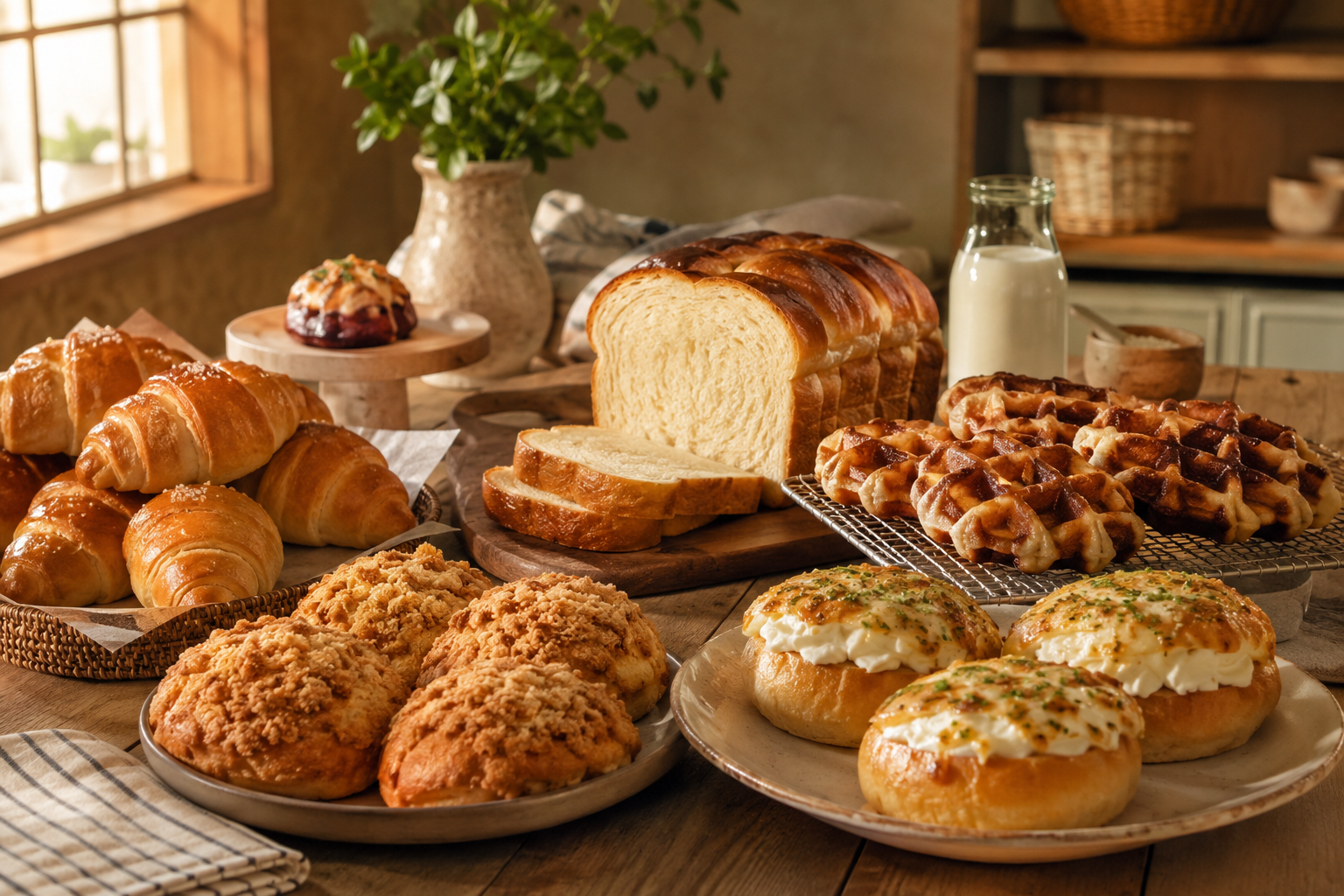
Korean café culture is influencing what customers expect from modern bakeries: compact menus, freshly baked bread, carefully controlled textures, balanced sweet-savoury flavours and products designed to look as satisfying when pulled apart as they taste when eaten.
The strongest Korean bakery opportunities for Indian cafés and home bakers are not complicated celebration cakes. They are approachable, repeat-purchase products such as crisp-bottomed salt bread, sweet-savoury garlic cream cheese buns, crumb-topped soboro, soft milk bread and croffles prepared fresh in a waffle iron.
These products suit several Indian selling models. A home baker can offer a weekend Korean bread box. A café can sell warm croffles and salt bread alongside coffee. A cloud kitchen can build a compact evening-snack menu around filled buns. A bakery can use milk bread as the base for sandwiches, toast boxes and seasonal flavours.
However, Korean bakery products cannot be treated as five interchangeable buns. Each product has a different selling window, production method, packaging requirement and delivery tolerance. Salt bread depends on a crisp butter-fried bottom. Garlic cream cheese buns contain a perishable dairy filling. Soboro needs a crumb topping that does not become wet. Milk bread needs moisture retention without condensation. Croffles are at their best immediately after pressing.
This guide explains how to develop these products for Indian kitchens and customers without losing the characteristics that made them popular. It covers formulation, production planning, Indian weather, eggless options, menu engineering, packaging, shelf life, pricing, delivery and relevant Bakeyy products.
Important: the production ratios, prices and storage periods below are planning examples, not universal commercial specifications. Final recipes, food-safety controls and shelf life should be tested under your actual ingredients, equipment, packaging, weather and delivery conditions.
Quick Answer: Which Korean Bakery Products Should You Sell?
| Product | Core customer experience | Production difficulty | Delivery suitability | Best selling model |
|---|---|---|---|---|
| Salt bread | Crisp buttery base, soft crumb and visible salt | Intermediate | Medium | Fresh batch drops and café counters |
| Garlic cream cheese bun | Soft bun, sweetened cream cheese and rich garlic butter | Intermediate | Medium with cold-chain control | Preorders, cafés and local delivery |
| Soboro | Soft bread with a nutty, crumbly streusel top | Beginner to intermediate | High when unfilled | Bread boxes, subscriptions and tea-time menus |
| Milk bread | Fine, feathery crumb and soft slices | Intermediate | High | Weekly loaves, toast menus and sandwiches |
| Croffle | Caramelised waffle exterior with flaky croissant layers | Easy with good croissant dough | Low | Made-to-order café or short-radius delivery |
For a new business, the most practical launch combination is:
One hero product: classic salt bread.
One rich signature product: Korean garlic cream cheese bun.
One stable packaged product: soboro.
One repeat-purchase product: milk bread.
One made-to-order experience: croffle.
This gives the menu variety without creating five unrelated production systems.
What Makes a Korean Café Bakery Different?
Korean bakery culture combines techniques and ideas from Korean, Japanese, European and American baking, then adapts them into products that feel appropriate for a modern café.
The emphasis is often on contrast:
A salt-bread roll has a crisp base and soft centre. A garlic bun combines sweet cream cheese with savoury garlic. Soboro places a crumbly top over soft bread. A croffle compresses flaky croissant layers into a caramelised waffle surface. Milk bread looks simple but depends on a controlled, delicate crumb.
Several characteristics make these products commercially attractive:
Small individual portions: customers can try one product without buying a large loaf or cake.
Coffee compatibility: the breads fit breakfast, tea-time and evening café occasions.
Visible texture: tearing, squeezing, dipping and cutting create strong short-form video moments.
Less dependence on heavy decoration: production quality matters more than fondant, toppers or elaborate piping.
Flavour flexibility: black sesame, red bean, corn cheese, injeolmi, matcha, yuzu, garlic and local Indian flavours can be introduced without rebuilding the entire menu.
Fresh-batch urgency: products can be marketed through fixed bake times instead of constant discounting.
Is Korean Bakery Food Really Growing in India?
Korean food has moved beyond a niche restaurant category in major Indian cities. Korean-inspired foods now appear on food-delivery menus, in specialist bakeries and in cafés targeting younger urban customers.
Korean cream cheese buns are already sold by bakeries in Bengaluru, Chennai and Mumbai. Delhi NCR also has Korean bakery businesses offering daily or scheduled fresh-bread deliveries. This shows that demand is not limited to recipe videos; customers are paying for Korean-inspired bakery products.
The opportunity is strongest in Bengaluru, Delhi NCR, Mumbai, Pune, Hyderabad, Chennai, Kolkata, Ahmedabad, Goa and other cities with active café, dessert and premium home-bakery markets.
Smaller-city businesses can still test the concept through a Korean weekend box rather than launching a permanent full menu.
Do Not Call Every Soft Bun “Korean”
A product should preserve the recognisable structure that gives it its identity.
A salt-bread roll should contain the internal butter and crisp base that define salt bread. A plain crescent-shaped dinner roll with salt sprinkled on top is not enough.
A Korean garlic cream cheese bun should have a soft round base, connected sections, piped cream cheese and a garlic-butter coating or wash. A normal garlic roll with cheese placed on top offers a different experience.
Soboro should contain the characteristic crumb topping. A plain bun dusted with biscuit crumbs after baking will not produce the same baked texture.
A croffle must use croissant-style laminated dough pressed in a waffle iron. Pressing normal bread dough produces a waffle-shaped bun, not a croffle.
Indian flavours can be added after the product’s core structure is understood.
Build the Menu From Shared Components
A small bakery should look for shared ingredients and production steps without forcing every product to use the exact same dough.
| Component | Products using it | Operational advantage |
|---|---|---|
| Strong bread flour | Salt bread, garlic buns, soboro and milk bread | Simplifies flour inventory |
| Soft enriched bun dough | Garlic buns and soboro | One dough can create two finished formats after separate topping and filling steps |
| Tangzhong or cooked flour paste | Milk bread and selected soft buns | Supports water retention and delayed firming |
| Cream cheese filling | Garlic buns and premium croffles | Allows several flavours from one prepared filling |
| Crumb topping | Soboro and seasonal topped buns | Can be produced in batches and held cold before use |
| Laminated croissant dough | Croffles and croissants | One dough supports a bakery item and a café item |
Salt bread should not automatically use the same dough as a sweet milk bun. The hydration, enrichment and shaping must support butter leakage and a crisp base. Croffle dough must remain laminated. Sharing ingredients is useful; erasing product differences is not.
Essential Ingredient: Bread Flour
Korean-style soft breads still need enough structure to hold fermentation gas, butter, fillings and shaping. A bread flour with suitable protein strength is generally more reliable than weak cake flour for salt bread, milk bread and enriched buns.

The Bakescape T65 Bread Flour was listed at ₹162 for 1 kg when checked on August 4, 2026. Use the live product page for current pricing and availability.
Essential Ingredient: Yeast
Consistent yeast performance matters more than unusually high yeast quantity. Using too much yeast to accelerate production can create an unpleasant aroma, uncontrolled proofing and weak scheduling.
Record dough temperature, yeast percentage, room temperature and actual proofing time. A dough that proofs correctly in an air-conditioned Bengaluru kitchen may ferment much faster in a warm non-air-conditioned space.

Gloripan Instant Dry Yeast was listed at ₹199 for 500 grams when checked on August 4, 2026.
How to Make Korean Salt Bread
Korean salt bread is commonly known as sogeum-ppang, while its Japanese predecessor is called shio pan. The format originated in Japan and became especially popular in South Korea from around 2021. It has since become a regular product in Korean bakeries rather than disappearing as a short-lived trend.
Salt bread resembles a small crescent roll, but it is not a traditional laminated croissant. A piece of dough is rolled into a long triangle, a cold baton or piece of butter is placed at the wider end, and the dough is rolled around it.
During baking, the butter melts. Part of it creates steam and an internal cavity; part of it escapes beneath the roll, frying and browning the base. This produces the product’s recognisable combination of a crisp, buttery underside and soft bread-like crumb.
Salt Bread Formula Structure
A commercial salt-bread dough generally contains bread flour, water or milk, yeast, salt, sugar and a controlled amount of fat. The butter enclosed during shaping is separate from the butter or fat mixed into the dough.
The dough should be extensible enough to roll into a long triangle without snapping back immediately, but strong enough to hold its shape and internal butter.
Too much enrichment can make the dough excessively soft. Too little structure can cause uncontrolled spreading. Excess sugar can make the product taste like a sweet roll and can darken the exterior before the centre is fully baked.
Cold Butter Is a Production Control
The enclosed butter should remain cold and firm during shaping. In a hot Indian kitchen, prepare measured butter batons in advance and keep most of them refrigerated while shaping a smaller working quantity.
If the butter becomes soft before the dough reaches the oven, it can smear into the layers or leak during proofing rather than producing the intended hollow centre and crisp base.
Do not compensate by freezing the butter so hard that it tears the dough. The ideal state is cold, firm and shapeable.
Shape for a Controlled Butter Pocket
Divide the dough accurately. Pre-shape each piece, allow it to relax, then roll it into a long triangle.
Place the butter near the wide edge, fold or seal the dough around it, and roll towards the point. The point should finish beneath the shaped roll to reduce unrolling during proofing and baking.
The ends should not be sealed so aggressively that the butter becomes completely trapped. Controlled leakage beneath the dough contributes to the signature base.
Use a Flat Lined Tray
Salt bread should bake on a flat, heat-conductive surface where melted butter can collect beneath each roll. Deep cavities can prevent the expected base from developing.

The Bakeyy Non-Stick Baking Paper Roll was listed from ₹49 to ₹102 depending on roll length when checked on August 4, 2026.
Salt Bread Troubleshooting
| Problem | Likely causes | What to test |
|---|---|---|
| No hollow butter pocket | Butter too soft, insufficient quantity or smeared during shaping | Colder butter, faster shaping and better sealing around the first roll |
| Base is oily but not crisp | Low bottom heat, crowded tray or insufficient bake | Tray material, spacing and lower-rack positioning |
| Rolls uncoil | Dough point placed upwards or dough not relaxed before shaping | Rest pre-shaped dough and keep the final point beneath the roll |
| Bread tastes excessively salty | Too much finishing salt or highly salted internal butter | Weigh finishing salt and compare salted versus unsalted internal butter |
| Dough is dense | Under-proofing, weak gluten development or dough too cold | Final dough temperature, kneading and proofing cues |
Salt Bread Flavours for India
Launch the classic version before adding flavours. Customers need to understand the crisp base and butter pocket first.
After the classic product is stable, test:
Black sesame salt bread: add black sesame to the exterior or use a controlled black-sesame filling.
Garlic herb salt bread: use garlic carefully so it does not burn or overpower the butter.
Chilli cheese salt bread: select a cheese that does not leak excessively.
Curry-leaf butter salt bread: infuse butter, strain solids when needed and test the final aroma after baking.
Masala corn salt bread: use a low-moisture filling to avoid a wet centre.
Filter-coffee cream salt bread: fill only after cooling and treat the cream-filled product as refrigerated and short-lived.
Do not add a heavy wet filling inside the classic butter layer without retesting proofing and baking. The product can quickly turn into a stuffed bun with no crisp salt-bread character.
How to Package Salt Bread
Salt bread is best sold warm or on the day of baking. Closing a warm roll inside an airtight plastic package traps steam and softens the base.
For café pickup, use grease-resistant paper or an open paper serving sleeve. For cooled same-day delivery, use a food-safe liner inside a rigid box with limited empty space.
Do not stack warm rolls. Butter from one roll can transfer onto another, while trapped heat softens both products.
For a multipack, place rolls in one layer or use separators. Include reheating instructions so customers can refresh the base in an oven or air fryer rather than a microwave.
How to Make Korean Garlic Cream Cheese Buns
Korean garlic cream cheese bread is often prepared as a small round milk-bread-style bun. The baked bun is cut into six connected sections without cutting through the base, filled with sweetened cream cheese, coated or dipped in a garlic-butter mixture and baked again.
The product is intentionally sweet-savoury. Removing all sweetness may create ordinary garlic bread, while excessive sugar can make the garlic feel confusing.
Begin With a Bun That Can Survive Double Baking
The base bun should be soft but not underbaked. It must remain intact when cut, piped, coated and returned to the oven.
A very thin crust can tear during filling. An extremely dry bun will become hard after the second bake. Test the first bake so the bun is fully structured without being excessively browned.
Cut Six Connected Sections
Allow the buns to cool enough to handle. Make three cuts across the top to create six sections, stopping before the base.
The bun should open like a flower while remaining one piece. Cutting completely through creates separate wedges that shift during dipping and packaging.
Pipe Cream Cheese Evenly
Pipe cream cheese into every cut rather than placing one large quantity in the centre. Distributed filling gives the customer a consistent bite and produces the recognisable visual effect.

The 19-inch Disposable Piping Bag Roll contains 100 bags and was listed at ₹440 when checked on August 4, 2026.
Control the Cream Cheese Filling
A commercial filling should be smooth enough to pipe but firm enough to remain inside the bun.
Very loose filling can leak during the second bake. Excessive icing sugar can make the product cloying. Adding large quantities of fresh cream increases moisture and can further shorten the practical selling window.
Use pasteurised dairy ingredients and keep the filling refrigerated before use. Prepare manageable quantities rather than allowing a large piping bag to remain in a hot production room.
Build a Stable Garlic-Butter Coating
Recipes may use melted butter, garlic, herbs, milk or cream, sweetener and sometimes egg. The mixture should coat the bun without separating immediately into a pool of oil.
Eggless versions can be made, but removing egg changes emulsification, colour and how the coating sets. Reformulate the liquid and thickening system instead of simply deleting the egg.
Fresh garlic can burn during the second bake. Finely mince or process it evenly and control the bake temperature and time.
Parsley gives the familiar visual finish, but coriander, spring onion greens or a restrained herb blend can suit local menus.
Should Garlic Cream Cheese Buns Be Refrigerated?
Cream cheese is a soft dairy product that requires refrigeration. Unless a bakery has validated a different process and formulation, garlic cream cheese buns should be treated as perishable.
Keep refrigerated products at approximately 4°C or below. Total time outside refrigeration includes filling, coating, packing, waiting for pickup, delivery and the customer’s holding time.
As a conservative handling rule, perishable foods should not remain at room temperature for more than two hours, or more than one hour when the surrounding temperature is above approximately 32°C.
Refrigeration protects safety but gradually firms bread. The product should therefore be sold with a short consumption window and tested reheating instructions.
Do not display dairy-filled buns on an unrefrigerated counter all day because they were baked a second time. Baking does not make every cream-cheese formulation shelf-stable.
Packaging Garlic Cream Cheese Buns
The bun is rich, oily and vulnerable to compression. Use a grease-resistant liner with a rigid individual or multipack box.
An individual box protects the six-section shape and keeps cream cheese away from other products.

The Individual Mini Muffin and Pastry Box was listed at ₹500 for 50 pieces when checked on August 4, 2026.
Garlic Bun Flavour Variations
Classic sweet garlic: the best introduction to the format.
Chilli garlic cream cheese: add heat without turning the coating into a wet sauce.
Gochujang garlic bun: use gochujang as a measured accent. Too much adds moisture, sugar and salt and can overwhelm the bread.
Corn cheese bun: use drained corn and a stable cheese mixture.
Jalapeño cream cheese: control pickling liquid before adding jalapeños.
Paneer tikka cream cheese: this is a fusion product and should be marketed clearly as such. Use a relatively dry filling and maintain refrigerated handling.
Black garlic bun: offers a deeper fermented flavour but requires customer education.
How to Make Soboro Bread
Soboro bread is a Korean bakery bun topped with a crumbly streusel-like mixture. Official Seoul bakery guides describe soboro as Korean streusel, and popular versions may include red bean, cream cheese, corn or onion fillings.
The unfilled version is one of the most delivery-friendly Korean bakery products because it does not depend on a crisp fried base or cold cream filling.
What Makes the Soboro Topping Different?
The topping is often made from flour, sugar and fat, with ingredients such as peanut butter, ground nuts, egg or raising agents depending on the formula.
It should form irregular crumbs rather than a smooth cookie sheet. During baking, these crumbs set into a rough, nutty topping over the soft bun.
The topping must adhere to the bread without becoming a solid helmet that separates in one piece.
Use a Soft Bun Base
Soboro benefits from contrast. The bun should remain soft while the topping is crumbly.
A dry bun beneath a dry topping feels stale immediately. Use a well-hydrated enriched dough and avoid overbaking.
Chill the Crumb Topping
Warm topping fat can smear rather than form crumbs. Prepare the mixture, create irregular pieces and refrigerate it when the kitchen is warm.
Before proofing is complete, ensure the topping can be applied without deflating the bun. Depending on the process, shaped dough may be lightly moistened or coated to encourage adhesion.
Prevent the Topping From Falling Off
Common causes include:
Crumbs that are too dry; insufficient contact with the dough; topping applied after the surface has dried; pieces that are excessively large; or rough movement after baking.
Test the product after normal packing and delivery. A beautiful bun that leaves half its topping inside the box creates poor customer value.
Soboro Flavour Ideas
Classic peanut soboro: familiar, nutty and economical, with a clear peanut allergen declaration.
Red bean soboro: combines a Korean bakery classic with a soft filling.
Black sesame soboro: visually distinctive and suitable for a premium café menu.
Coffee soboro: pairs naturally with Indian filter coffee and café drinks.
Chocolate hazelnut soboro: attractive but more expensive and sweeter.
Coconut cardamom soboro: an Indian adaptation that maintains the crumb-topped structure.
Onion cream cheese soboro: savoury and premium, but perishable because of the filling.
Packaging Soboro
Soboro should be fully cooled before packing. Warmth creates condensation that softens the crumb topping.
For one bun, use a pastry box or gusseted food-safe pouch with enough space around the top. For multiple buns, use a rigid pastry box and avoid stacking.
If a plastic or laminated inner package is used to preserve softness, test whether the topping becomes soft during the intended holding period.
A small amount of softness may be acceptable for next-day sale, but the product should not become wet or greasy.
How to Make Korean-Style Milk Bread
Milk bread is valued for its soft, fine and slightly elastic crumb. The bread can be shaped as a pullman-style loaf, domed loaf, rolls or small buns.
The softness comes from the complete formulation and process: strong dough development, suitable hydration, milk, sugar, fat, fermentation and controlled baking.
Tangzhong is useful, but it should not be treated as a magical ingredient that fixes weak dough or poor fermentation.
What Is Tangzhong?
Tangzhong is made by heating a portion of flour with water, milk or both until the starch gelatinises and the mixture thickens.
Heating allows starch to absorb and hold more water. When the cooked paste is incorporated into bread dough, it can support moisture retention and delay firming during storage.
Research and baking science sources also caution that tangzhong is not the sole reason for milk bread’s lightness. Sugar, fat, yeast performance, gluten development and fermentation remain important.
Tangzhong Versus Yudane
Both techniques pre-gelatinise some flour, but they are prepared differently.
Tangzhong is generally cooked with a larger quantity of liquid into a smooth paste. Yudane commonly involves pouring boiling water over flour and allowing the mixture to rest.
Do not change between the methods without recalculating flour and water. The paste is part of the formula, not an extra ingredient added on top.
Cool Tangzhong Before Mixing
Hot tangzhong can raise dough temperature and damage yeast if it comes into direct contact with it. Prepare the paste in advance, cover the surface to reduce drying and cool it appropriately before mixing.
Record the weight after cooking. Excess evaporation changes the total hydration of the dough.
Develop the Dough Properly
Milk bread is an enriched dough. Butter is often added after the dough begins developing so it does not coat the flour too early and delay gluten formation.
Knead until the dough has sufficient strength and extensibility. A soft dough should not automatically be corrected with large quantities of flour.
In hot weather, use chilled milk or water and control mixer friction. Overheated enriched dough can become greasy and ferment too quickly.
Use a Consistent Loaf Pan
A fixed pan, dough weight and shaping method make milk bread easier to slice, price and package.

The Non-Stick Rectangular Baking Pan was listed from ₹180 to ₹240 depending on the variant when checked on August 4, 2026.
Milk Bread Shaping Options
Three-roll loaf: divide the dough into three portions, roll and place them side by side for an attractive pull-apart structure.
Four-roll loaf: creates smaller visual sections and can suit wider pans.
Pullman loaf: use a lid to create square slices when the tin is designed for it.
Mini loaf: suitable for sampler boxes and individual gifting.
Soft rolls: useful as the base for garlic cream cheese buns and sandwiches.
Cool Before Slicing or Bagging
Cutting hot milk bread compresses its delicate crumb and releases moisture. Bagging it warm creates condensation.
Cool on a rack until the centre is no longer warm. Package promptly after complete cooling to limit drying.
Packaging Milk Bread
Unlike crusty sourdough, milk bread benefits from a reasonably closed package after cooling because the selling objective is softness rather than a dry crisp crust.
Use a suitable food-safe bread pouch matched to the loaf dimensions. Excessively large bags allow the loaf to move and become compressed during transport.

The Kraft Paper Bread Pouch With Clear Window was listed from ₹700 to ₹1,125 for 50 pieces depending on size when checked on August 4, 2026.
Milk Bread Product Extensions
Milk bread can support several related products:
Japanese-style fruit sandwiches; eggless café sandwiches; Korean street-toast-inspired sandwiches; French toast; garlic buns; red bean buns; corn-cheese buns; black sesame rolls; milk-bread rusks; and flavoured toast boxes.
Filled sandwiches belong to a different food-safety and shelf-life category from the plain loaf. Do not transfer the plain bread’s storage period onto egg, dairy, meat or vegetable sandwiches.
How to Make Croffles
A croffle combines croissant and waffle. Korea Tourism describes it as a Korean café staple made by pressing croissant dough in a waffle iron.
The iron compresses the laminated dough, creating a caramelised patterned exterior while retaining flaky layers inside.
Croffles work best as a café product because they can be pressed in a few minutes and served immediately. They are less suitable for long delivery routes.
Use Croissant Dough, Not Ordinary Bun Dough
The product depends on laminated layers of dough and butter. Ready-to-bake frozen croissant dough can be useful for testing demand, while a skilled bakery can produce its own laminated dough.
Canned bread dough or normal soft-bun dough will not give the same flaky interior.
Proof Before Pressing
Frozen croissant pieces generally need thawing and proofing according to their specific instructions. Under-proofed dough may remain dense, while over-proofed dough can collapse and release butter.
The correct degree of proofing also depends on the waffle iron’s pressure and heat.
Control the Sugar Coating
A light sugar coating can caramelise against the hot iron. Too much sugar can burn, stick and create bitter residue that affects later orders.
Clean the waffle plates according to the manufacturer’s instructions and monitor buildup during service.
Do Not Overfill the Waffle Iron
Croissant dough expands. A large dough piece can overflow the plates or cook unevenly.
Test each frozen or handmade croissant weight in the actual machine. Record heat setting, press time and finished weight.
Serve Croffles Immediately
The main appeal is the contrast between the crisp exterior and flaky interior. Steam softens this texture after pressing.
Add toppings only after the croffle leaves the iron. Heavy sauces, ice cream and whipped cream should be added close to serving.
For delivery, pack wet toppings separately. Do not pour syrup over the croffle and then send it on a 45-minute route.
Croffle Menu Ideas
Classic sugar croffle: the best format for demonstrating texture.
Black sesame cream croffle: visually distinctive and connected to Korean café flavours.
Injeolmi croffle: use roasted soybean powder and a suitable cream or syrup.
Strawberry cream croffle: highly visual but temperature-sensitive.
Tiramisu croffle: use coffee syrup carefully to avoid immediate sogginess.
Filter-coffee croffle: a natural Indian café adaptation.
Mango cheesecake croffle: seasonal and premium, with chilled toppings packed separately for delivery.
Chilli cheese croffle: a savoury option for breakfast and evening service.
Corn-cheese croffle: Korean-inspired and familiar to Indian customers.
Paneer gochujang croffle: suitable as a clearly identified fusion café product.
Croffle Packaging
For dine-in, serve on a plate or open paper liner.
For takeaway, use a rigid box with enough venting to release steam. Place the croffle on grease-resistant paper and keep the lid from touching tall toppings.
For delivery, use separate cups for cream, syrup, ice cream, fruit and savoury toppings. The customer can assemble immediately before eating.
A croffle that travels for one hour will not retain the exact texture of a fresh café croffle. Set customer expectations honestly and limit the delivery radius.
Product Opportunity Scorecard
Milk bread—repeat-purchase potential: 92%
Salt bread—social-media potential: 90%
Garlic cream cheese bun—premium pricing potential: 88%
Soboro—delivery suitability: 85%
Croffle—fresh café experience: 95%
These percentages are a strategic comparison, not market-research statistics. They illustrate how each product plays a different role in the menu.
The Best Five-Item Korean Café Launch Menu
| Menu role | Recommended product | Reason |
|---|---|---|
| Entry product | Classic salt bread | Simple appearance, strong texture and accessible flavour |
| Signature indulgence | Korean garlic cream cheese bun | Recognisable pull-apart visual and premium ingredient perception |
| Packaged tea-time product | Black sesame or peanut soboro | Stable for delivery and different from ordinary buns |
| Weekly staple | Soft milk-bread loaf | Creates household repeat demand beyond trend customers |
| Made-to-order café product | Classic or black sesame croffle | Creates aroma, theatre and beverage pairing |
How to Create a Korean Bakery Box
A mixed box allows customers to try several products without committing to a full loaf or large order.
A practical four-piece box could include:
One classic salt bread; one garlic cream cheese bun; one soboro; and one seasonal filled bun.
Milk bread should be sold separately as a loaf because placing slices beside garlic and sweet toppings can cause aroma and moisture transfer.
Croffles should not be included in a box prepared hours earlier. Offer a separate croffle kit or made-to-order add-on instead.
Use grease-resistant separators so butter and garlic do not transfer to sweet soboro.

The Corrugated Bakery Carry Box With Handle was listed from ₹290 to ₹540 for five pieces depending on size when checked on August 4, 2026.
Packaging Comparison by Product
| Product | Recommended system | Main packaging goal | Avoid |
|---|---|---|---|
| Salt bread | Grease-resistant paper plus rigid same-day box | Protect the base without trapping excessive steam | Sealing while warm |
| Garlic cream cheese bun | Individual rigid box with grease-resistant liner and refrigerated transport | Protect shape, contain butter and maintain cold handling | Unrefrigerated all-day display |
| Soboro | Individual pouch or pastry box after complete cooling | Preserve bun softness without wetting the topping | Stacking and crushing the crumb top |
| Milk bread | Close-fitting food-safe bread pouch | Reduce moisture loss and compression | Slicing or bagging while hot |
| Croffle | Vented rigid box with toppings packed separately | Limit steam and sauce contact | Long delivery with wet toppings already added |
Quality-First Shelf-Life Starting Points
The table below gives conservative product-development starting points. It does not replace testing or establish a universal expiry date.
| Product | Best-quality selling window | Storage direction | Primary deterioration |
|---|---|---|---|
| Classic salt bread | Best on bake day; generally test up to 1–2 days for packaged quality | Cool room-temperature holding after full cooling; freeze for longer storage | Loss of base crispness and crumb firming |
| Garlic cream cheese bun | Same day offers best texture; establish a short refrigerated period through testing | Refrigerated at approximately 4°C or below | Bread firming, dairy deterioration and oil migration |
| Unfilled soboro | About 1–2 days as a quality-first starting point | Room temperature in tested packaging after full cooling | Topping softening and bun staling |
| Plain milk bread | About 2–3 days as a quality-first starting point | Sealed room-temperature package; freeze for longer storage | Moisture loss, mould and starch firming |
| Croffle | Immediately after pressing | Serve warm; store chilled toppings separately when required | Steam-softened exterior and soggy toppings |
Filled soboro, cream croffles and sandwiches must follow the requirements of their most perishable component.
Read Bakeyy’s Bakery Shelf Life Guide for India for a more detailed framework covering quality life, safety life, refrigeration and testing.
How Indian Summer Affects Korean Bread
Indian heat affects butter, cream cheese, dough temperature and delivery.
Salt bread: butter softens during shaping and can leak before baking.
Garlic buns: cream cheese and garlic butter warm quickly, shortening safe handling time.
Soboro: topping fat softens and loses its crumb structure.
Milk bread: dough can ferment too quickly and become sticky.
Croffles: butter melts from laminated dough during thawing and proofing.
Use chilled liquids, smaller working batches, refrigerated fillings and controlled proofing whenever possible.
Do not place freshly shaped butter-rich dough beside a hot oven while waiting for tray space.
Read How to Package and Sell Baked Goods During Indian Summer for broader heat-management guidance.
How Monsoon Humidity Affects Korean Bread
Humidity softens the two products that depend most on crispness: salt bread and croffles.
It also softens soboro topping, weakens paper packaging and creates condensation when refrigerated garlic buns enter warm air.
During monsoon:
Cool products in a dry, well-ventilated area. Pack promptly after complete cooling. Keep unused boxes and paper liners away from damp walls and floors. Reduce long open-counter display. Test delivery during actual rainy conditions. Use separate cold bags for cream-cheese products. Shorten the commercial quality window when the product deteriorates faster.
Read Texture Is King: Packaging for Crunchy and Crusty Baked Goods for more information on moisture movement.
How to Price Korean Bakery Products
Do not price only from flour, butter and cream cheese. Korean bakery products often require multiple production stages, controlled refrigeration, individual packaging and short selling windows.
Use this formula:
Total batch cost = ingredients + packaging + direct labour + electricity or gas + cold storage + delivery preparation + wastage + allocated overhead.
Cost per saleable unit = total batch cost ÷ saleable units.
Required selling price = cost per unit ÷ target cost percentage.
Illustrative Costing: 20 Garlic Cream Cheese Buns
The following figures demonstrate the method only. Replace every amount with your actual supplier rates, recipe and batch yield.
| Cost component | Illustrative batch cost |
|---|---|
| Flour, milk, yeast, sugar and salt | ₹260 |
| Butter, garlic, herbs and coating ingredients | ₹480 |
| Cream cheese filling | ₹620 |
| Individual packaging and labels | ₹260 |
| Direct labour | ₹400 |
| Electricity and refrigeration allocation | ₹140 |
| Wastage and overhead allocation | ₹240 |
| Total batch cost | ₹2,400 |
| Cost per saleable bun | ₹120 |
If ₹120 should represent 50% of the selling price:
₹120 ÷ 0.50 = ₹240.
If ₹120 should represent 45% of the selling price:
₹120 ÷ 0.45 = approximately ₹267.
The correct price depends on product weight, cream-cheese quantity, city, sales channel, taxes, delivery and positioning.
Indian menu examples checked in 2026 showed Korean cream-cheese buns at different price points, including approximately ₹149, ₹175, ₹178 and ₹240. These examples demonstrate the market range; they do not replace your costing.
Visual Cost Distribution
Ingredients: 57%
Labour: 17%
Packaging: 11%
Wastage and overhead: 10%
Energy and refrigeration: 5%
The chart demonstrates why cream cheese and butter-rich products can cost significantly more than ordinary buns even when their flour weight is similar.
Price by Menu Role
Traffic product: a classic salt bread with a lower entry price encourages first-time trials.
Premium product: a garlic cream cheese bun or filled salt bread can carry a higher price because of filling, labour, packaging and cold handling.
Repeat staple: milk bread should offer good value per serving to encourage weekly reorders.
Add-on product: soboro can be bundled with beverages or bread boxes.
Experience product: croffles can be priced through fresh preparation, toppings and café presentation rather than weight alone.
Build a Korean Café Combo Strategy
Use combinations that increase average order value without damaging product quality.
Classic trial box: two salt breads and two soboro buns.
Premium bun box: two garlic cream cheese buns and two seasonal buns.
Breakfast box: milk-bread loaf, butter, jam and four salt breads.
Café combo: one croffle and one beverage.
Weekend Korean box: salt bread, garlic bun, soboro and a mini milk loaf.
Do not include ice-cream croffles in a delivery box unless frozen and hot components are genuinely separated and the journey is controlled.
Weekly Production Plan
| Day | Production activity | Business activity |
|---|---|---|
| Monday | Test one dough or seasonal flavour | Review wastage, sales and customer comments |
| Tuesday | Prepare content batch and photograph crumb or texture | Open weekend preorders |
| Wednesday | Produce milk-bread subscription orders | Buy cream cheese, butter and packaging |
| Thursday | Prepare soboro crumb and portion butter batons | Confirm paid orders and delivery zones |
| Friday | Mix, shape and bake selected products | Prepare labels, liners and routing sheets |
| Saturday | Main fresh-bake batches and croffle service | Local delivery and pickup |
| Sunday | Second café batch or limited rest day | Collect structured feedback and update demand forecast |
Use Batch Drop Times
Salt bread and croffles benefit from being sold around freshness rather than constant availability.
A café can announce:
Salt bread batches at 10:00 AM, 1:00 PM and 5:00 PM.
Croffles pressed to order from 3:00 PM.
Garlic cream cheese buns available through refrigerated preorder pickup.
Batch times create urgency while protecting texture. They also prevent the bakery from holding salt bread on the counter until closing time.
How to Deliver Korean Bakery Products
Salt bread: use a shallow rigid box, one layer and limited delivery time.
Garlic cream cheese buns: use an insulated delivery bag and keep the product refrigerated until dispatch.
Soboro: protect the topping from friction and stacking.
Milk bread: keep heavy products away from the loaf and avoid bending the bag.
Croffles: use vented packaging, separate toppings and a short delivery radius.
Include the customer’s total journey in the quality test. Ten minutes on a cooling rack plus twenty minutes awaiting a rider plus forty minutes in traffic is already seventy minutes before the customer opens the package.
Delivery Test Protocol
Pack the product exactly as it will be sold. Send it on the longest planned route during realistic traffic and weather.
After delivery, check:
Box temperature; condensation; butter or oil leakage; bun compression; soboro topping loss; croffle crispness; cream-cheese temperature; aroma transfer; appearance; and reheating performance.
Repeat the test during summer and monsoon. One successful winter delivery does not prove year-round performance.
How to Market Korean Bakery Products
Korean bakery products are texture-led. Show the evidence instead of relying only on words such as “viral” and “authentic.”
For salt bread, film the crisp base and hollow butter pocket.
For garlic buns, show cream cheese being piped into six sections and the final pull-apart.
For soboro, show the contrast between the crumb topping and soft centre.
For milk bread, show strands separating when the loaf is pulled apart.
For croffles, film the waffle iron opening and the first crisp cut.
Use natural sound where possible. Crispness, tearing and pressing communicate quality quickly.
Do Not Depend Only on the Word “Viral”
Viral positioning can generate a first purchase but does not automatically create a reorder.
After launch, communicate:
Fresh batch times; product weight; filling quantity; flavour description; storage; reheating; allergen information; delivery radius; and how each product is intended to be eaten.
A customer who understands that croffles are best eaten immediately is less likely to judge a one-hour-old delivered product against a fresh café video.
Indian Flavour Adaptation Without Losing the Product
| Korean bakery format | Indian adaptation | What must remain intact |
|---|---|---|
| Salt bread | Curry-leaf butter or chilli cheese | Butter pocket, crisp base and restrained salt finish |
| Garlic cream cheese bun | Jalapeño, chilli garlic or paneer tikka | Six-section shape, piped filling and double-baked coating |
| Soboro | Coconut cardamom or filter coffee | Baked crumb topping over soft bread |
| Milk bread | Saffron cardamom, masala corn or chai swirl | Soft, fine and elastic crumb |
| Croffle | Filter coffee, mango cheesecake or chilli paneer | Laminated croissant dough pressed fresh in a waffle iron |
Common Korean Bakery Business Mistakes
Launching ten flavours before mastering the classic product: every filling changes moisture, cost and production.
Calling normal bread salt bread: customers attracted by the trend expect a butter pocket and crisp base.
Packing hot products: this destroys croffle, salt-bread and soboro texture.
Leaving cream-cheese buns unrefrigerated: dairy-filled products require controlled handling.
Using one box for every product: milk bread, croffles and oily garlic buns have different needs.
Overusing gochujang: Korean identity does not require adding gochujang to every bun.
Ignoring labour: cutting, filling, coating and double baking make garlic buns more labour-intensive than plain rolls.
Offering nationwide delivery immediately: these products are better suited to local freshness-led sales.
Using very sweet fillings: the appeal often comes from balanced sweet-savoury flavour rather than maximum sugar.
Depending on social-media views instead of reorders: track repeat customers and actual profit.
30-Day Korean Bakery Launch Plan
| Week | Product work | Commercial work |
|---|---|---|
| Week 1 | Master classic salt bread and one soft bun dough | Research local customer price tolerance and delivery radius |
| Week 2 | Develop garlic filling, soboro topping and milk-bread loaf | Calculate batch cost and shortlist packaging |
| Week 3 | Run cooling, storage, reheating and delivery tests | Create photographs, menu descriptions and preorder form |
| Week 4 | Produce a limited paid launch batch | Measure sales, wastage, complaints, delivery quality and reorders |
Frequently Asked Questions
What is Korean salt bread?
Korean salt bread, or sogeum-ppang, is a soft crescent-shaped bread rolled around butter and finished with salt. The butter melts during baking, creating a hollow interior and crisp buttery base.
Did salt bread originate in Korea?
The format originated in Japan as shio pan and later became highly popular in South Korea, where Korean bakeries helped turn it into an international trend.
Is salt bread the same as a croissant?
No. Salt bread is generally made from a yeasted bread dough rolled around a piece of butter. A croissant is made from laminated dough containing repeated layers of dough and butter.
Why does salt bread have a hole inside?
The internal butter melts and releases steam during baking, leaving a cavity. Butter leakage also helps fry and crisp the base.
Why is my salt bread not crispy?
Possible causes include insufficient bottom heat, crowded trays, excess trapped steam, underbaking or packaging while warm.
What is Korean garlic cream cheese bread?
It is a soft round bun cut into connected sections, piped with cream cheese, coated in a sweet-savoury garlic-butter mixture and baked again.
Do Korean garlic buns need refrigeration?
Cream cheese is a perishable soft dairy product. Unless the formulation and process have been professionally validated otherwise, filled buns should be refrigerated at approximately 4°C or below.
Can Korean garlic buns be eggless?
Yes, but the bun dough and garlic coating must be reformulated. Simply removing egg can change colour, emulsification, moisture and how the coating sets.
What is soboro bread?
Soboro is a Korean bakery bun topped with a crumbly streusel-style mixture. It can be plain or filled with ingredients such as red bean, cream cheese or corn.
Why does soboro topping fall off?
The topping may be too dry, too large, poorly attached or applied after the dough surface has dried. Rough packaging and stacking can also remove crumbs.
What is Korean milk bread?
Korean-style milk bread is a soft enriched loaf with a fine, elastic crumb. It may use tangzhong or another pre-gelatinised flour technique to support water retention.
Does tangzhong make bread fluffy?
Tangzhong helps flour hold more water and can delay firming, but softness also depends on fat, sugar, dough development, yeast and fermentation.
What is a croffle?
A croffle is croissant dough cooked in a waffle iron. It combines laminated pastry layers with a patterned, caramelised waffle exterior.
Can croffles be delivered?
They can be delivered over short distances, but steam and toppings quickly soften the exterior. Pack toppings separately and use a vented rigid box.
Can I make croffles with normal bread dough?
You can press bread dough in a waffle iron, but it will not have the flaky laminated texture that defines a croffle.
Which Korean bakery product is easiest to start?
Soboro or milk-bread rolls are practical starting points. Salt bread requires greater butter and base control, while croffles require laminated dough and immediate service.
Which Korean product is best for delivery?
Plain soboro and packaged milk bread generally tolerate delivery better than croffles, warm salt bread and dairy-filled garlic buns.
Which product has the best repeat-purchase potential?
Milk bread can become a weekly household product. Salt bread and garlic buns may attract more first-time attention, but staple loaves can create steadier repeat demand.
Can Korean bakery products be sold from a home kitchen?
Yes, when production capacity, hygiene, temperature control and applicable business requirements are managed. A limited preorder menu is more practical than daily on-demand production.
Should I sell many Korean flavours at launch?
No. Begin with a classic version of each core product. Add one rotating flavour after the base recipe, packaging and cost are stable.
Final Korean Café Bakery Checklist
Master classic products before fusion flavours. Use strong flour suited to enriched dough. Control dough temperature in Indian weather. Keep butter cold during salt-bread shaping. Use a bun strong enough for double baking. Pipe cream cheese evenly. Refrigerate perishable dairy products. Keep soboro topping cold and crumbly. Calculate tangzhong inside total hydration. Cool milk bread before slicing. Use real laminated dough for croffles. Serve croffles immediately. Match packaging to each product. Separate wet toppings. Test delivery during summer and monsoon. Calculate labour, packaging and wastage. Sell through controlled batch drops. Track reorders rather than only views.
Shop Korean Bread-Making and Packaging Supplies at Bakeyy
Bread Making and Packaging Collection
Complete Bakery Packaging Collection
Related Bakeyy Guides
Artisan Bread Business Guide for India
Japanese Desserts in India 2026
Bakery Shelf Life Guide for India
Complete Baking Ingredients Guide
Complete Guide to Bakery Packaging
Texture Is King: Packaging for Crunchy and Crusty Baked Goods
How to Package and Sell Baked Goods in Indian Summer
How to Start a Home Baking Business in India
This article provides general bakery product-development and business-planning information. Recipes, shelf life, cold-chain controls, allergen declarations and commercial claims should be validated for the specific ingredients, process, kitchen, packaging and delivery system.