
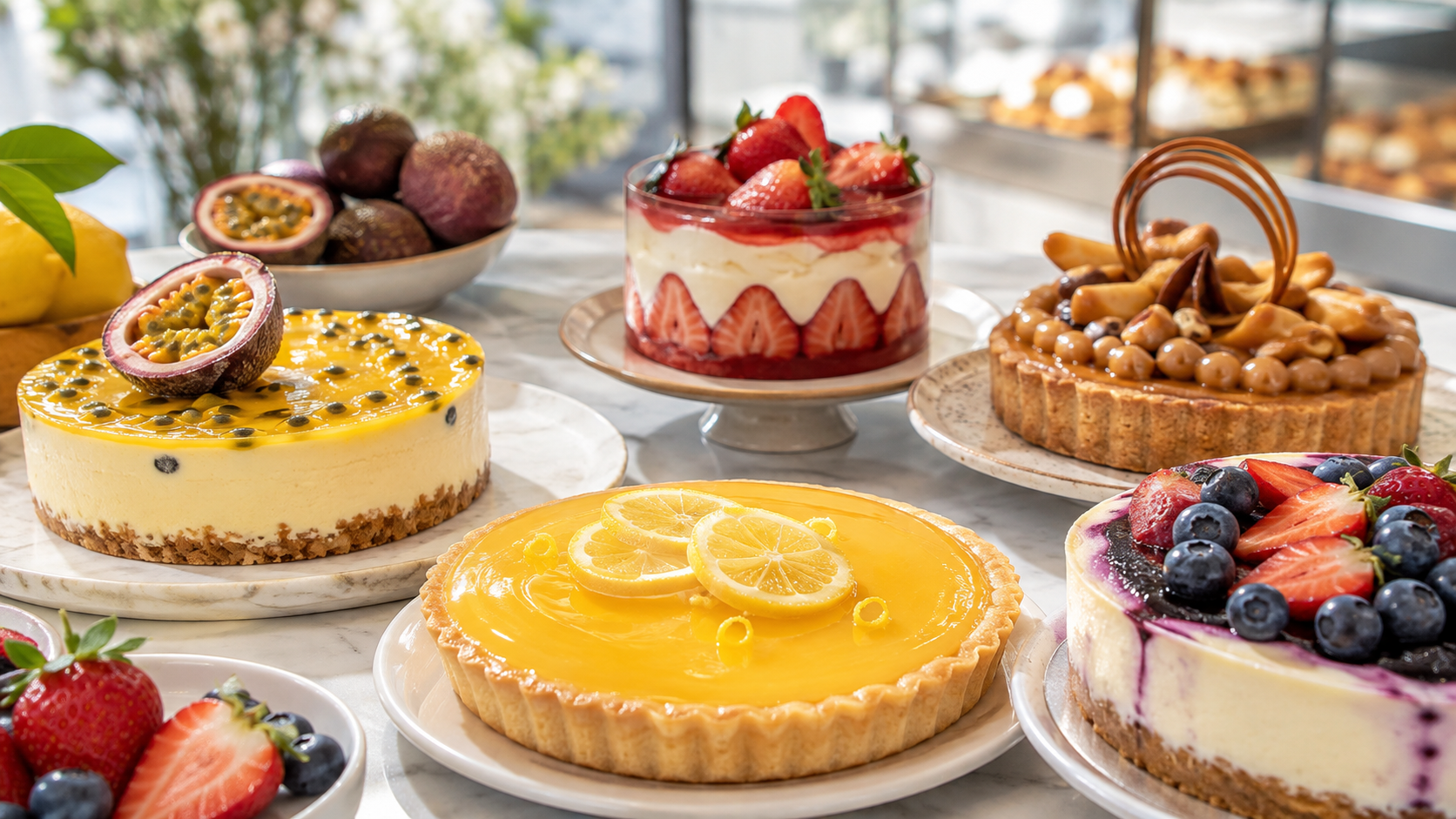
Quick answer: Tangy desserts use acidity to balance sweetness and make cakes, cheesecakes, tarts, cupcakes, mousse, cookies and plated desserts taste brighter and less heavy. Some of the most useful tangy flavours for bakers are lemon, lime, orange, passion fruit, strawberry, blueberry, raspberry and tamarind. The secret is not simply adding more sour ingredients. A good tangy dessert balances acidity with sweetness, fat, aroma, texture and the character of the base dessert.
Chocolate is rich. Caramel is deep. Vanilla is comforting.
But sometimes a dessert needs something else.
A sharp spoonful of lemon curd through cheesecake. Passion fruit cutting through sweet white chocolate. Strawberry balancing cream. Blueberry against vanilla. Tamarind turning an ordinary caramel into something unexpectedly complex.
That is where tangy desserts become interesting.
Tanginess can make a very sweet dessert feel lighter, add contrast to rich cream or chocolate, wake up a simple sponge cake and give home bakers flavour combinations that customers remember.
This guide is not a list of whatever dessert happens to be viral this week. It is a practical flavour guide for home bakers, cafés, bakery owners and dessert businesses that want to understand how tangy flavours actually work, which ingredients pair well together, where each flavour works best and how to turn acidity into desserts people genuinely want to order again.
We will cover lemon, lime, orange and other citrus flavours, passion fruit, strawberries and blueberries, tamarind, flavour-pairing ideas, mistakes to avoid, menu ideas, packaging and storage considerations for Indian conditions.
If you are building a professional baking setup, you can also explore Bakeyy.com for baking ingredients, bakeware, decorating tools, tart pans, fruit fillings, dessert containers, packaging and other supplies used throughout this guide.
What Is a Tangy Dessert?
A tangy dessert is a sweet dish where noticeable acidity forms an intentional part of the flavour.
That acidity may come from:
- Fresh citrus juice
- Citrus zest
- Passion fruit pulp
- Fresh berries
- Berry compotes and fillings
- Tamarind
- Yogurt
- Cream cheese
- Fruit purées
- Fruit curds
A tangy dessert does not need to taste aggressively sour.
In fact, the best versions usually do the opposite.
They use enough acidity to stop the sweetness from becoming tiring.
Think about a lemon tart. The filling is still sweet, but the lemon prevents the sugar and buttery pastry from feeling flat.
Think about passion fruit cheesecake. Cream cheese is already slightly tangy, but passion fruit adds a sharper tropical acidity that cuts through the richness.
Think about berry buttercream. Without fruit acidity, buttercream can taste mainly of sugar and fat. A tart berry component adds contrast.
Why Does Tanginess Work So Well in Desserts?
Sweetness and acidity pull the palate in different directions.
Sugar softens perceived sourness. Acid prevents sugar from becoming overwhelming. Fat adds richness. Salt sharpens flavour. Aroma from zest, vanilla, spices and fruit completes the experience.
That is why adding acidity can make an already sweet dessert seem more balanced without necessarily reducing the sugar dramatically.
This is especially useful in rich desserts such as:
- Cheesecake
- White chocolate mousse
- Buttercream cakes
- Ganache tarts
- Caramel desserts
- Cream desserts
- Tres leches
- Brownies
- Dense tea cakes
The Tangy Dessert Balance Formula
| Element | What It Adds | Examples |
|---|---|---|
| Acidity | Brightness, freshness, contrast | Lemon, passion fruit, berries, tamarind |
| Sweetness | Balances sourness and bitterness | Sugar, honey, jaggery, white chocolate |
| Fat | Richness and roundness | Butter, cream, chocolate, cream cheese |
| Aroma | Makes flavour feel fuller | Citrus zest, vanilla, mint, spices |
| Texture | Stops the dessert feeling one-dimensional | Biscuit crumbs, seeds, nuts, crumble |
| Salt | Sharpens and rounds flavour | Fine salt, salted caramel |
If your dessert tastes too sweet, the answer is not always simply “use less sugar.”
Sometimes what is missing is contrast.
Quick Tangy Flavour Selector for Bakers
| Flavour | Character | Best With | Good Dessert Formats |
|---|---|---|---|
| Lemon | Bright, clean, sharp | Vanilla, blueberry, white chocolate, coconut | Tarts, cakes, curds, cheesecakes, cupcakes |
| Lime | Sharper, aromatic, fresh | Coconut, mango, mint, white chocolate | Cheesecake, mousse, pies, bars |
| Orange | Sweeter citrus, aromatic | Chocolate, almond, cranberry, vanilla | Cakes, cookies, ganache, loaf cakes |
| Passion Fruit | Intense tropical sweet-sour flavour | Mango, coconut, vanilla, white chocolate | Cheesecake, mousse, entremets, fillings |
| Strawberry | Fruity, gently tart | Cream, vanilla, chocolate, lemon | Cakes, cupcakes, cheesecake, dessert cups |
| Blueberry | Fruity, mildly tart and deep | Lemon, vanilla, cheesecake, almond | Cheesecake, muffins, tarts, fillings |
| Raspberry | Sharper berry acidity | Dark chocolate, pistachio, vanilla, rose | Ganache, mousse, cakes, macarons |
| Tamarind | Deep, fruity, sharp and complex | Jaggery, caramel, ginger, chocolate, chilli | Caramel, tart, sauce, bonbons, fusion desserts |
1. Lemon Desserts: The Easiest Place to Start
If you are new to tangy desserts, start with lemon.
Lemon works because it gives bakers two different flavour tools from one fruit.
Lemon juice gives acidity.
Lemon zest gives aroma.
They are related, but they are not interchangeable.
A cake containing only lemon juice can taste acidic without smelling strongly lemony. A cake containing zest but very little juice can smell intensely citrusy while tasting relatively mild.
Using both thoughtfully usually gives a more complete lemon flavour.
Where Lemon Works Best
- Lemon tart
- Lemon curd
- Lemon cheesecake
- Lemon loaf cake
- Lemon cupcakes
- Lemon blueberry cake
- Lemon buttercream
- Lemon mousse
- Lemon bars
- Lemon cookies
- Lemon panna cotta
Lemon + Blueberry
This is one of the easiest flavour combinations for a home bakery menu.
Lemon gives brightness while blueberry contributes fruitiness, colour and a softer kind of tartness.
Use the combination in:
- Lemon sponge with blueberry filling
- Blueberry cheesecake with lemon zest
- Lemon cupcakes with blueberry centres
- Lemon tart topped with blueberry compote
- Blueberry mousse with lemon curd
For a convenient ready-to-use bakery filling, Bakeyy currently carries Mala's Blueberry Fruit Filling.

Lemon + White Chocolate
White chocolate is sweet and rich.
Lemon gives it the contrast it needs.
This works especially well in mousse, ganache, tartlets, cheesecake and layered celebration cakes.
Rather than making every component lemon-flavoured, try contrast:
Vanilla sponge + white chocolate cream + lemon curd.
That gives the customer separate moments of sweetness, creaminess and acidity.
Common Lemon Mistake: Using Too Much Juice
More juice does not automatically mean better lemon flavour.
Too much liquid can alter batter consistency, destabilise cream-based components or make fillings excessively sharp.
When you want stronger lemon flavour without dramatically increasing liquid, zest can help intensify aroma.
Avoid aggressively grating the white pith under the coloured skin because it can introduce bitterness.
2. Lime Desserts: Sharper and More Tropical
Lime is related to lemon but has its own identity.
It can feel sharper, greener and more aromatic.
Lime is especially useful with tropical flavours.
Best Lime Pairings
| Pairing | Why It Works |
|---|---|
| Lime + Coconut | Coconut richness softens lime acidity |
| Lime + Mango | Lime prevents ripe mango from becoming overly sweet |
| Lime + Mint | Very fresh aromatic profile |
| Lime + White Chocolate | Acidity cuts through sweetness |
| Lime + Cheesecake | Works naturally with the existing tang of cream cheese |
Ideas to Try
- Coconut lime cheesecake
- Mango lime mousse cups
- Lime curd tartlets
- Lime and white chocolate cookies
- Lime coconut cupcakes
- Lime cheesecake bars
3. Orange Desserts: Softer Citrus for Customers Who Do Not Want Strong Sourness
Orange is useful when you want citrus aroma without the same sharpness customers associate with lemon or lime.
It is especially strong with chocolate.
Orange + Chocolate
Dark chocolate has bitterness and intensity.
Orange zest introduces fragrance and freshness without competing with chocolate.
Try:
- Chocolate orange loaf cake
- Orange dark chocolate ganache tart
- Chocolate orange brownies
- Orange chocolate cookies
- Orange mousse with chocolate crumble
- Orange-flavoured truffles
Bakeyy also carries IFF Bush Flavour Essence, including a Sweet Orange variant for professional bakery applications.
Important: flavouring, juice and zest perform different jobs. Use a professional flavour only according to the manufacturer's directions and the requirements of your recipe.
4. Passion Fruit Desserts: Sweet, Sour and Intensely Tropical
Passion fruit is one of the strongest flavours in this entire guide.
Its appeal comes from the combination of acidity, tropical aroma and sweetness.
It can completely transform a rich dessert with a relatively small visual component.
Best Passion Fruit Pairings
- Passion fruit + mango
- Passion fruit + coconut
- Passion fruit + vanilla
- Passion fruit + white chocolate
- Passion fruit + cheesecake
- Passion fruit + pineapple
- Passion fruit + milk chocolate
Passion Fruit + White Chocolate
This is one of the best examples of balancing sweetness with acidity.
White chocolate can become cloying when used heavily.
Passion fruit gives it a sharp aromatic counterpoint.
Possible desserts include:
- White chocolate passion fruit mousse
- Passion fruit white chocolate tart
- White chocolate cake with passion fruit curd
- Passion fruit bonbon filling
- Passion fruit cheesecake with white chocolate decoration
Passion Fruit + Mango
Mango brings sweetness, body and a familiar tropical profile.
Passion fruit supplies the acidity.
This combination works beautifully in Indian summer dessert menus because both flavours feel tropical while doing different jobs.
Try a layered dessert cup:
Mango mousse → vanilla cream → passion fruit centre → biscuit crumble.
Instead of mixing everything together, distinct layers create clearer flavour and stronger visual appeal.
5. Strawberry Desserts: Familiar, Flexible and Easy to Sell
Strawberry sits in a useful middle ground.
It is fruity and recognisable, but it also contains enough natural acidity to brighten rich desserts.
That makes it useful for both beginner-friendly and premium menus.
Best Strawberry Pairings
- Strawberry + vanilla
- Strawberry + cream
- Strawberry + lemon
- Strawberry + chocolate
- Strawberry + pistachio
- Strawberry + cream cheese
Strawberry + Cream
This is a classic because the components are opposites.
Cream is fatty, soft and mild.
Strawberry is aromatic, fruity and acidic.
Use this profile for:
- Fresh cream cakes
- Shortcakes
- Strawberry mousse
- Cheesecake cups
- Cupcakes
- Layered sponge desserts
For production consistency, Bakeyy currently stocks Mala's Strawberry Fruit Filling for bakery and dessert applications.

6. Blueberry Desserts: A Natural Partner for Lemon and Cheesecake
Blueberry is especially useful when you want fruit acidity that feels less aggressive than lemon.
Its darker flavour profile also gives desserts an attractive purple-blue colour.
Blueberry Works Well With
- Lemon
- Vanilla
- Cream cheese
- Almond
- White chocolate
- Cinnamon in selected baked products
Blueberry Cheesecake
This combination works because cheesecake already contains richness and acidity from cream cheese.
Blueberry adds fruit sweetness, colour and another layer of tartness.
Instead of placing a very thick sugary topping over the whole cheesecake, consider:
- A thinner blueberry layer
- A swirled blueberry centre
- A blueberry compote with whole fruit pieces
- Blueberry filling plus fresh lemon zest
This keeps the cheesecake itself visible rather than turning the dessert into mainly topping.
7. Raspberry and Other Tart Berries
Raspberry is useful when you want a sharper berry profile.
It pairs exceptionally well with chocolate because its acidity cuts through cocoa richness.
Raspberry + Dark Chocolate
Try:
- Dark chocolate raspberry cake
- Raspberry ganache tart
- Chocolate mousse with raspberry centre
- Raspberry brownie cheesecake
- Chocolate raspberry macarons
Raspberry + Pistachio
Pistachio contributes fat, nuttiness and a soft earthy character.
Raspberry contributes colour and sharpness.
That contrast works particularly well in:
- Tarts
- Entremets
- Cupcakes
- Cheesecakes
- Layered dessert cups
8. Tamarind Desserts: One of the Most Interesting Indian Tangy Flavours
Tamarind deserves far more attention in desserts.
Indian cooking already uses tamarind for sourness, but many bakers still think of it only as a savoury ingredient.
Used carefully, tamarind can create desserts that feel deeply familiar and completely different at the same time.
Its acidity is different from the clean brightness of lemon.
Tamarind feels darker, fruitier and more complex.
What Goes Well With Tamarind?
- Jaggery
- Caramel
- Ginger
- Dark chocolate
- Milk chocolate
- Coconut
- Chilli
- Vanilla
- Dates
Tamarind + Jaggery
This is an obvious starting point for an Indian dessert because jaggery's deep sweetness rounds off tamarind's acidity.
Possible uses:
- Tamarind jaggery tart
- Tamarind caramel sauce
- Jaggery cheesecake with tamarind swirl
- Tamarind sticky pudding sauce
- Tamarind-jaggery chocolate bonbons
Tamarind + Caramel
Caramel is sweet, slightly bitter and rich.
Tamarind gives it acidity.
A tamarind caramel can work as:
- A tart filling
- A plated dessert sauce
- A brownie drizzle
- A cheesecake accent
- A chocolate bonbon centre
Tamarind + Chocolate
This pairing needs restraint.
Do not try to make the entire chocolate dessert taste like tamarind.
Use tamarind as a concentrated accent:
Chocolate tart + thin tamarind caramel layer.
Dark chocolate mousse + tamarind gel.
Chocolate brownie + tamarind-jaggery sauce.
The contrast is more interesting when customers can still clearly identify the chocolate.
How Strong Should a Tangy Dessert Be?
There is no universal number because fruit variety, ripeness, recipe, sugar level and personal preference all change perception.
For practical menu development, use a sensory scale instead.
| Level | Customer Experience | Example |
|---|---|---|
| 1 – Mild | Sweet first, acidity only in finish | Orange vanilla cake |
| 2 – Fresh | Noticeable brightness | Strawberry cream cake |
| 3 – Balanced | Sweetness and sourness equally noticeable | Lemon blueberry cheesecake |
| 4 – Tangy | Acidity becomes a defining flavour | Passion fruit tart |
| 5 – Sharp | For customers who actively enjoy sour flavours | Intense lime or tamarind preparation |
Important: this is a practical sensory scale, not a laboratory pH ranking.
Tanginess Chart: How Different Flavours Feel
Orange        ■■□□□  Soft citrus
Strawberry    ■■□□□  Fruity tang
Blueberry     ■■□□□  Gentle berry acidity
Lemon         ■■■■□  Bright acidity
Lime          ■■■■□  Sharp aromatic acidity
Passion Fruit ■■■■□  Tropical sweet-sour intensity
Raspberry     ■■■■□  Sharp berry tang
Tamarind      ■■■■□  Deep complex sourness
The actual intensity depends strongly on ripeness, cultivar, concentration and recipe.
The Most Important Rule: Use Tanginess as a Layer, Not Always the Whole Dessert
This is where many home bakers make their desserts more sophisticated.
Instead of flavouring every component identically, build contrast.
Example 1: Lemon Blueberry Cake
Rather than:
Lemon sponge + lemon cream + lemon syrup + lemon frosting.
Try:
Vanilla-lemon sponge + blueberry filling + lightly flavoured cream + lemon zest finish.
Example 2: Passion Fruit Cheesecake
Instead of making the entire cheesecake extremely sour:
Vanilla cheesecake + passion fruit centre + passion fruit glaze.
Example 3: Tamarind Chocolate Tart
Cocoa tart shell + thin tamarind caramel + dark chocolate ganache.
Each component now has a job.
20 Tangy Dessert Ideas Home Bakers Can Put on a Menu
| # | Dessert | Main Tangy Element |
|---|---|---|
| 1 | Lemon Blueberry Cake | Lemon + blueberry |
| 2 | Passion Fruit Cheesecake | Passion fruit |
| 3 | Strawberry Cream Cake | Strawberry |
| 4 | Lemon Tart | Lemon curd |
| 5 | Chocolate Orange Loaf | Orange zest |
| 6 | Mango Passion Fruit Mousse | Passion fruit |
| 7 | Blueberry Cheesecake Cups | Blueberry |
| 8 | Raspberry Chocolate Tart | Raspberry |
| 9 | Coconut Lime Cheesecake | Lime |
| 10 | Tamarind Jaggery Tart | Tamarind |
| 11 | Lemon White Chocolate Cupcakes | Lemon |
| 12 | Strawberry Lemon Cupcakes | Strawberry + lemon |
| 13 | Orange Chocolate Cookies | Orange |
| 14 | Passion Fruit White Chocolate Tart | Passion fruit |
| 15 | Blueberry Lemon Muffins | Blueberry + lemon |
| 16 | Tamarind Caramel Brownies | Tamarind |
| 17 | Raspberry Pistachio Cake | Raspberry |
| 18 | Lime Coconut Dessert Cups | Lime |
| 19 | Strawberry Cheesecake Jars | Strawberry |
| 20 | Lemon Meringue Tartlets | Lemon |
Best Bakeware for Tangy Tarts
Tarts are one of the best formats for tangy flavours because the pastry shell provides butter, texture and mild sweetness while the filling can carry much stronger acidity.
For lemon, passion fruit, berry and tamarind tarts, a removable-base tart pan makes unmoulding much easier.
Bakeyy's Non-Stick Pie Dish with Removable Bottom is currently available in multiple sizes and works for fruit tarts, lemon tarts, pies and similar baked desserts.

Tools That Make Tangy Desserts Easier to Produce
Silicone Spatula
A flexible spatula is useful for:
- Folding mousse
- Mixing fruit fillings
- Scraping curd from pans
- Folding whipped cream
- Transferring ganache
See the Bakeyy Silicone Spatula.

Electric Hand Mixer
For whipped cream, mousse bases, cake batters and frosting, a hand mixer is one of the most useful pieces of equipment in a home bakery.
Bakeyy currently carries a 7-Speed Electric Hand Mixer.

Piping Nozzles
Tangy cupcakes, mini cheesecakes and dessert cups often need only a simple cream finish rather than complicated decoration.
A reusable nozzle set gives you stars, rosettes, swirls and borders without needing a different decorating tool for every product.
Explore the Stainless Steel Cake Decorating Nozzle Set.

If you are still building your cake-decorating kit, read Bakeyy's Complete Cake Decorating Tools Guide for Beginners.
How to Package Tangy Dessert Cups, Cheesecakes and Mousse
Fruit-based fillings frequently appear in chilled desserts.
For a home bakery, flavour is only half the job.
The product also needs to survive storage and delivery.
Spoonable desserts such as:
- Passion fruit mousse
- Strawberry cheesecake
- Blueberry cheesecake
- Lemon cream desserts
- Mango passion fruit desserts
benefit from a secure food-grade container with enough headroom for decoration.
Bakeyy's Square Dessert Box with Clear Lid & Fork is designed for individual portions of cake, pastry and dessert.

For larger layered desserts, Bakeyy also carries the Oval PET Transparent Food Box with Lid.

For delivery-specific advice, read the Bakery Delivery Packaging Guide India 2026.
During India's humid months, also see Monsoon Packaging Lab: Kraft vs PET vs Pouches vs Butter Paper in Indian Humidity.
Food Safety: Tangy Does Not Mean Shelf-Stable
This is extremely important.
A dessert tasting acidic does not automatically mean it can safely sit at room temperature.
Cheesecake, fresh-cream cakes, mousse, dairy custards and many other desserts still require appropriate chilled handling.
For commercial food handling in India, FSSAI hygiene guidance specifies cold foods at 5°C or below in relevant food-service contexts.
That means a baker should not assume that lemon juice, berry filling, passion fruit or another acidic ingredient makes a dairy dessert safe for unrefrigerated delivery.
Build your storage and delivery plan around the most perishable component in the recipe.
For example:
| Dessert | Main Concern | Practical Approach |
|---|---|---|
| Lemon Loaf Cake | Recipe-dependent freshness | Protect from drying and humidity |
| Passion Fruit Cheesecake | Chilled dairy | Keep refrigerated |
| Strawberry Fresh Cream Cake | Fresh cream + fruit | Maintain cold chain |
| Blueberry Mousse | Dairy/mousse stability | Keep chilled |
| Tamarind Caramel Brownie | Depends on caramel and toppings | Assess complete recipe |
Fresh Fruit vs Fruit Filling: Which Should a Home Baker Use?
Both have a place.
| Fresh Fruit | Commercial Fruit Filling |
|---|---|
| Fresh flavour and texture | More consistent batch-to-batch |
| Seasonality affects quality | Available beyond fruit season |
| Water content varies | Designed for bakery applications |
| Requires preparation | Often ready to use |
| Premium visual appeal | Useful for high-volume production |
A professional home bakery can use both.
For example:
Blueberry filling inside the cake + a small amount of fresh blueberry for decoration.
Or:
Strawberry filling between layers + fresh strawberry only when season and quality allow.
Do Not Confuse Food Colour With Flavour
A yellow cake does not automatically taste lemony.
A pink cream does not automatically taste like strawberry.
Colour influences expectation, but flavour still needs to come from the correct flavouring ingredient.
Bakeyy sells several food colours that can be used to visually support a dessert theme, but use colour for appearance and the appropriate fruit, zest, filling or permitted flavouring for taste.
This distinction matters especially for:
- Lemon cupcakes
- Orange cakes
- Strawberry cream
- Berry mousse
- Passion fruit desserts
How to Develop Your Own Tangy Dessert Flavour
Step 1: Choose the Rich Base
Start with what needs balancing.
Examples:
- Vanilla cake
- Cheesecake
- White chocolate mousse
- Dark chocolate tart
- Buttercream
- Caramel
Step 2: Choose One Main Acidic Flavour
Do not begin with five fruits.
Start with one.
Lemon.
Passion fruit.
Strawberry.
Blueberry.
Tamarind.
Step 3: Add One Supporting Flavour
Examples:
- Lemon + blueberry
- Passion fruit + mango
- Strawberry + vanilla
- Tamarind + jaggery
- Orange + chocolate
Step 4: Add Texture
Tangy desserts become much more interesting when texture changes.
Try:
- Almond crumble
- Biscuit base
- Chocolate shards
- Roasted pistachios
- Passion fruit seeds
- Shortcrust pastry
- Cookie crumb
Step 5: Test It Cold
If the dessert is sold refrigerated, taste it refrigerated.
A warm filling sampled directly from the stove can taste different from the same component after chilling and setting.
Evaluate the dessert in the state your customer will actually receive it.
Step 6: Test the Complete Bite
Do not test the filling alone.
A lemon curd may taste too sharp on a spoon but perfectly balanced with sweet sponge and cream.
A tamarind caramel may taste intense alone but excellent inside a chocolate tart.
Your customer eats the combined dessert, not your mise en place.
Common Mistakes When Making Tangy Desserts
1. Making Sourness the Only Flavour
A good tangy dessert still needs sweetness, aroma and texture.
2. Adding Acid Randomly to Dairy
Highly acidic ingredients can affect dairy mixtures. Follow a tested recipe rather than pouring large quantities of juice into cream and hoping it remains stable.
3. Forgetting Zest
With citrus desserts, aroma is a major part of perceived flavour.
4. Making Every Layer the Same Flavour
Contrast is usually more exciting.
5. Hiding Fruit Under Too Much Sugar
If every fruit filling tastes mainly sweet, the tangy identity disappears.
6. Using Fruit Primarily for Colour
Choose it for flavour first.
7. Ignoring Delivery Temperature
A perfectly balanced passion fruit cheesecake still fails if it arrives warm and damaged.
8. Overcomplicating the Menu
A clear “Lemon Blueberry Cheesecake” is often easier to sell than a dessert containing six unrelated flavour names.
Best Tangy Desserts for Home Bakery Menus
If you sell cakes and desserts commercially, I would divide the menu into three levels.
Easy Sellers
- Lemon blueberry cake
- Strawberry cream cake
- Blueberry cheesecake
- Chocolate orange cake
These flavours are familiar and easy for customers to understand.
Premium Desserts
- Passion fruit cheesecake
- Passion fruit white chocolate tart
- Raspberry pistachio cake
- Mango passion fruit mousse
These feel more specialised and can work well as premium menu items.
Signature / Experimental Flavours
- Tamarind caramel brownie
- Tamarind jaggery tart
- Tamarind dark chocolate bonbon
- Chilli tamarind chocolate tart
Do not make the entire menu experimental.
One or two unusual flavours are enough to build identity while familiar flavours continue driving orders.
Tangy Dessert Menu Matrix
| If You Sell... | Try This Tangy Version |
|---|---|
| Vanilla Cake | Lemon blueberry cake |
| Chocolate Cake | Chocolate orange cake |
| Cheesecake | Passion fruit or blueberry cheesecake |
| Brownies | Raspberry chocolate or tamarind caramel brownie |
| Cupcakes | Lemon curd or strawberry-filled cupcake |
| Mousse Cups | Mango passion fruit |
| Tarts | Lemon, passion fruit or tamarind caramel |
| Cookies | Orange chocolate or lemon white chocolate |
What Tangy Dessert Should a Beginner Baker Make First?
Start with lemon blueberry.
It is forgiving, familiar and easy to translate into several products.
One flavour combination can become:
- A celebration cake
- Cupcakes
- Muffins
- Cheesecake
- Dessert cups
- Tartlets
Once you understand how acidity changes sweetness, move into passion fruit.
After that, experiment with tamarind if you want a more distinctive Indian signature flavour.
Where to Buy Baking Supplies for Tangy Desserts in India
You do not need a completely separate baking setup for fruit and citrus desserts.
The most useful equipment is the same reliable kit used across professional home baking:
- Digital scale
- Mixing bowls
- Hand mixer
- Silicone spatula
- Palette knife
- Piping bags and nozzles
- Cake tins
- Tart pans
- Dessert containers
- Cake boxes
- Food-grade packaging
Bakeyy.com brings baking tools, ingredients, bakeware, cake decorating supplies and bakery packaging together in one specialist baking store.
Browse Bakeyy.com, or read the Where to Buy Baking Supplies in India 2026 guide if you are building or upgrading a home bakery setup.
For a broader ingredient overview, see the Complete Baking Ingredients Guide.
Frequently Asked Questions About Tangy Desserts
What are the best tangy desserts?
Popular tangy desserts include lemon tart, passion fruit cheesecake, lemon blueberry cake, strawberry cream cake, blueberry cheesecake, raspberry chocolate tart, lime cheesecake and fruit mousse desserts. Bakers wanting a more unusual Indian flavour can also experiment with tamarind caramel and tamarind-jaggery desserts.
What fruit is best for a tangy cake?
Lemon, passion fruit, raspberry, blueberry and strawberry are useful choices. Lemon gives strong citrus brightness, passion fruit provides intense tropical acidity, while berries offer varying levels of fruitiness and tartness.
What flavours pair with lemon cake?
Blueberry, strawberry, raspberry, vanilla, coconut and white chocolate all pair well with lemon. Lemon blueberry is one of the easiest combinations for cakes, cupcakes and cheesecakes.
What flavours pair with passion fruit?
Passion fruit works especially well with mango, coconut, white chocolate, vanilla and cheesecake.
Can tamarind be used in desserts?
Yes. Tamarind can be used in caramel, tarts, sauces, chocolate fillings and fusion desserts. It works particularly well with jaggery, caramel, ginger, chocolate and selected spice combinations.
Does lemon juice make cream desserts safe at room temperature?
No. Do not assume acidity makes a dairy dessert shelf-stable. Cheesecake, fresh cream desserts, mousse and similar products should be handled according to the food-safety requirements of the complete recipe, including appropriate refrigeration.
Is fruit filling the same as fresh fruit?
No. Fresh fruit provides fresh texture and seasonal character, while commercial bakery fillings are formulated for convenience and consistency. Bakers can use either or combine them depending on recipe, cost, season and production requirements.
How do I make a cake taste more lemony without making it extremely sour?
Use lemon zest for aroma rather than relying only on additional lemon juice. A good citrus dessert balances juice, zest, sugar and the other components of the recipe.
Which tangy flavour works best with chocolate?
Orange and raspberry are beginner-friendly choices. Passion fruit works particularly well with white chocolate, while tamarind can create a more experimental pairing with dark or milk chocolate when used as an accent.
What is the easiest tangy dessert to sell from a home bakery?
Lemon blueberry cake, strawberry cream cake and blueberry cheesecake are good starting points because customers already understand the flavour combinations. Passion fruit cheesecake is a strong option when you want something slightly more premium.
Final Takeaway
Tangy desserts are not about making food as sour as possible.
They are about balance.
Lemon can brighten a sweet cake.
Passion fruit can cut through white chocolate.
Strawberry can make cream taste fresher.
Blueberry can turn a simple cheesecake into something more layered.
Orange can lift dark chocolate.
And tamarind can give Indian bakers a flavour that feels familiar without producing another predictable fusion dessert.
If you are developing a menu, start with combinations customers understand:
Lemon + blueberry.
Strawberry + cream.
Orange + chocolate.
Then move into:
Passion fruit + white chocolate.
Raspberry + pistachio.
And when you are ready to create something more distinctive:
Tamarind + jaggery.
Tamarind + caramel.
Tamarind + chocolate.
The best flavour is not necessarily the newest one.
It is the one where sweetness, acidity, richness, aroma and texture come together so well that the customer wants another bite.
For fruit fillings, tart pans, mixers, spatulas, decorating tools, dessert containers, cake boxes and thousands of other baking and packaging supplies, explore Bakeyy.com.